
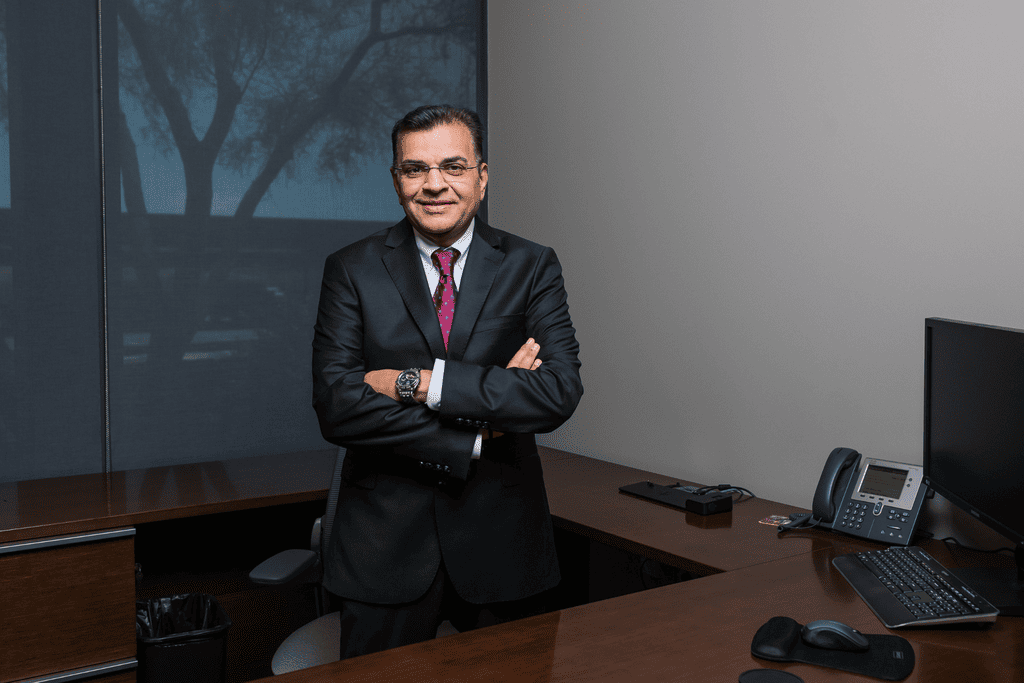
There is a particular kind of frustration that comes from being close enough to a broken system to see exactly what is wrong with it, and not having the tools to fix it. For Dr. Amish Purohit, that frustration arrived early, sharpened by years of clinical practice and military service, and it eventually became the engine behind one of the most consequential healthcare leadership careers in the United States.
Today, Dr. Amish Purohit is Co-Founder, President, and Chief Health Officer of Arkos Health, a technology-enabled population health platform operating across five states and covering more than 600,000 lives. He leads a $560 million enterprise built around a deceptively simple conviction: that the most vulnerable patients in America deserve the same quality, coordination, and continuity of care as anyone else and that building systems capable of delivering that care is not just a moral imperative, it is an entirely achievable operational goal.
The journey from Air Force medical officer to healthcare entrepreneur is not a straight line. It is a story of 25 years spent deliberately moving through every layer of the healthcare system, accumulating a kind of knowledge that no single degree could have provided, and waiting for the moment when everything learned could be assembled into something genuinely new.
A Foundation Built in Uniform
Dr. Amish Purohit’s entry into healthcare did not begin in a hospital or a boardroom. It began in the United States Air Force, where he served for 16 years in the Medical Corps, including four and a half years of active duty, before achieving the rank of Major. He served as a flight surgeon in the USAF reserves and, early in his military career, received both the Air Force Achievement Medal in 1996 and the Air Force Commendation Medal in 1998.
Military medicine, particularly at the operational level, teaches things that civilian practice rarely demands. It teaches triage, the discipline of making high-stakes decisions with incomplete information and no margin for error. It teaches that systems matter as much as skill: that a brilliant clinician operating within a dysfunctional system will still produce poor outcomes. And it teaches accountability in its most unambiguous form when the mission is the mission, there is no softening of what it means to fall short.
These lessons never left him. Years later, when Dr. Amish Purohit was running healthcare organisations spanning entire states, colleagues would note a leadership style that was direct, mission-focused, and structurally rigorous, the hallmarks of someone who had spent formative years in an environment where clarity and execution were not optional.
His educational path ran alongside and beyond his military career. He earned a Bachelor of Science in Public Administration from George Mason University, a Master of Health Administration from Penn State, his Medical Degree from Saba University School of Medicine in 2003, and decades into his career, an MBA from Northwestern University’s Kellogg School of Management in 2020. He is currently enrolled in a Master of Science in Clinical Service Operations at Harvard University. This is not a résumé assembled for appearances. Each credential filled a specific gap clinical, operational, financial, strategic and each expanded his capacity to lead at levels most physicians never reach.
Learning the System from the Inside
After leaving active duty, Dr. Amish Purohit did something that distinguished him from the majority of physician executives: he moved deliberately through multiple layers of the healthcare system, understanding each from the inside before attempting to change any of them from the outside.
He practiced family medicine at Maricopa Family Health Center, staying connected to the realities of direct patient care. He then took on the role of Primary Care and Employee Health Medical Director at Gila River Health Care, a significant health system dedicated to Native American care, where he would later return as President and CEO. That tenure at Gila River was defining. Managing Arizona’s largest healthcare ecosystem for an underserved population, he maintained a 15% operating margin while actively advancing culturally sensitive care models for communities that the broader system had repeatedly failed. The complexity of that environment clinical, financial, cultural, and political prepared him for challenges that most healthcare executives had never encountered.
As Chief Medical Officer at Arizona Priority Care, an affiliate of the Heritage Provider Network, he took on a $120 million budget and transformed the organisation into a financially sustainable entity. He created strategic partnerships with provider groups that measurably reduced hospital admissions and readmissions, and implemented a Shared Savings model Accountable Care Organisation that generated genuine Medicare savings not projected savings, actual ones.
When he took the helm as President and CEO of US Health Systems, leading Medicare Advantage medical groups, he launched a care management startup that achieved $11 million in revenue and $800,000 in EBITDA in its first year alone. The combination of value-based contracting expertise, operational discipline, and clinical authority was by this point fully assembled. What remained was the right vehicle to deploy it at real scale.
Building Arkos Health: A Merger as a Mission
In 2020, Dr. Amish Purohit co-founded Arkos Health not as a startup in the conventional sense, but as the purposeful integration of three established organisations: US Health Systems, CarePointe, and Curavi Health. The merger itself was a statement of philosophy. Rather than building another fragmented healthcare entity, he created a unified platform designed from the ground up around the needs of the patients it was built to serve: complex, high-risk, underserved populations who tend to fall through the cracks of a system optimised for volume rather than outcomes.
Leading a merger of this scale and complexity is not primarily a financial challenge. It is a human one. Three organisations, each with its own culture, clinical philosophy, and operational rhythm, had to be brought into coherence without losing what made each of them valuable. Dr. Amish Purohit described it himself as one of his proudest achievements: harmonising distinct missions, values, and structures into a single, purpose-driven enterprise focused on one shared goal providing comprehensive, value-based care to the populations most in need.
The result is a $560 million enterprise operating across five states, with over 600,000 covered lives and a clinical model that integrates care management, telehealth, in-home visits, and AI-enabled analytics into a coherent system of support for patients who often have nowhere else to turn. Arkos Health’s model is built around a principle Dr. Amish Purohit has articulated consistently throughout his career: patients should receive timely care when they need it, not when it is convenient for the healthcare system to provide it.
Value-Based Care as a System, Not a Slogan
What sets Dr. Amish Purohit’s work apart from the broader industry conversation about value-based care is the specificity of execution. Value-based care is a phrase that has become so widely used in healthcare that it risks losing meaning. Dr. Amish Purohit’s career is a detailed argument for what it actually looks like when the concept is implemented with rigour and accountability.
At its core, value-based care asks a different question than the system it is trying to replace. Instead of asking “How many patients did we see?”, it asks “Did the care we provided actually improve health outcomes?” That reorientation from volume to outcomes sounds straightforward in theory and is extraordinarily difficult in practice. It requires aligning clinical decisions, financial incentives, technology infrastructure, and patient engagement in ways that most healthcare organisations have neither the expertise nor the patience to sustain.
Dr. Amish Purohit has spent 25 years building exactly that expertise. His approach to value-based contracting with insurance payors is widely recognised in the industry as among the most sophisticated in the market. His integration of technology, data analytics, AI-enabled care coordination, telehealth into clinical delivery models is not an add-on to Arkos Health’s operation. It is the architecture of the operation itself. And his focus on underserved populations is not simply a mission statement. It is a deliberate strategic choice grounded in the understanding that the greatest opportunity for meaningful improvement in American healthcare lies precisely in the communities that traditional models have consistently underinvested in.
Recognition That Reflects Real Results
The recognitions that have accumulated across Dr. Amish Purohit’s career reflect the breadth of what he has built and the consistency with which he has built it. He was inducted into the Phoenix Titan 100 Hall of Fame after three consecutive years as one of Phoenix’s top C-level executives a recognition earned for leadership, growth, and community impact.
He was honoured as an Ernst & Young Entrepreneur of the Year 2025 in the Pacific Region, one of the most rigorous entrepreneurial distinctions in American business. He has been named Global Healthcare Leader of the Year by the Forttuna Group and recognised among the Top 100 Healthcare Visionaries and Leaders by major international healthcare forums, including the International Forum on Advancement of Healthcare in 2019 and 2021.
Earlier in his career, he was recognised among America’s Top Family Doctors and America’s Top Physicians. He is a Board-Certified Family Physician, a Fellow of the American Academy of Family Physicians, a Fellow of the American College of Healthcare Executives, and a Fellow of the American College of Health Data Management. He serves on multiple boards and is a Forbes Council Member. These credentials are not honorary. They are the markers of a career spent operating at the highest level across clinical, operational, and executive domains simultaneously a combination that very few in American healthcare can credibly claim.
A Philosophy Built Around People, Not Systems
What runs beneath the credentials and the enterprise metrics is a leadership philosophy that Dr. Amish Purohit has articulated simply and returned to consistently: true success is not about financial outcomes; it is about the lives impacted and the difference made.
He speaks openly about his personal goal as a business leader: to build the kind of trust with executives and employees that makes every person in the organisation genuinely delighted to be there. His message to aspiring leaders is equally direct: find your true passion and follow it, but understand that the real competition is with yourself, with the question of whether you are continuously outpacing who you were.
His approach to building culture at Arkos Health reflects this. He has championed fairness, compassion, and purposeful action at every level of the organisation not as HR language, but as operational principles. The belief that doing good and doing well are not competing objectives is central to how Arkos Health is structured, hired, and led. In a healthcare context, where the temptation to optimise for financial performance at the expense of patient outcomes remains persistent and powerful, that clarity of values is not a small thing.
The Vision Ahead
Dr. Amish Purohit sees the next five years as an opportunity for meaningful healthcare evolution, particularly within Medicare Advantage and Medicaid the programmes serving the populations Arkos Health was built to reach. His goal is a scalable care model that integrates technology, analytics, and person-centred design without ever sacrificing the human connection that makes care effective.
He is building toward a future where physician-led, AI-enabled systems can deliver the kind of coordinated, proactive, compassionate care that has historically been available only to the privileged few and where the measure of a healthcare system’s success is not the revenue it generates, but the actual health of the communities it serves.
That vision is not new. What is new is the infrastructure, the experience, and the demonstrated track record to make it real.
Dr. Amish Purohit spent 25 years learning how the system works, and why it fails the people who need it most. He is now, with considerable precision, building something better.
Explore more expert insights, leadership stories, and business strategies at GlobeVox Leaders