

In today’s fast-changing business world, staying ahead is no longer optional. Instead, it has become a necessity for organizations that want to grow, remain competitive, and create lasting value. Every year, new technologies, changing customer expectations, and economic shifts reshape how businesses operate. As a result, leaders who understand and adapt to these business growth trends are more likely to outperform their competitors.
Moreover, businesses can no longer rely only on traditional growth methods. While expanding into new markets and increasing sales remain important, companies must also embrace innovation, digital transformation, artificial intelligence, and customer-centric strategies. Consequently, organizations that evolve quickly are often the ones that experience sustainable growth.
Furthermore, the rise of AI, automation, cloud computing, and data-driven decision-making has completely changed how businesses identify opportunities. At the same time, customers now expect personalized experiences, faster service, and greater transparency. Therefore, organizations must rethink their strategies to meet these evolving expectations.
Whether you are a CEO, entrepreneur, startup founder, investor, or business executive, understanding the latest business growth trends will help you make smarter decisions, reduce risks, and discover new opportunities for long-term success.
In this comprehensive guide, you will learn:
- The meaning of business growth trends
- Why they matter more than ever in 2026
- The biggest forces driving business growth
- The top strategies successful companies are adopting
- Practical steps to future-proof your organization
Ultimately, this guide will help you build a stronger, smarter, and more resilient business in an increasingly competitive marketplace.
What Are Business Growth Trends?
Business growth trends are the emerging strategies, technologies, market shifts, and leadership practices that help organizations increase revenue, improve profitability, expand into new markets, and strengthen their competitive position over time.
Unlike short-term business fads, these trends have a long-lasting impact on industries and customer behavior. Moreover, they influence how companies innovate, serve customers, manage operations, and prepare for future challenges.
For example, artificial intelligence, digital transformation, predictive analytics, and sustainability are no longer optional initiatives. Instead, they have become essential drivers of business success. Therefore, organizations that recognize these trends early can adapt faster and gain a significant competitive advantage.
Simply put, business growth trends act as a roadmap that helps leaders identify where the market is heading and how they should prepare for future opportunities.
Key Characteristics of Business Growth Trends
Although trends vary across industries, successful growth trends usually share several common characteristics.
1. They Influence Multiple Industries
The most powerful trends affect businesses across different sectors. For instance, AI is transforming healthcare, finance, retail, manufacturing, education, and logistics alike. Consequently, organizations across industries are investing heavily in intelligent technologies.
2. They Change Customer Expectations
Modern consumers expect seamless, personalized, and digital-first experiences. Therefore, businesses must continuously improve customer interactions to stay relevant and build long-term loyalty.
3. They Encourage Innovation
Business growth trends inspire companies to rethink products, services, and operations. As a result, organizations become more agile and better prepared for market changes.
4. They Create Long-Term Competitive Advantages
Businesses that adopt meaningful trends early often enjoy stronger brand recognition, greater efficiency, and higher profitability. Moreover, early adoption enables companies to stay ahead of competitors while creating new revenue opportunities.
Why Business Growth Trends Matter
Many businesses fail not because they lack great products, but because they fail to adapt to changing market conditions. On the other hand, organizations that monitor emerging trends can identify opportunities before their competitors.
Furthermore, understanding business growth trends allows leaders to make proactive decisions instead of reacting to disruption after it occurs.
Key Benefits
Businesses that actively embrace growth trends can:
- Improve operational efficiency
- Increase revenue and profitability
- Strengthen customer loyalty
- Enhance employee productivity
- Expand into new markets
- Reduce business risks
- Improve decision-making through data
- Build stronger competitive advantages
- Accelerate innovation
- Create sustainable long-term growth
In addition, organizations that consistently invest in innovation and digital capabilities are generally better equipped to respond to economic uncertainty and changing customer demands.
Key Takeaway
Business growth is no longer driven by size alone. Instead, it depends on adaptability, innovation, customer experience, and the ability to respond quickly to change.
The Biggest Drivers of Business Growth in 2026
Several global forces are reshaping how businesses operate. While each organization faces unique challenges, these drivers are influencing almost every industry.
1. Artificial Intelligence Is Becoming Mainstream
Artificial intelligence has moved beyond experimentation. Today, it supports customer service, marketing, finance, cybersecurity, operations, and supply chain management.
Moreover, AI helps organizations automate repetitive tasks, improve forecasting accuracy, reduce operational costs, and deliver better customer experiences.
As AI technology continues to mature, businesses of every size can use affordable AI-powered tools to become more productive and competitive.
Business Impact
- Faster decision-making
- Lower operational costs
- Higher productivity
- Better customer insights
- Smarter forecasting
2. Data-Driven Decision Making
Modern businesses generate more data than ever before. However, collecting data alone is not enough. Instead, organizations must transform that information into actionable insights.
Therefore, companies are investing in predictive analytics, business intelligence platforms, and real-time dashboards.
As a result, leaders can identify market trends, forecast customer demand, optimize pricing strategies, and improve operational performance with greater confidence.
Key Benefits
- Better forecasting
- Improved customer understanding
- Faster strategic decisions
- Increased profitability
3. Customer Experience Is Driving Revenue Growth
Today’s customers expect more than quality products. They also expect personalized experiences, fast support, and seamless digital interactions.
Consequently, businesses that invest in customer experience often enjoy stronger customer loyalty, higher retention rates, and increased lifetime value.
Furthermore, satisfied customers are more likely to recommend a brand, helping businesses grow through referrals and positive word-of-mouth.
Businesses are therefore investing in:
- Personalization
- Omnichannel communication
- AI-powered customer support
- Customer journey optimization
- Loyalty programs
4. Digital Transformation Continues to Accelerate
Digital transformation is no longer just an IT initiative. Instead, it has become a core business strategy.
Organizations are redesigning their operations by adopting cloud computing, automation, digital workflows, and integrated business platforms.
Moreover, companies that successfully embrace digital transformation can respond faster to market changes, reduce operational costs, and improve customer satisfaction.
Digital transformation also enables businesses to scale more efficiently while creating new digital revenue streams.
5. Sustainability Is Becoming a Business Growth Strategy
Sustainability is now a strategic business priority rather than simply a corporate responsibility initiative.
Customers, investors, and regulators increasingly prefer organizations that demonstrate environmental and social responsibility.
As a result, businesses that integrate sustainable practices into their operations often improve brand reputation, attract investment, reduce waste, and strengthen long-term resilience.
Moreover, sustainability encourages innovation by inspiring companies to develop more efficient products, processes, and business models.
Top 10 Business Growth Trends Every Leader Should Watch in 2026
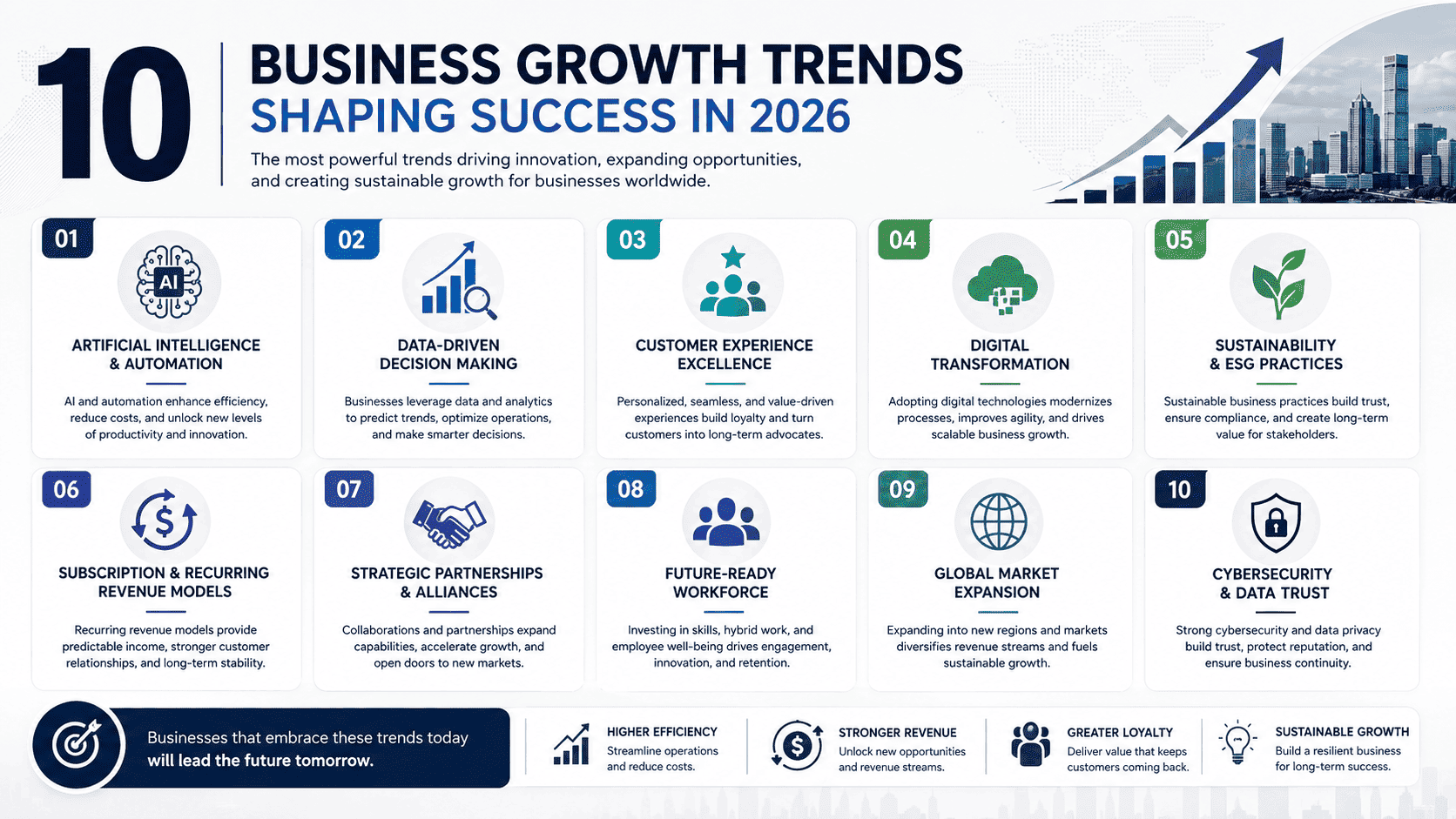
As industries continue to evolve, businesses must stay ahead of emerging opportunities rather than react to change after it happens. Therefore, understanding these business growth trends can help organizations make smarter decisions, improve profitability, and build long-term resilience.
Let’s explore the ten most important trends shaping business success in 2026.
1. AI-Powered Operations Are Transforming Every Industry
Artificial intelligence has become one of the biggest drivers of business growth. Previously, businesses viewed AI as an experimental technology. However, today it is an essential part of daily operations.
Companies are now using AI to automate repetitive tasks, improve customer service, predict market demand, optimize inventory, detect fraud, and generate business insights. Consequently, employees spend less time on manual work and more time on strategic initiatives.
Furthermore, AI helps organizations make faster and more accurate decisions by analyzing large amounts of data within seconds.
Why This Trend Matters
Businesses that integrate AI into their operations often experience:
- Lower operating costs
- Increased employee productivity
- Faster decision-making
- Better customer experiences
- Higher profitability
Real-World Example
Many retailers now use AI to predict customer demand and optimize inventory. As a result, they reduce waste while improving product availability.
Leadership Tip: Start with one AI use case, such as customer support or sales forecasting, before expanding AI across the organization.
2. Data-Driven Decision Making Is Becoming a Competitive Advantage
Successful businesses no longer rely on intuition alone. Instead, they use data to guide every important decision.
Organizations now collect information from customers, websites, sales channels, marketing campaigns, and operations. Moreover, advanced analytics platforms transform this information into meaningful insights.
Consequently, leaders can identify trends earlier, forecast demand more accurately, and allocate resources more effectively.
Benefits
- Better strategic planning
- Improved pricing decisions
- Faster market response
- Higher operational efficiency
- Reduced business risks
Example
A manufacturing company can use predictive analytics to identify equipment failures before they happen, reducing downtime and maintenance costs.
Key Takeaway: Data should support every major business decision rather than relying solely on experience or assumptions.
3. Hyper-Personalized Customer Experiences Are Driving Revenue
Customers expect businesses to understand their needs. Therefore, personalization has become one of the strongest growth drivers.
Instead of offering the same experience to everyone, leading companies personalize websites, product recommendations, email campaigns, pricing, and customer support.
Furthermore, AI enables businesses to personalize experiences in real time.
Business Benefits
- Higher conversion rates
- Better customer retention
- Increased customer lifetime value
- Stronger brand loyalty
- More referrals
Best Practices
- Segment your audience.
- Use customer behavior data.
- Personalize communication.
- Improve customer journeys continuously.
4. Sustainability Is Becoming a Competitive Advantage
Sustainability is no longer just about protecting the environment. Instead, it has become a business strategy that creates long-term value.
Consumers increasingly support brands that demonstrate responsible business practices. Likewise, investors are paying closer attention to environmental, social, and governance (ESG) performance.
Consequently, businesses that embrace sustainability often strengthen their reputation while reducing operational costs.
Growth Opportunities
- Energy-efficient operations
- Sustainable supply chains
- Eco-friendly products
- Waste reduction
- Responsible sourcing
Business Impact
Organizations that integrate sustainability into their long-term strategy often attract more customers, employees, and investors.
5. Digital Transformation Is Expanding Beyond IT
Digital transformation is no longer limited to technology departments. Instead, it influences every function within an organization.
Businesses are redesigning customer experiences, automating workflows, improving collaboration, and modernizing legacy systems.
Moreover, cloud technology allows organizations to scale quickly without significant infrastructure investments.
Digital Transformation Priorities
- Cloud computing
- Workflow automation
- CRM integration
- Digital customer journeys
- Remote collaboration
Leadership Insight
Digital transformation succeeds when technology, people, and business strategy work together.
6. Subscription and Recurring Revenue Models Continue to Grow
Predictable revenue is becoming increasingly valuable. Therefore, many businesses are moving toward subscription-based business models.
While software companies pioneered this model, industries such as healthcare, education, consulting, retail, and manufacturing are also adopting recurring revenue strategies.
Advantages
- Stable monthly income
- Improved customer retention
- Better financial forecasting
- Increased customer lifetime value
Example
Many professional service firms now offer monthly advisory subscriptions instead of charging only for one-time projects.
7. Strategic Partnerships Are Accelerating Growth
Businesses rarely grow alone. Instead, they achieve faster success by building strong partnerships.
Strategic alliances enable organizations to enter new markets, access new technologies, reduce costs, and improve customer value.
Furthermore, collaboration often creates opportunities that individual companies cannot achieve independently.
Partnership Examples
- Technology integrations
- Distribution partnerships
- Marketing collaborations
- Joint ventures
- Innovation ecosystems
Business Benefit
Companies that build strong ecosystems often grow faster while reducing business risks.
8. Workforce Transformation Is Reshaping Organizations
Technology is changing how people work. Therefore, organizations must continuously develop new skills.
High-performing businesses invest in employee learning, leadership development, AI literacy, and digital collaboration tools.
Moreover, flexible work environments continue to improve employee satisfaction and productivity.
Key Priorities
- Continuous learning
- Hybrid work
- Leadership development
- AI upskilling
- Employee engagement
Leadership Tip: Invest in people as much as technology. Skilled employees remain the biggest driver of long-term business growth.
9. Global Expansion Through Digital Channels
Growing internationally has become easier than ever.
Digital marketing, cloud platforms, e-commerce, and online payment systems allow businesses to reach customers worldwide without opening physical offices.
Consequently, even small businesses can compete globally.
Expansion Strategies
- Localized websites
- International SEO
- Digital advertising
- Cross-border e-commerce
- Local partnerships
10. Cybersecurity Is Fueling Sustainable Growth
As businesses become more digital, cybersecurity has become essential for maintaining trust.
Customers expect their data to remain secure. Likewise, investors and partners increasingly evaluate businesses based on their cybersecurity practices.
Therefore, companies that invest in security reduce operational risks while strengthening customer confidence.
Business Benefits
- Increased customer trust
- Lower financial risks
- Better compliance
- Business continuity
- Stronger brand reputation
Business Growth Trends Comparison Table
| Business Growth Trend | Primary Benefit | Priority Level |
|---|---|---|
| AI & Automation | Efficiency and productivity | ⭐⭐⭐⭐⭐ |
| Data Analytics | Better decision-making | ⭐⭐⭐⭐⭐ |
| Customer Personalization | Higher revenue | ⭐⭐⭐⭐⭐ |
| Digital Transformation | Business scalability | ⭐⭐⭐⭐⭐ |
| Sustainability | Brand trust and long-term growth | ⭐⭐⭐⭐ |
| Subscription Models | Predictable revenue | ⭐⭐⭐⭐ |
| Strategic Partnerships | Faster market expansion | ⭐⭐⭐⭐ |
| Workforce Transformation | Employee productivity | ⭐⭐⭐⭐ |
| Global Expansion | New revenue opportunities | ⭐⭐⭐⭐ |
| Cybersecurity | Business resilience | ⭐⭐⭐⭐⭐ |
How Businesses Can Capitalize on These Trends
Identifying trends is only the first step. More importantly, businesses must turn insights into measurable results. Therefore, leaders should focus on execution rather than observation.
A Practical Growth Framework
Step 1: Assess Your Current Position
Evaluate your existing business model, revenue streams, customer needs, and operational challenges.
Step 2: Prioritize High-Impact Opportunities
Focus on initiatives that can deliver measurable outcomes within the next 12–24 months.
Step 3: Invest in Digital Capabilities
Modernize your technology stack by adopting cloud platforms, automation tools, AI solutions, and advanced analytics.
Step 4: Build Cross-Functional Teams
Encourage collaboration between leadership, marketing, sales, operations, finance, and technology teams to accelerate innovation.
Step 5: Measure Performance
Track meaningful KPIs such as:
- Revenue growth
- Customer acquisition cost (CAC)
- Customer lifetime value (CLV)
- Customer retention rate
- Employee productivity
- Net Promoter Score (NPS)
- Operational efficiency
Key Takeaway: Businesses that continuously measure, adapt, and innovate are better positioned for sustainable growth.
Common Challenges Leaders Must Address
While growth creates opportunities, it also introduces new challenges. Therefore, organizations should prepare for potential obstacles before they slow progress.
Common challenges include:
- Resistance to organizational change.
- Limited budgets for transformation initiatives.
- Integration of legacy systems with modern technologies.
- Skill gaps in AI, analytics, and digital capabilities.
- Increasing cybersecurity threats.
- Difficulty scaling operations while maintaining quality.
- Balancing innovation with profitability.
However, businesses that plan proactively and invest strategically are more likely to overcome these challenges successfully.
Best Practices for Achieving Sustainable Business Growth
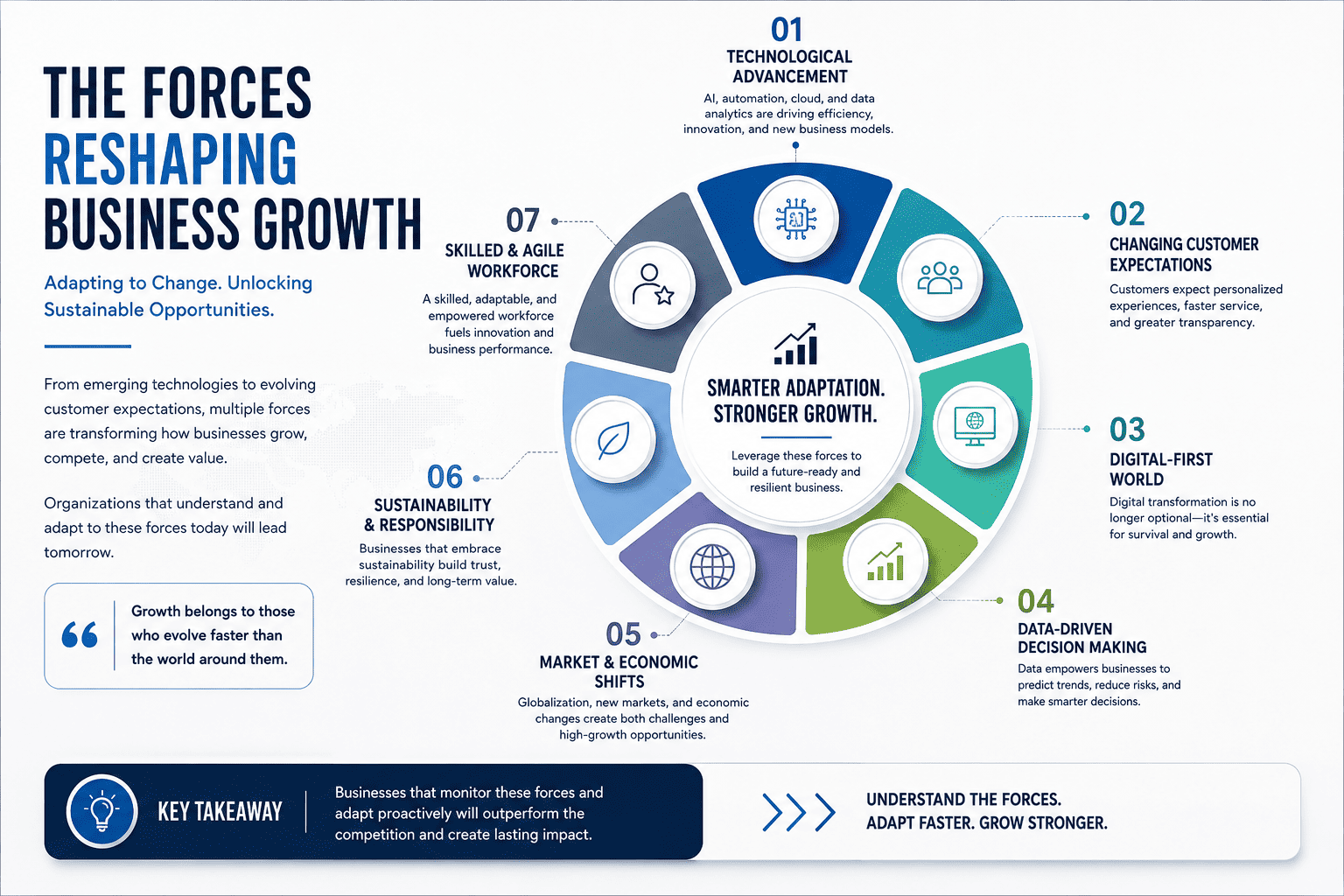
Growing a business is important. However, growing sustainably is what creates long-term success. While many organizations focus on short-term revenue, the most successful businesses build strong foundations that support continuous innovation, profitability, and resilience.
Therefore, leaders should adopt strategies that not only increase revenue but also strengthen operations, improve customer relationships, and prepare the business for future opportunities.
Here are some best practices every organization should follow.
1. Build a Customer-First Culture
Customers are the foundation of every successful business. Therefore, every decision should begin with understanding customer needs, expectations, and pain points.
Businesses that consistently deliver exceptional customer experiences often achieve higher retention rates, stronger brand loyalty, and increased referrals.
Best Practices
- Listen to customer feedback regularly.
- Personalize products and services.
- Improve response times.
- Deliver consistent experiences across all channels.
- Measure customer satisfaction using surveys and Net Promoter Score (NPS).
Key Insight: Acquiring a new customer is often more expensive than retaining an existing one. Therefore, investing in customer experience delivers long-term returns.
2. Make Data Your Competitive Advantage
Modern businesses generate enormous amounts of information. However, data creates value only when it supports better decisions.
Therefore, organizations should build a data-driven culture where leaders use insights instead of assumptions.
Focus on monitoring:
- Revenue trends
- Customer acquisition cost (CAC)
- Customer Lifetime Value (CLV)
- Churn rate
- Sales conversion rate
- Marketing ROI
- Employee productivity
- Operational efficiency
Moreover, using dashboards and predictive analytics allows leaders to identify opportunities before competitors do.
3. Invest in Continuous Innovation
Innovation should become an ongoing process rather than a one-time initiative.
Markets evolve rapidly. Consequently, businesses that fail to innovate often struggle to remain competitive.
Innovation can include:
- New products
- Better services
- Improved customer experiences
- Business model innovation
- Process automation
- AI implementation
- Digital products
Furthermore, encouraging employees to share ideas often leads to valuable improvements across the organization.
4. Develop Agile Leadership
Strong leadership remains one of the biggest drivers of business success.
Today’s leaders must make decisions quickly while remaining flexible enough to adapt when circumstances change.
Successful leaders:
- Encourage collaboration.
- Empower employees.
- Embrace technology.
- Promote learning.
- Support innovation.
- Make decisions based on evidence.
As a result, organizations become more resilient during periods of uncertainty.
5. Strengthen Digital Capabilities
Technology should support every business function—not just IT.
Therefore, organizations should continuously modernize their digital infrastructure.
Key investments include:
- Cloud computing
- CRM platforms
- Marketing automation
- AI-powered analytics
- Cybersecurity
- Workflow automation
- Collaboration tools
Ultimately, strong digital capabilities improve productivity while enabling faster business growth.
6. Build Strategic Partnerships
Business growth rarely happens in isolation.
Partnerships help organizations:
- Enter new markets
- Reach new customers
- Reduce costs
- Share expertise
- Accelerate innovation
- Expand service offerings
Moreover, collaborative ecosystems often create opportunities that individual companies cannot achieve alone.
7. Prioritize Employee Development
Employees remain every organization’s greatest asset.
Therefore, businesses should continuously invest in:
- Leadership training
- Digital skills
- AI literacy
- Technical certifications
- Soft skills
- Continuous learning programs
Organizations with skilled employees adapt faster and innovate more effectively.
Key Takeaways
✔ Put customers at the center of every strategy.
✔ Use data to guide important decisions.
✔ Make innovation a continuous process.
✔ Invest in technology and people equally.
✔ Build partnerships that create long-term value.
Business Growth Checklist
Use this checklist to evaluate whether your organization is prepared for future growth.
| Checklist | Status |
|---|---|
| Defined a clear business growth strategy | ☐ |
| Invested in AI and automation | ☐ |
| Adopted data-driven decision-making | ☐ |
| Improved customer experience | ☐ |
| Implemented digital transformation initiatives | ☐ |
| Strengthened cybersecurity | ☐ |
| Built recurring revenue streams | ☐ |
| Invested in employee development | ☐ |
| Expanded strategic partnerships | ☐ |
| Established measurable KPIs | ☐ |
| Integrated sustainability into business planning | ☐ |
| Reviewed growth strategy quarterly | ☐ |
Quick Tip: Businesses that regularly review and update their growth strategy are often better prepared for changing market conditions.
Future Outlook: What Will Shape Business Growth Beyond 2026?
The future of business growth will be defined by organizations that can adapt faster than the pace of change.
Over the next decade, several trends are expected to reshape industries worldwide.
Artificial Intelligence Will Become Standard
AI will become an essential business capability rather than a competitive advantage. Consequently, organizations that delay adoption may struggle to keep pace with more agile competitors.
Hyper-Personalization Will Continue to Grow
Customers will increasingly expect businesses to deliver personalized experiences across every interaction.
Therefore, companies that use AI and data effectively will strengthen customer loyalty and improve lifetime value.
Sustainability Will Influence Investment Decisions
Investors, governments, and consumers will continue to prioritize organizations with responsible environmental and social practices.
Businesses that integrate sustainability into their long-term strategy will likely enjoy stronger brand trust and better financial performance.
Hybrid Work Will Become More Sophisticated
Flexible work models are expected to evolve further.
Organizations will continue investing in digital collaboration tools, AI-powered productivity platforms, and employee well-being initiatives.
Digital Ecosystems Will Replace Traditional Business Models
Businesses will increasingly collaborate through digital ecosystems instead of operating independently.
As a result, partnerships, integrations, and platform-based business models will become major growth drivers.
Businesses Will Become More Data-Driven
Decision-making will rely more heavily on predictive analytics, automation, and real-time insights.
Consequently, organizations that build strong data capabilities today will be better prepared for tomorrow’s opportunities.

Future Growth Priorities for Business Leaders
To remain competitive over the next five years, leaders should focus on:
- Building AI-ready organizations.
- Improving customer experiences.
- Investing in employee skills.
- Strengthening cybersecurity.
- Expanding into global digital markets.
- Encouraging continuous innovation.
- Creating sustainable business models.
- Developing agile leadership teams.
Future Outlook: The businesses that succeed in the coming decade will not necessarily be the largest. Instead, they will be the most adaptable, customer-focused, and innovation-driven.
Final Thoughts
Business growth is no longer measured only by revenue or market share. Instead, it is defined by an organization’s ability to innovate, adapt, and create long-term value in an increasingly competitive world.
As technology continues to evolve, businesses must embrace artificial intelligence, digital transformation, customer-centric strategies, and data-driven decision-making. At the same time, leaders should invest in their people, strengthen strategic partnerships, and build sustainable business models that can withstand future disruptions.
Ultimately, the organizations that succeed in 2026 and beyond will not simply react to change they will anticipate it, embrace it, and use it as a catalyst for innovation and growth.
Whether you lead a startup, a growing enterprise, or a multinational organization, now is the time to evaluate your strategy, adopt emerging business growth trends, and position your business for long-term success.
Frequently Asked Questions (FAQs)
1. What are business growth trends?
Business growth trends are emerging strategies, technologies, and market developments that help organizations increase revenue, improve efficiency, strengthen customer relationships, and achieve sustainable long-term growth.
2. Why are business growth trends important?
They help businesses anticipate market changes, identify new opportunities, reduce risks, improve decision-making, and stay ahead of competitors.
3. Which business growth trend will have the biggest impact in 2026?
Artificial intelligence, automation, data analytics, and digital transformation are expected to have the greatest impact because they improve productivity, customer experience, and strategic decision-making.
4. How can small businesses benefit from these trends?
Small businesses can adopt affordable AI tools, cloud software, digital marketing, automation platforms, and data analytics to compete with larger organizations while keeping costs under control.
5. How often should businesses review their growth strategy?
Business leaders should monitor market trends continuously. In addition, they should conduct quarterly strategic reviews and perform a comprehensive annual assessment to ensure long-term alignment with changing business conditions.
6. What role does digital transformation play in business growth?
Digital transformation improves efficiency, streamlines operations, enhances customer experiences, supports innovation, and creates new revenue opportunities through modern technologies.
7. How does customer experience influence business growth?
Excellent customer experiences increase satisfaction, encourage repeat business, generate referrals, improve customer loyalty, and enhance brand reputation, all of which contribute to sustainable revenue growth.
8. What is sustainable business growth?
Sustainable business growth refers to expanding a business while maintaining profitability, operational resilience, customer satisfaction, employee development, and responsible environmental and social practices.
Explore more expert insights on leadership, AI, digital transformation, entrepreneurship, finance, innovation, and business strategy at GlobeVox Leaders.