
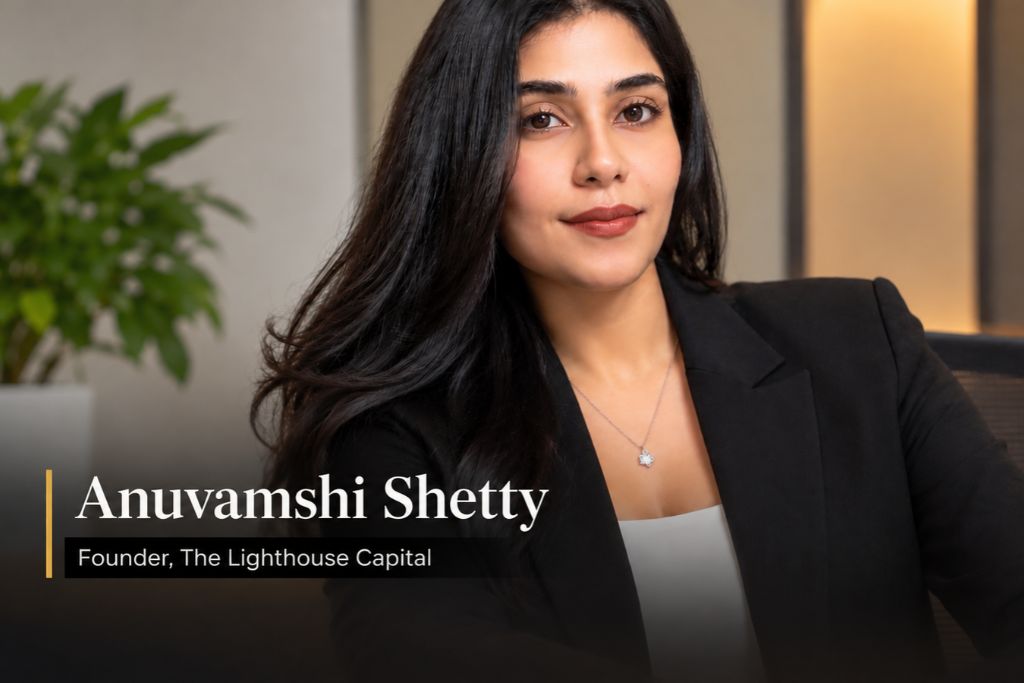
If you had told the 18-year-old Anuvamshi Shetty that she would one day build a company in finance, she says she would have laughed. She was a young woman who loved cars, aircraft and machines, who pictured herself designing vehicles or perhaps flying them. Finance was nowhere on the map.
Today, Anuvamshi Shetty is the Founder of The Lighthouse Capital, a firm built at the intersection of good businesses and the right capital. It is a journey she describes without polish and without a master plan: “Sometimes you only understand your path when you look backwards.”
From Mechanical Engineering to Mumbai
Anuvamshi Shetty studied Mechanical Engineering, drawn not by a five-year career plan but by simple curiosity about how things work. College, she admits, changed her in unexpected ways, and by the time she graduated in 2017 and took an IT role at Accenture, she knew almost immediately that it was not where she belonged.
So she did what has become a recurring theme in her life: she changed direction.
She moved to Mumbai, began volunteering, and met people pursuing MBAs. Through those conversations she discovered the CFA pathway, and with it a field that let her combine numbers, businesses, technology and problem-solving. She had no finance family and no traditional finance education, which meant she had a great deal to learn.
The road was not smooth. An early job left her questioning whether she was good enough for finance at all. She left, cried, felt embarrassed, and told people she had “randomly quit.” The next morning, she got up and started looking for another job. That opportunity eventually led her into investment banking, where she realised that what she enjoyed was not only analysing businesses, but understanding “the people behind them, the decisions they were making and the capital that could help them grow.”
Entrepreneurship, she says, then felt “less like a dramatic leap and more like the next experiment I wanted to run on myself.”
The Idea Behind the Lighthouse
Through her work, Anuvamshi Shetty kept noticing the same disconnect. Founders with strong businesses struggled to find the right investors. Investors with capital and a clear thesis struggled to find credible opportunities that fit it. The Lighthouse Capital was built to work in the space between the two.
The name carries the philosophy. “A lighthouse doesn’t sail the ship,” she explains. “It doesn’t decide where the ship should go. It simply provides visibility and helps people navigate uncertainty.” That is how she sees the firm’s role: bringing clarity to the uncertainty that both entrepreneurship and investing involve, by understanding the business, understanding the investor, creating the right connections, and helping both sides make better-informed decisions.
The Unglamorous Reality of Building
The biggest surprise of entrepreneurship, she says, was how unglamorous it can be. Her early mental model was simple: understand businesses, understand investors, find the match, facilitate the deal. Reality arrived in the form of due-diligence issues, payments, negotiations, founders changing their minds, investors backing out, and “countless operational details that nobody puts on a motivational Instagram post.”
The Lighthouse Capital’s first deal took roughly six months to close. When it finally did, she remembers thinking: Okay. This is real. I am actually building something. But the larger lesson was that one successful transaction does not make entrepreneurship predictable.
The experience has changed how she makes decisions. She is more comfortable with uncertainty, more careful about alignment and trust, and unwilling to chase growth “simply for the sake of saying we grew.” She wants the relationships the firm creates to hold their value over the long term. Entrepreneurship, she says, has made her “less obsessed with having the perfect answer and more focused on asking the right questions.”
What Founders Get Wrong About Fundraising
From her work with entrepreneurs, Anuvamshi Shetty believes founders often mistake fundraising for convincing someone to hand over money. In her view, it is really about answering a harder question: why should this particular investor believe that this particular business can create significant value?
A beautiful pitch deck, she says, is not enough. Investors want to understand the business beneath the presentation: the market, the economics, the competitive advantage, the team, the risks, and what the capital will actually accomplish.
Her advice runs against instinct. Investor-readiness is not about pretending to have no problems. Credibility often comes from knowing your problems extremely well. A founder who can say what is working, what is not, what has been learned and exactly how the capital will change things is far more compelling than one whose story sounds perfect.
She also urges founders to think about the right capital, not just capital. The right investor can bring relationships, knowledge, credibility and strategic value that may matter far more than the cheque itself.
Leadership, Without the Loudest Voice
Anuvamshi Shetty is candid that she is still learning how to lead, and does not claim a neat five-point philosophy. A few principles, however, are non-negotiable: ownership, integrity, curiosity and accountability.
She wants the people around her to feel comfortable saying “I don’t know,” because pretending to know is far more dangerous than asking. She believes mistakes are not necessarily failures; repeating them without learning is. And she has come to see leadership as less about having the loudest voice in the room and more about “creating enough clarity for everyone else to do their best work.”
Her view of confidence is equally grounded. She once assumed confident people were simply born that way. Today she believes confidence is built through repeated exposure to uncomfortable situations: giving the presentation while nervous, taking the meeting before feeling ready, making the decision and living with the outcome. “Eventually, you realise you can handle more than you thought.”
Women, Ambition and the Courage to Begin
For Anuvamshi Shetty, the most interesting part of being a woman entrepreneur has been confronting her own ideas about what she was capable of. She was extremely shy growing up, and recalls a college presentation she could barely get through. Today she creates content publicly, speaks to audiences and runs a company.
“I didn’t wake up one morning and become fearless,” she says. “I just kept putting myself in situations where I had to do the thing I was afraid of.”
That experience shapes her view of what women in finance and entrepreneurship need. Better access to capital, networks, mentorship and opportunity matter, but so do environments where women do not feel they must be 100 percent qualified, confident or certain before taking the leap. “Sometimes you become qualified by doing the job.” And women, she adds, should be allowed to be ambitious without feeling the need to soften that ambition.
Building the Next Generation
The CFA ecosystem mattered to Anuvamshi Shetty precisely because she entered finance from outside it. It gave her technical knowledge and structure, but experience has shown her that technical knowledge is only the beginning.
The next generation of finance professionals, she believes, must be curious, adaptable and commercially intelligent. They must be able to build a brilliant financial model and also explain what the business actually does, understand technology, speak to a founder, build trust with an investor, and get curious about an industry they know nothing about.
Her advice to young professionals is to seek exposure: talk to people outside your field, attend events, ask questions, read widely and build things. “Some of the most important turns in my career came from conversations I never could have planned.”
Where Finance Is Heading
Anuvamshi Shetty does not subscribe to the idea that AI will simply replace finance professionals. The more interesting shift, she says, is that information and analytical capability are becoming widely accessible, and when everyone has more information, judgement becomes more valuable, not less.
For founders, technology is lowering the barriers to building and testing businesses, which creates opportunity but also means competition can intensify quickly. For investors, AI can sharpen sourcing, research and analysis, yet understanding a founder, assessing culture, building trust and sensing when something does not add up remain deeply human work.
That is the direction she sees The Lighthouse Capital taking: using technology to become more efficient and data-driven, while keeping relationships and judgement at the centre.
Redefining Success
For a long time, Anuvamshi Shetty believed success was a destination, a point at which she would finally feel she had “made it.” At 31, she is no longer sure she believes that, and finds the realisation strangely freeing.
Today, success means the freedom to build a life that feels meaningful to her: financial independence, continuous learning, building things that create value, meaningful relationships, and the courage to change direction when necessary. Setbacks no longer frighten her in the way they once did. Success, in her words, is becoming “someone who can experience something going wrong without allowing it to completely redefine how she sees herself.”
Her message to the next generation of women leaders is simple. She began as a mechanical engineering student who wanted to work around cars and aircraft, and went on to finance, setbacks, a company of her own, and eventually content creation as a way to overcome the fear of being seen and judged. None of it followed one perfect plan.
“You don’t need to know exactly where you’re going to start moving,” she says. “The goal is to stay curious enough to keep moving.”
Discover more inspiring exclusive leader interviews with GlobeVox Leaders