
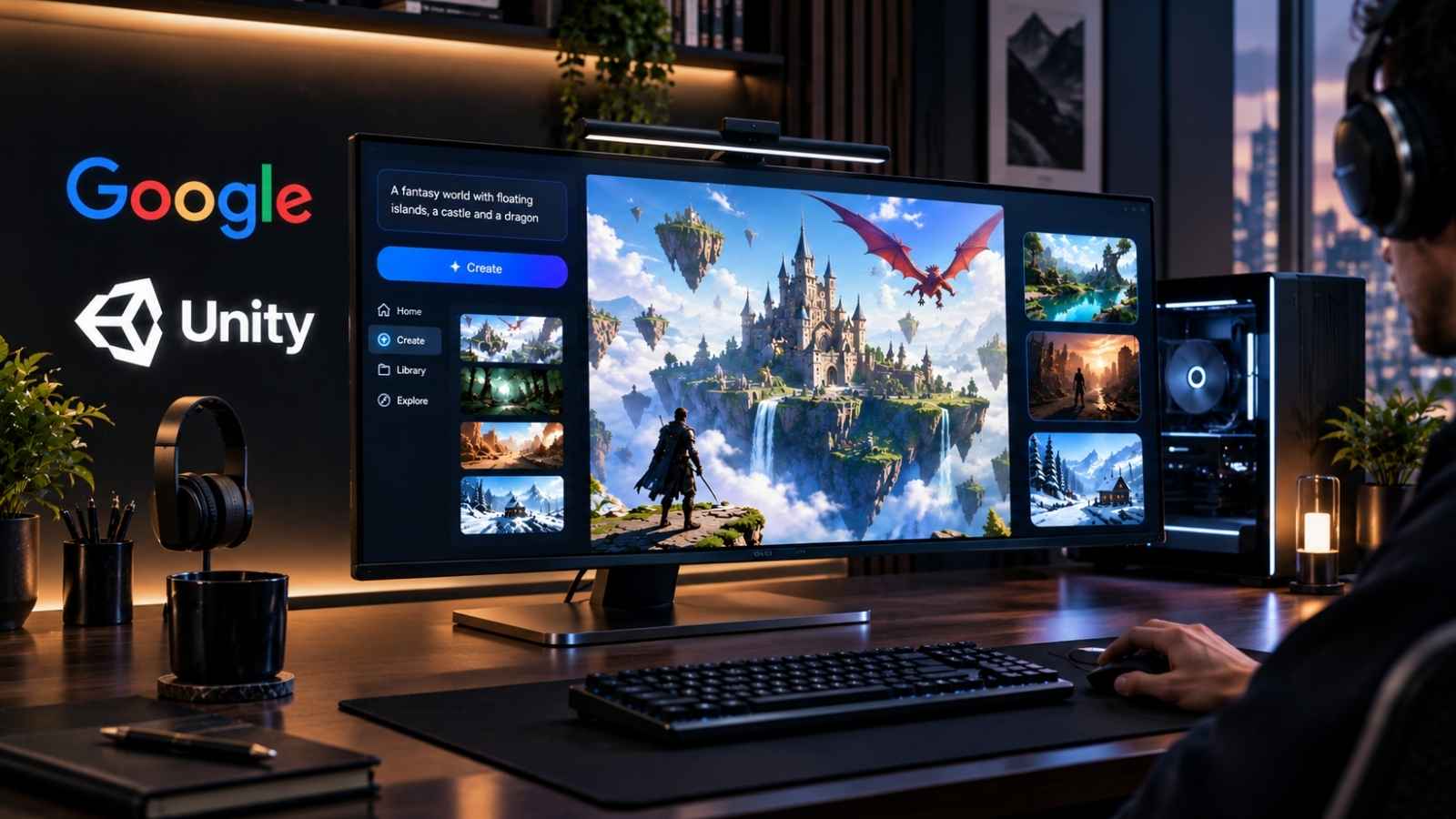
Google’s new AI game creation platform, called Playground, lets anyone build a playable video game from a text prompt, no coding required, using Google’s world-model AI paired with Unity’s game-development tools.
Google AI Game Creation Platform: How Playground Works
The Google AI game creation platform, named Playground, launched on Wednesday in partnership with Unity, giving anyone the ability to turn a written description into a playable video game. The tool pairs Google’s world-model technology, AI systems built to understand and simulate the physical world rather than simply process language, with Unity’s existing engine and development tools, so a plain-text prompt can be converted into an actual interactive game environment.
Google said in a blog post that game creation has historically been limited to people with technical expertise, and that Playground is intended to lower that barrier by letting anyone turn ideas into games through prompts, with no coding experience required. Once a game is built, creators can publish it directly to Google Playground, where other users can discover, download and play it, turning the platform into both a creation tool and a distribution hub in one place.
Unity Spark: The Next Phase of the Google AI Game Creation Platform
A more advanced companion product, Unity Spark, is due to be integrated into the Google AI game creation platform later this year. Spark will combine Google’s AI models with other frontier technology and Unity’s established game engine, giving creators a more capable toolkit for building playable worlds that go beyond simple prompt-based demos. Both Playground and Spark are set to offer free and paid tiers based on usage, letting casual creators experiment for free while charging more active users for heavier workloads.
Unity has said Spark will generate some in-game assets using AI, but that the bulk of imagery and effects will continue to come from its existing library of content created by human artists, who will be credited and compensated for their work. The distinction is a direct response to concerns from the developer community that AI-generated assets could displace paid creative work across the games industry.
Why Google and Unity Are Betting on AI-Generated Games
Unity chief executive Matthew Bromberg said the rise of short-form video content is likely to push more creators toward interactive formats such as games, positioning the Google AI game creation platform as a natural next step for creators already comfortable making quick, shareable content on other platforms. Bromberg also pushed back directly on market fears that AI tools will make game developers redundant, arguing that AI complements the software development process rather than replacing it outright.
The launch builds on Google’s broader progress with world-model AI, technology increasingly discussed not just in gaming but in robotics, simulation and autonomous-systems research, where the ability to model physical environments has wide commercial value beyond entertainment. Google first introduced its Genie 3 world model last year and released a public prototype in January capable of generating interactive worlds and characters directly from prompts, an early preview of the capability now powering Playground.
Unity’s Stock Recovery Ahead of the AI Game Creation Platform Launch
Google’s January Genie 3 prototype release rattled gaming stocks at the time. Unity suffered its worst single-day drop in nearly four years, with shares falling more than 20% as investors weighed the competitive threat posed by AI-generated game worlds to traditional engine providers like Unity itself. The market reaction reflected genuine uncertainty about whether tools like Genie 3 would compete directly with Unity’s business rather than complement it.
Unity’s shares have since largely recovered from that January selloff, with the company valued at $19.8 billion as of Tuesday’s close, just a day before the Playground announcement. The rebound, and Unity’s decision to partner directly with Google on Playground and Spark rather than compete against Google’s world models, suggests both companies see more value in combining their technology than in treating each other as rivals.
Industry Pushback Facing the Google AI Game Creation Platform
Resistance to AI-driven creation tools remains strong among many gamers and developers, particularly around concerns for artists’ livelihoods, the long-term quality of AI-assisted games, and how creative credit and compensation will be handled as these tools scale across the industry. Unity’s commitment to crediting and paying human artists for the bulk of Spark’s assets is a direct attempt to address those concerns before the deeper AI integration arrives later this year.
How Google and Unity navigate that pushback, especially once Unity Spark’s more advanced AI integration rolls out, is likely to shape how quickly the wider game-development community adopts the platform, and whether it becomes a meaningful on-ramp for new creators or remains a niche experimentation tool.
Beyond the announcement
The partnership signals a broader shift in how major technology companies see interactive entertainment: not just as a product category but as a proving ground for world-model AI more generally. Game creation offers a large, highly engaged user base to test and refine these models in a lower-stakes commercial setting than robotics or autonomous systems, where mistakes carry much higher real-world costs.
Analysis
The Google AI game creation platform marks one of the clearest consumer-facing applications yet of world-model AI, and Unity’s involvement gives the project immediate distribution into an established game-development ecosystem rather than requiring Google to build that audience from scratch. The real test will come once Unity Spark’s deeper integration arrives later this year, when the platform moves from simple prompt-to-game demos toward tools capable of supporting more ambitious projects, and when the industry gets a clearer sense of how AI-generated and human-made content will coexist within the same games. Unity’s stock recovery to a $19.8 billion valuation suggests the market is cautiously optimistic that this partnership model, cooperation rather than competition between AI labs and game engines, is the more durable path forward.
Explore more expert insights, leadership stories, and business strategies at GlobeVox Leaders