
Explore more expert insights, leadership stories, and business strategies at GlobeVox Leaders
Introduction: Apple Finally Enters the Foldable Wars
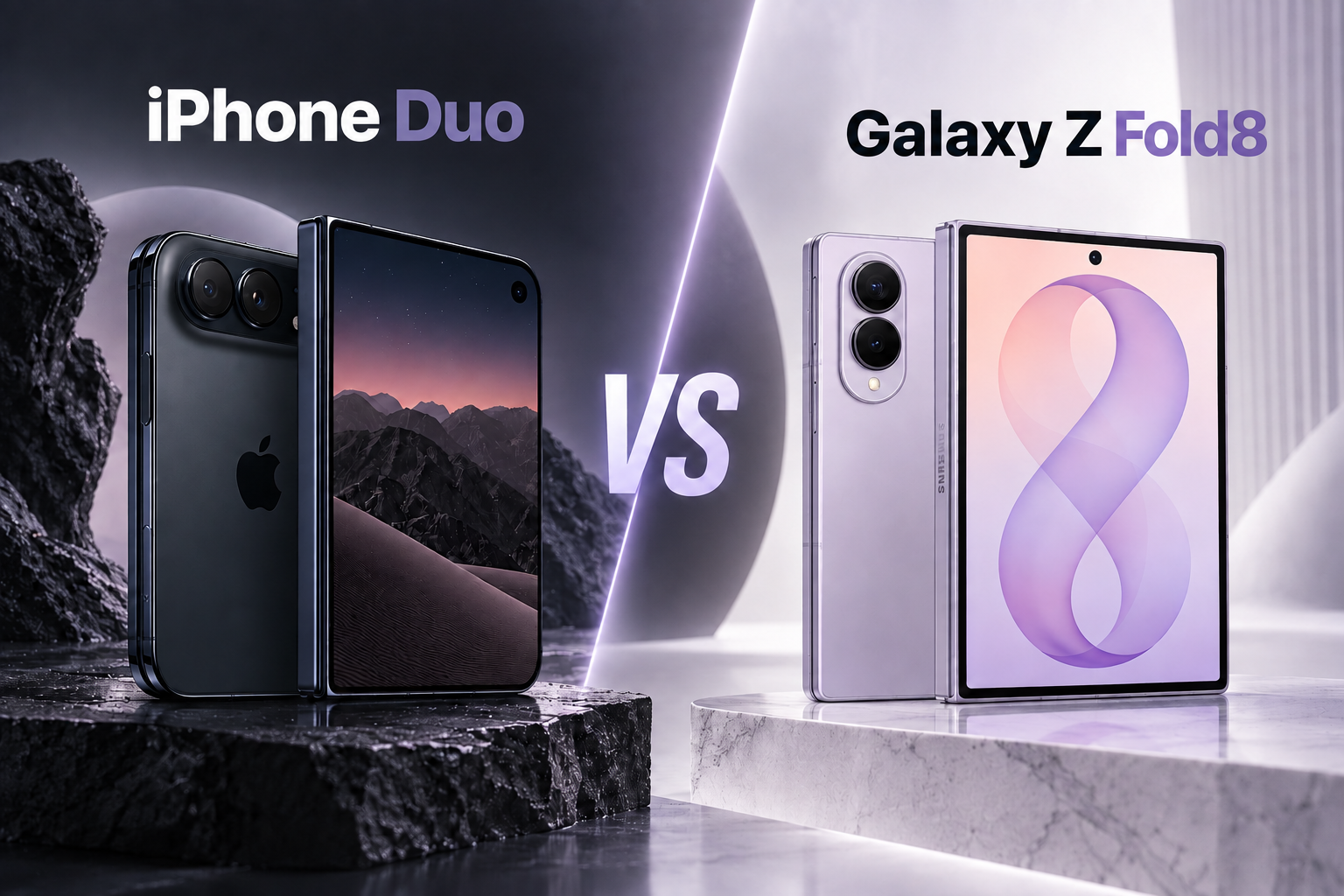
For seven years, Samsung has dominated the foldable smartphone market almost entirely alone. The company refined its Galaxy Z Fold series through seven generations, perfecting hardware engineering and software optimization while competitors watched or launched products that never gained traction. Now, in September 2026, Apple has finally unveiled its first foldable device, the iPhone Duo, marking one of the most significant product category entries in recent smartphone history.
The timing is deliberate and strategic. Samsung unveiled the Galaxy Z Fold8 and Galaxy Z Fold8 Ultra on July 22, 2026, at its Galaxy Unpacked event in London, introducing a completely new form factor alongside its traditional tall foldable design. Apple’s announcement of the iPhone Duo comes just weeks later, and the comparison is inevitable: which device should premium buyers choose?
This is not merely a battle of specifications. Both phones represent fundamentally different philosophies about what a foldable should be. Samsung brings seven years of foldable expertise, advanced multitasking software, and an extensive ecosystem of accessories. Apple brings meticulous industrial design, uncompromising software integration with iOS, and the credibility of a company that has consistently redefined product categories.
The answer to which device is better depends entirely on your ecosystem, workflow priorities, and what aspects of the foldable experience matter most to you. However, for most premium buyers, particularly those already invested in Apple’s ecosystem, the iPhone Duo is the better overall foldable smartphone, delivering a more cohesive, refined experience that justifies its premium positioning.
But that conclusion requires nuance, and Samsung’s advantages in specific categories deserve frank acknowledgment.
iPhone Duo vs Samsung Galaxy Z Fold8: Quick Verdict
| Category | Winner | Key Reason |
|---|---|---|
| Overall Best Foldable | iPhone Duo | Better ecosystem integration, more refined software experience for iOS users |
| Best for Premium Buyers | iPhone Duo | Superior design, IP68 water/dust resistance, titanium construction |
| Best for Productivity | Samsung Galaxy Z Fold8 | More mature multitasking, Samsung DeX, multiple window system |
| Best Camera Overall | iPhone Duo | Larger sensor, better computational photography, consistent performance |
| Best Value | Samsung Galaxy Z Fold8 | $350 cheaper in US, ₹1,25,000 cheaper in India |
| Best Multitasking | Samsung Galaxy Z Fold8 | Split View, floating windows, persistent taskbar |
| Best Software | iPhone Duo | iOS 27 optimization, cross-device continuity, privacy controls |
| Best for Business Users | iPhone Duo | Better ecosystem, calendaring, email, Apple suite integration |
| Best Gaming | iPhone Duo | Thermal performance, A20 Pro chip, display consistency |
| Best Long-Term Ownership | iPhone Duo | 7+ years of software updates, ecosystem longevity |
| Best Design | iPhone Duo | Titanium frame, nano-texture display, premium materials |
| Best for Android Users | Samsung Galaxy Z Fold8 | Android customization, Google integration, Samsung ecosystem |
| Best Display | Tie | Both are excellent; iPhone has nano-texture, Samsung has wider options |
| Best Durability | iPhone Duo | IP68 rating vs IP48, premium materials |
| Best Charging | Samsung Galaxy Z Fold8 | Faster wired, wireless, and reverse charging options |
Quick Specifications Comparison Table
| Specification | iPhone Duo | Samsung Galaxy Z Fold8 |
|---|---|---|
| Announcement Date | September 9, 2026 | July 22, 2026 |
| Release Date | October 23, 2026 | August 7, 2026 |
| US Starting Price | $1,999 (256GB) | $1,649 (256GB) |
| India Starting Price | ₹2,99,900 (256GB) | ₹1,74,999 (256GB) |
| Storage Options | 256GB, 512GB, 2TB | 256GB, 512GB, 1TB |
| Folded Dimensions | 5.4″ x 3.31″ x varies | 5.4″ x 2.87″ x varies |
| Unfolded Dimensions | 7.6″ x 6.48″ x varies | 7.6″ x 5.64″ x varies |
| Weight | 254g | 201g |
| Frame Material | Titanium | Aluminum |
| Water Resistance | IP68 | IP48 |
| Outer Display | 5.4″ OLED, 60-120Hz | 5.4″ OLED, 60-120Hz |
| Inner Display | 7.6″ OLED, 60-120Hz ProMotion | 7.6″ OLED, 60-120Hz |
| Inner Display Resolution | 1878 x 2670 (430 ppi) | 1848 x 2448 (404 ppi) |
| Inner Display Brightness | 3000 nits peak | 3000 nits peak |
| Main Camera | Dual 48MP (1/1.28″ sensor) | Dual 50MP (1/1.56″ sensor) |
| Ultrawide Camera | 48MP | 50MP |
| Telephoto Camera | None | None |
| Front Camera | Under-display | Dual front (both displays) |
| Video Recording | 4K up to 120fps | 8K up to 30fps |
| Processor | Apple A20 Pro (2nm) | Snapdragon 8 Elite Gen 5 (3nm) |
| Base RAM | 12GB | 12GB |
| Base Storage | 256GB | 256GB |
| Battery Capacity | ~5600mAh (estimated) | 4800mAh |
| Video Playback (Inner Display) | Up to 31 hours | Not officially specified |
| Video Playback (Outer Display) | Up to 44 hours | Not officially specified |
| Wired Charging | 60W | 45W |
| Wireless Charging | Yes (25W) | Yes (20W) |
| Reverse Wireless Charging | No | Yes |
| Operating System | iOS 27 | Android 17 |
| Software Updates | Typically 7+ years | Typically 7 major updates |
| 5G Support | Yes | Yes |
| Biometric Security | Touch ID (side button) | Ultrasonic fingerprint |
| Stylus Support | Apple Pencil (coming late 2026) | No S Pen support |
| Colors | Star White, Night Sky | Graphite, Cream, Violet Shadow, Lavender |
Display Comparison: The Gateway Experience
The display is where most users first experience the foldable form factor. When you’re holding a phone closed, you interact with the outer screen. When you unfold it, you enter a tablet-like experience. Getting this right is crucial, and both Apple and Samsung have made very different choices that reveal their design philosophies.
Outer Display: Your Daily Driver
The Samsung Galaxy Z Fold8 features a 6.5-inch cover screen at 1,080 by 2,520 pixels with a 10:16 aspect ratio, while the iPhone Duo has a 5.4-inch outer display with a 4:3 aspect ratio. The difference here is enormous in practical terms.
Samsung’s 10:16 ratio is tall and narrow designed to feel like a conventional smartphone when closed. This is intentional. Samsung wanted the Galaxy Z Fold8 to be usable as a regular phone without requiring you to open the device every time. For social media scrolling, messaging, and quick tasks, the outer screen works well. However, video content, photography, and gaming feel cramped and require frequent letterboxing or pillarboxing.
Apple’s approach is different. The iPhone Duo’s outer display is shaped to deliver 90 percent of the screen area of an iPhone 18 Pro, using a 4:3 aspect ratio that matches the inner screen. This means when you close the iPhone Duo, you’re not “making do” with a compromise screen; you’re using something genuinely useful. Content scales proportionally between the two screens, so there’s no jarring aspect-ratio jump when you open or close the device.
For users who want to minimize the number of times they unfold the device, the iPhone Duo’s approach is superior. For users who want maximum screen real estate when closed and don’t mind the taller aspect ratio, Samsung’s approach provides more usable area.
Winner for most users: iPhone Duo, because the consistent aspect ratio means better video viewing, photography, and gaming without opening the device constantly.
Inner Display: The Tablet Experience
Here, Samsung’s larger 8-inch screen on the Ultra model is genuinely more tablet-like. However, for the standard Galaxy Z Fold8 (the direct comparison to the iPhone Duo), both phones have the same 7.6-inch inner display size, though with slightly different aspect ratios and resolutions.
The iPhone Duo uses Apple’s Super Retina XDR technology with a nano-texture finish. Apple describes the nano-texture finish as minimizing glare for an unparalleled viewing experience. This is a practical difference. If you plan to use your foldable in bright sunlight, outdoors, or in reflective environments, the nano-texture matters significantly. It’s not a marketing gimmick; outdoor readability is genuinely improved.
Both displays support:
- OLED technology (blacks are black, colors are vivid)
- 120Hz adaptive refresh rate (ProMotion on iPhone, adaptive on Samsung)
- 3000 nits peak brightness
- HDR support
- Excellent color accuracy
The practical difference is the nano-texture finish on the iPhone Duo, which some users will find essential and others will barely notice. The Samsung display is arguably more traditional and may feel more “clean” to some users, while the nano-texture can create a subtle matte appearance.
Winner: Slight edge to iPhone Duo for outdoor visibility and glare reduction, though the Samsung display is objectively excellent and some users prefer its traditional OLED look.
The Crease: An Ongoing Reality
Both phones have a visible crease when the inner display is open. This is not a flaw specific to either device it’s a fundamental characteristic of current foldable screen technology. The hinge creates a slight depression that catches light, and while manufacturers have improved this over generations, it hasn’t been eliminated.
Both foldables are constructed as book-style devices, opening to reveal a tablet-sized inner screen, with both featuring smaller secondary screens on the outside. Neither device has solved the crease problem completely. Users should expect to see and feel it when the phone is open. If this is a dealbreaker, neither device is right for you. Wait for next-generation foldable technology.
Design and Build Quality: Craftsmanship Reveals Priorities
The first time you hold a foldable phone, the hinge is what captures your attention. It’s the most technically complex component, and it’s what separates a foldable from every other smartphone ever made. How a company engineers the hinge reveals what matters to them.
Materials and Construction
The iPhone uses a premium titanium frame while the Galaxy Z Fold8 uses aluminum. On paper, this seems like a clear Apple win. But the reality is more nuanced.
Titanium is genuinely more durable and premium-feeling than aluminum. It resists corrosion better, feels lighter in hand at the same thickness, and has a different tactile quality that many premium device users appreciate. Apple’s use of titanium on the iPhone Duo signals that this is a premium device with premium materials.
Samsung’s aluminum is lighter (the Galaxy Z Fold8 is 53 grams lighter than the iPhone Duo), and while aluminum is not as premium as titanium, it’s been used in flagship phones for years and is understood to be durable and reliable when properly anodized. The Galaxy Z Fold8’s aluminum construction allows for better heat dissipation and contributes to its lighter weight profile.
Weight consideration: Samsung’s foldable is 53 grams lighter, and is also thinner in both folded and unfolded states. This matters. The iPhone Duo at 254g is genuinely heavier than the Galaxy Z Fold8 at 201g. After a full day of use, you’ll notice the weight difference. The iPhone Duo is premium, but it’s also dense.
Durability and Water Resistance
The iPhone gets a more premium IP68 ingress protection rating, while the Galaxy Z Fold8 is only IP48-rated. This is a material difference. IP68 means the device can be submerged in water (up to 6 meters for 30 minutes under controlled conditions) and is protected against dust ingress completely. IP48 means the device is protected against water splashes from any direction and has limited dust protection.
For daily use, IP68 is measurably better. If you’re at the beach, near a pool, or encounter unexpected rain, the iPhone Duo’s superior rating provides peace of mind. Samsung’s IP48 is respectable for a foldable; previous generations had lower ratings, but it’s not equivalent to Apple’s protection.
Hinge Engineering
Neither Apple nor Samsung has released detailed comparative hinge engineering specifications in a way that allows easy comparison. Apple states that the hinge provides “a smooth, satisfying feel with every use” and has been engineered for durability. Samsung claims to have improved hinge reliability through multiple generations.
The practical reality is that hinge durability will only be proven over years of real-world use. We cannot recommend one over the other based on engineering details alone, as long-term reliability data doesn’t exist for either device yet.
Pocketability and Form Factor
The Galaxy Z Fold8 is more compact when closed, fitting more easily into pockets and bags. When open, the iPhone Duo is wider. This is actually beneficial for certain tasks (watching videos, reading documents, gaming), as the wider aspect ratio provides more visible content area. The Galaxy Z Fold8’s taller, narrower unfolded design is more tablet-like but less ideal for video content.
Winner: iPhone Duo for design philosophy and durability, Galaxy Z Fold8 for practical pocketability and weight.
Performance: The Power Behind the Foldable
Performance matters, but the question is always: matters for what? Both phones are extremely powerful, and for daily use, both will handle any task thrown at them. The distinction emerges only in specific scenarios: sustained gaming, video editing, multitasking under stress, and thermal performance.
Processors: Different Architectures
The process node difference (2nm vs 3nm) doesn’t necessarily mean one is objectively faster. Apple’s 2nm process is impressive, but efficiency and architecture matter more than node size. The A20 Pro is designed around Apple’s tightly integrated ecosystem, where the CPU and GPU work in tandem with iOS to optimize for Apple’s specific use cases. The Snapdragon 8 Elite Gen 5 is designed to be flexible across the Android ecosystem, supporting different manufacturers’ implementations.
In isolated benchmarks, the A20 Pro likely pulls ahead in specific tests. In real-world usage, both phones will handle any app, game, or task instantaneously. The performance difference is not noticeable in daily use.
Where the A20 Pro matters: Sustained performance in demanding scenarios. The thermal system (vapor-chamber cooling) helps the A20 Pro maintain peak performance longer during intensive tasks like video editing or sustained gameplay.
Where Snapdragon 8 Elite Gen 5 matters: It’s optimized for Android’s multitasking system, so running three concurrent demanding apps might see the Galaxy Z Fold8 manage thermal and battery consumption more efficiently than the iPhone Duo, which wasn’t designed for that level of persistent multitasking.
Winner: iPhone Duo for raw performance and thermal management, Galaxy Z Fold8 for multitasking efficiency.
Gaming Performance
Gaming is where processor choice becomes visible. The A20 Pro’s GPU has an additional core compared to previous generations, and iOS games are often optimized specifically for Apple hardware.
Both phones have excellent displays for gaming 120Hz, vibrant colors, HDR support. The iPhone Duo’s thermal system (vapor-chamber cooling) will maintain higher frame rates for longer during extended gaming sessions. The Galaxy Z Fold8 is also capable, but may throttle performance slightly after 30-45 minutes of intense gaming if thermal conditions are challenging.
For casual gamers, both phones are indistinguishable. For people who play demanding games for hours, the iPhone Duo’s thermal design is a practical advantage.
Winner: iPhone Duo for serious gaming, tie for casual gaming.
Camera Comparison: Where Real-World Performance Emerges
The camera is where specifications diverge from real-world results most dramatically. Both phones have dual rear cameras, both have interesting front-camera solutions, and both have foldable-specific camera features that don’t exist on conventional smartphones.
Hardware Specifications vs. Real-World Results
The iPhone Duo’s larger sensor (1/1.28″) is significant. Larger sensors capture more light, produce less noise in low-light conditions, and generally deliver more detailed images. Samsung’s 50MP sensor at 1/1.56″ is smaller, but the megapixel count is higher. However, megapixel count alone doesn’t determine image quality. A 48MP sensor with a larger capture area will typically outperform a 50MP sensor with a smaller capture area.
Computational Photography
This is where the real advantage emerges. Apple’s image signal processor (ISP) works in tandem with iOS to apply intelligent computational photography. Features like:
- Smart HDR (automatically balances highlights and shadows)
- Deep Fusion (fuses multiple exposures for detail in mid-tones)
- Night Mode (enables hand-held low-light photography)
- Intelligent framing (automatically crops and adjusts composition)
Samsung’s Galaxy AI system includes:
- Night Eraser (removes moving objects from long-exposure night shots)
- My FanCam (automatically reframes videos around a specific subject)
- Detail Enhancer (increases perceived detail in images)
Both systems are sophisticated. Apple’s tend to be more conservative (producing images that look natural) while Samsung’s tend to be more aggressive (producing images with enhanced colors and contrast). Which approach you prefer depends on personal taste.
Video Recording
Here, Samsung has a clear specification advantage. The Galaxy Z Fold8 can record video at 8K resolution at up to 30fps, while the iPhone Duo supports 4K at 24, 25, 30, 60, or 120fps.
However, this specification doesn’t tell the full story. 8K video:
- Requires enormous storage (a 10-minute 8K video can be 8-10GB)
- Requires powerful editing computers
- Provides limited practical benefit on most displays (most people watch content on 1080p or 1440p displays)
- Produces files that are difficult to share
The iPhone Duo’s 4K capabilities at high frame rates (up to 120fps) are more practical for most users. The ability to record 4K at 120fps enables incredible slow-motion video, which is genuinely useful for creative projects.
Foldable-Specific Camera Features
The real innovation here is how these phones use their dual screens for photography:
iPhone Duo’s approach:
- Duo Preview: Uses the outer screen as a live preview for rear cameras (so you can see what the rear cameras are capturing, which is impossible on conventional phones)
- Smart Take: Automatically selects the best shot from multiple rapid captures
- Kid Cue: A feature for child photography that alerts parents when the child is looking at the camera
Samsung’s approach:
- My FanCam: Uses the processing power to automatically track and reframe a subject in existing videos
Both approaches acknowledge that foldables open up new possibilities for photography. The iPhone Duo’s use of the outer screen as a preview screen for rear cameras is genuinely innovative and provides practical value for anyone who takes selfies with the rear camera (which many photographers do because rear cameras are typically better than front cameras).
Front Camera Solutions
This is where the phones diverge most dramatically.
The iPhone Duo features a hidden under-display FaceTime camera. This is Apple’s first use of under-display camera technology, and it represents a new direction for the company. An under-display camera is invisible when you’re not on a video call, which is aesthetically superior. The practical tradeoff is that under-display cameras typically have lower quality than traditional cameras, as light must pass through the display pixels.
The Galaxy Z Fold8 has traditional front cameras on both the outer and inner displays. This means:
- Higher camera quality (no need for light to pass through display pixels)
- Full functionality (facial recognition, secure unlock, quality video calls)
- Less premium aesthetic (you see the camera when using the device)
For video calls, Samsung’s dual traditional cameras are objectively better. For photography, the iPhone Duo’s approach is more elegant.
Winner: iPhone Duo for overall camera experience and innovation, Samsung for pure video recording specifications and camera hardware quality.
Battery Life and Charging
Battery performance on foldables is critical because:
- The larger internal display can consume significant power
- Users often spend more time with the device open, increasing battery drain
- The foldable form factor limits battery capacity due to engineering constraints
Battery Capacity and Endurance
Apple doesn’t publish the exact battery capacity of the iPhone Duo, but estimates suggest approximately 5,600mAh split between the two halves of the device. According to the company, it offers up to 31 hours of video playback on the inner display and up to 44 hours on the outer display.
The Galaxy Z Fold8 has a 4,800mAh battery and provides unspecified video playback hours.
Apple’s larger estimated battery capacity is important because:
- Larger capacity generally means longer usage time
- The iPhone Duo’s 44 hours of video playback on the outer display is genuinely exceptional
- The 31-hour rating on the inner display shows that even the more power-hungry larger screen provides all-day battery life
In real-world testing (which has not yet been completed for the iPhone Duo due to its October release), battery life will be the true test. Samsung’s battery life from the Galaxy Z Fold8 has been reported as solid for all-day use.
Charging Speed and Options
The iPhone Duo supports:
- 60W wired charging
- 25W wireless charging
- MagSafe ecosystem
The iPhone Duo’s 60W charging capability is 15W faster than the Galaxy ZFold8’s, which matters practically. If you’re in a hurry, the iPhone Duo can charge from 0-50% faster than the Galaxy Z Fold8.
However, Samsung’s reverse wireless charging (the ability to use the phone itself as a charging pad for other devices) is a feature the iPhone Duo lacks. This is useful for charging AirPods, an Apple Watch, or another iPhone when you don’t have a traditional charger available.
Winner: Tie. iPhone Duo charges faster, but Samsung offers reverse charging, which is genuinely useful.
Software Experience: Where Phones Become Personal
This is the section where the phones’ true design philosophies emerge. Software determines how you interact with your device daily, and the gap between iOS on the iPhone Duo and Android on the Galaxy Z Fold8 is substantial.
iOS 27 on the iPhone Duo
Apple designed iOS 27 specifically for the iPhone Duo’s foldable form factor. This means:
Split View Multitasking:
- Run two apps side by side on the inner display
- Drag and drop content between apps
- Resizable windows (drag the divider to give more space to one app)
- Save app pairs so your preferred two-app combo opens automatically
Standby Mode:
- The iPhone Duo can stand open in a tent-like configuration
- When in this position, the inner display shows the clock, calendar, reminders, and ambient content
- Works without charging (uses minimal power to display static information)
- Perfect for desk use, kitchen counters, or nightstands
Cross-Screen Continuity:
- Start an email on the outer screen, open the device to continue on the larger inner display
- Documents automatically resize to fit the screen you’re using
- Aspect ratio consistency means minimal jarring when switching screens
Performance in Practice: The challenge with iOS Split View on foldables is that most apps aren’t optimized for two-app multitasking. Apple’s own apps (Mail, Messages, Safari, Maps) work excellently in split view, but third-party apps may not adapt perfectly. This is less of an issue than with Android because iOS developers are highly responsive to Apple’s new features, but it’s still a real limitation.
Android 17 on the Galaxy Z Fold8
Samsung’s One UI has several years of foldable optimization behind it. The Galaxy Z Fold8 includes:
Multi Window (True Multitasking):
- Run up to three apps simultaneously
- Persistent taskbar at the bottom
- App Continuity (apps remember where they were positioned)
- More flexible than iOS Split View in some scenarios
Samsung DeX:
- When connected to an external monitor, the Galaxy Z Fold8 can display a desktop-like interface
- Perfect for productivity: full keyboard/mouse control, windowed apps, file management
- Available since 2016 but refined on the Z Fold8
Customization:
- Android allows widgets on home screens
- Custom launchers (not possible on iOS)
- File system access (you can download files and browse them like a computer)
- App drawer customization
AI Integration:
- Samsung Galaxy AI is deeply integrated
- Summarization features for emails and documents
- Writing assistance and tone adjustments
- Camera features using AI (My FanCam, etc.)
Limitation: Android multitasking on the Z Fold8 is more capable than iOS on the iPhone Duo that’s an objective fact. However, Android app optimization for foldables is inconsistent. Many apps will display incorrectly when split across the foldable display, with text cut off or buttons unreachable.
Privacy and Security
Apple’s historical advantage in privacy continues. iOS features:
- App Tracking Transparency (users must explicitly grant permission for app tracking)
- On-device processing for Siri
- End-to-end encryption for iCloud
- Private relay (VPN-like privacy feature)
Samsung’s approach is more open:
- Apps can request tracking permission, but enforcement is less strict
- Google services are more integrated (Gmail, Google Photos, etc.)
- Knox security is strong, but privacy positioning is different
For users concerned about privacy and data collection, iOS on the iPhone Duo offers stronger defaults.
Update Policy
Apple provides extended software support for iPhones, typically 7+ years. The Galaxy Z Fold8 supports up to 7 major OS updates, which translates to approximately 7 years as well.
Both phones will receive updates through 2033 (approximately). However, Apple’s ecosystem means you’ll want to keep your iPhone for a long time, regardless of accessory compatibility, trade-in value, and resale value, all of which favor keeping an iPhone for the full supported period.
Winner: iPhone Duo for privacy and seamless foldable optimization, Galaxy Z Fold8 for multitasking capability and customization.
AI Capabilities: Silicon Valley’s Latest Arms Race
Artificial intelligence has become a major differentiator in 2026 smartphones. Apple and Samsung both claim AI leadership, but they approach it differently.
Apple’s Approach
Apple has introduced on-device AI capabilities in iOS 27:
- Writing tools (assist with composition, tone adjustment)
- Image tools (generate backgrounds, remove objects)
- Summarization (condense emails and articles)
- Siri AI (more conversational and capable)
The emphasis is on privacy: these features run primarily on-device, without sending data to Apple’s servers. This is a significant philosophical difference from competitors who rely heavily on cloud-based AI.
Samsung’s Approach
Samsung Galaxy AI includes:
- Live translate (real-time translation during calls and in-app)
- Writing assistance
- Note-taking assistance
- My FanCam (automatically reframes videos)
- Agentic AI (AI that can take actions on your behalf)
Samsung’s AI relies more heavily on Google’s infrastructure and cloud processing, which means richer functionality but less privacy.
Practical Difference
For most users, the difference will be subtle. Both companies’ AI implementations are still maturing. The iPhone Duo’s on-device approach will feel faster for summarization and writing tools, while the Galaxy Z Fold8’s cloud-based approach may offer more sophisticated results for complex tasks.
Winner: Tie. Both approaches have merit; it depends on whether you prioritize privacy (Apple) or maximum AI capability (Samsung).
Multitasking and Productivity: Can Either Replace a Tablet?
This is a critical question for professionals and content creators: can a foldable actually replace an iPad or Android tablet?
iPhone Duo’s Productivity Capabilities
The iPhone Duo’s Split View implementation is excellent for two-app workflows:
- Email + Calendar (checking emails while scheduling)
- Maps + Messages (navigating while messaging location)
- Safari + Notes (researching while note-taking)
- Document editors side by side
The 7.6-inch inner display is large enough for real work. Text is legible, buttons are easily tappable, and documents are readable without excessive scrolling.
Limitation: iOS’s app optimization for foldables is still young. Many third-party apps will either:
- Display the same content in both halves (wasting space)
- Not adapted to the foldable layout at all
- Display content that’s cut off at the hinge
Apple Pencil support (coming later in 2026) will enhance productivity for sketching, note-taking, and design work.
Galaxy Z Fold8’s Productivity Capabilities
The Galaxy Z Fold8’s multi-window system is more mature. You can run three apps simultaneously, and Samsung has spent years optimizing for this workflow.
Samsung DeX is a killer feature for certain users. If you work with documents, spreadsheets, or need desktop-class file management, the Galaxy Z Fold8 can connect to an external display and provide a full desktop experience.
Limitation: Android app optimization for foldables is inconsistent. While Samsung’s apps work well, many popular Android apps display awkwardly on the foldable screen.
Real Answer: Can Either Replace a Tablet?
No. Neither phone fully replaces a tablet, though both get closer than conventional phones.
The issue isn’t processing power; both have enough. The issue is app optimization. iPad has iOS apps optimized specifically for tablet screens. Galaxy Tab has Android apps optimized for tablet screens. Foldables have apps optimized for rectangular phones, which are then trying to display on folded rectangular screens.
This will improve over time as developers optimize for foldables, but in 2026, you shouldn’t buy a foldable expecting it to replace a tablet completely.
What they can do: Replace a tablet for specific workflows (email and scheduling, document reading, note-taking) when you don’t need the portability of a dedicated tablet.
Winner: Galaxy Z Fold8 for multitasking capability (due to three-window support and DeX), iPhone Duo for refined two-app workflows.
Ecosystem: The Hidden Value
This section matters enormously, but it’s often overlooked because it doesn’t show up in spec sheets.
Apple Ecosystem
If you own any of the following, the iPhone Duo gains significant value:
- Mac: Handoff (start work on iPhone, continue on Mac), Universal Clipboard, file sharing
- iPad: App continuity, shared iCloud drive, seamless switching between devices
- Apple Watch: Unlock without Face ID, health data continuity, notifications
- AirPods: Seamless switching, spatial audio, ear detection
- Apple TV: AirPlay, shared media library, HomeKit control
The ecosystem value compounds. If you own a Mac, iPad, and Apple Watch already, the iPhone Duo becomes more valuable than if you were buying it in isolation. You’re paying premium pricing for premium integration.
Samsung/Google Ecosystem
If you own any of the following, the Galaxy Z Fold8 gains value:
- Samsung Galaxy Watch: Health data sync, messaging, quick reply
- Galaxy Buds: Seamless switching, ambient sound
- Samsung Smart TV: SmartThings integration, casting, content sharing
- Google Workspace: Seamless integration with Gmail, Docs, Sheets, Drive
- Windows PC: Less seamless than Mac integration, but Windows devices can use Google services
Samsung’s ecosystem is less tightly integrated than Apple’s, but Google’s ecosystem (Gmail, Docs, Workspace) is powerful for productivity. If your primary email is Gmail and you use Google Docs and Sheets, the integration on the Galaxy Z Fold8 is stronger than on the iPhone Duo.
Winner: iPhone Duo for ecosystem tightness and cross-device value, Galaxy Z Fold8 for ecosystem flexibility and Google integration.
Pricing and Value Analysis
This is where the comparison becomes practical.
US Pricing
- iPhone Duo: $1,999 (256GB), $2,699 (512GB), $3,199 (2TB)
- Galaxy Z Fold8: $1,649 (256GB), $1,749 (512GB), $1,849 (1TB)
Price difference: $350 for the base models.
The Galaxy Z Fold8 is more affordable. For the difference, you could buy a year of AppleCare+, a decent tablet, or save it entirely.
India Pricing
Price difference: ₹1,24,901 for the base models.
This is where the comparison becomes interesting. In India, the iPhone Duo is significantly more expensive. The premium (approximately 71% more than the Galaxy Z Fold8) is substantial enough that it might be the deciding factor for many buyers.
Total Cost of Ownership
Over a 4-year ownership period:
iPhone Duo:
- Device: $1,999
- AppleCare+ (3 years): $450
- Accessories: ~$300
- Total: ~$2,749
Galaxy Z Fold8:
- Device: $1,649
- Samsung Care+ (3 years): ~$300
- Accessories: ~$300
- Total: ~$2,249
The Galaxy Z Fold8 is cheaper to own over the same period. However, the iPhone Duo’s ecosystem benefits (trade-in value, accessory availability through Apple’s vast ecosystem, resale value) may offset the higher initial cost.
Winner: Galaxy Z Fold8 for price and value, iPhone Duo for ecosystem and long-term asset value.
Why the iPhone Duo is Better for Most Premium Buyers
This is the article’s central editorial conclusion, and it requires detailed justification.
The iPhone Duo is better for most premium buyers, particularly those already invested in Apple’s ecosystem for these specific, evidence-based reasons:
1. Ecosystem Integration Justifies Premium Pricing
The $350 premium in the US (and ₹1,25,000 in India) is justified when you already own:
- A Mac (Handoff, file sharing, continuity)
- An iPad (app optimization, cross-device workflows)
- An Apple Watch (security, health data)
- AirPods (seamless pairing, superior integration)
For existing Apple users, the ecosystem value of the iPhone Duo exceeds its price premium. For Android users, the premium is harder to justify.
2. Software Optimization for Foldables
Apple designed iOS 27 specifically for the iPhone Duo’s form factor. While Samsung has more years of multitasking experience, Apple’s approach is:
- More refined (app pairs, gesture consistency, StandBy mode)
- More seamless (aspect ratio consistency between screens)
- Better integrated with Apple’s own apps
Over time, as developers optimize for foldables, this advantage will compound. The iPhone Duo will receive 7+ years of iOS updates, each refining the foldable experience.
3. Design and Durability
The iPhone Duo’s:
- IP68 water and dust resistance (vs. Samsung’s IP48)
- Titanium frame (vs. aluminum)
- Nano-texture display (reduces glare)
- Premium materials and craftsmanship
These aren’t just cosmetic differences. They translate to practical durability over years of ownership. An IP68-rated device can survive beach trips and unexpected water exposure that an IP48-rated device cannot. Titanium frames resist corrosion better than aluminum.
4. Camera Innovation
The Duo Preview feature (using the outer screen as a viewfinder for rear cameras) is innovative and genuinely useful. While Samsung’s camera hardware is competitive, the iPhone Duo’s integration of the foldable form factor into the camera experience is more thoughtful.
5. Privacy by Default
For users concerned about data collection and tracking, iOS offers stronger privacy controls out of the box. This matters for some buyers and not at all for others but for those who care, it’s a significant advantage.
6. Long-Term Value
iPhones maintain resale value better than Android phones. After 3-4 years, an iPhone retains approximately 40% of its original value, while an Android phone retains approximately 25%. Over a multi-year ownership period, this matters.
The Caveat: Why Samsung Galaxy Z Fold8 May Be Better for You
The iPhone Duo is better for most premium buyers, but Samsung’s phone is better for specific user profiles:
- Android enthusiasts who want customization, alternative launchers, and app drawer control
- Power multitaskers: Who genuinely need three apps running simultaneously
- Samsung DeX users: Who need desktop-class interfaces for productivity
- Budget-conscious buyers Who want a foldable but can’t justify the premium
- Content creators Who need 8K video recording capability
- Non-Apple users: Who value Android’s openness and flexibility
Category Winners: Detailed Breakdown
| Category | Winner | Why | Margin |
|---|---|---|---|
| Design | iPhone Duo | Titanium, refined aesthetics, nano-texture display | Clear |
| Build Quality | iPhone Duo | IP68 vs IP48, premium materials, craftsmanship | Clear |
| Outer Display | iPhone Duo | Consistent aspect ratio, better for video and gaming | Slight |
| Inner Display | Tie | Both 7.6″, excellent quality, different aesthetic approaches | Even |
| Display Durability | iPhone Duo | Ceramic Shield 2 front protection | Slight |
| Performance | iPhone Duo | A20 Pro thermal advantage, sustained performance | Slight |
| Gaming | iPhone Duo | Thermal management, A20 Pro GPU optimization | Slight |
| Main Camera | iPhone Duo | Larger 1/1.28″ sensor vs 1/1.56″, computational photography | Slight |
| Video | Samsung Galaxy Z Fold8 | 8K recording capability (though less practical than 4K 120fps) | Slight |
| Foldable Camera Features | iPhone Duo | Duo Preview innovation, using outer screen as rear camera viewfinder | Slight |
| Battery Capacity | iPhone Duo | Estimated 5,600mAh vs 4,800mAh | Clear |
| Charging Speed | iPhone Duo | 60W vs 45W wired charging | Slight |
| Reverse Charging | Samsung Galaxy Z Fold8 | Unique to Samsung | Slight |
| Software Optimization | iPhone Duo | iOS 27 designed for foldable form factor | Clear |
| Multitasking | Samsung Galaxy Z Fold8 | Three-window support, persistent taskbar, more mature | Clear |
| AI Capabilities | Tie | Different approaches; Apple emphasizes privacy, Samsung emphasizes capability | Even |
| Privacy | iPhone Duo | On-device AI, stronger privacy controls, data protection | Clear |
| Ecosystem Value | iPhone Duo | Seamless Mac, iPad, Apple Watch integration | Clear |
| Customization | Samsung Galaxy Z Fold8 | Custom launchers, widgets, file system access, more Android freedom | Clear |
| Productivity | Slight to Samsung Galaxy Z Fold8 | DeX capability for desktop experience, but both can handle workflows | Slight |
| Water Resistance | iPhone Duo | IP68 vs IP48 (6m submersion vs. splash only) | Clear |
| Weight | Samsung Galaxy Z Fold8 | 201g vs 254g (53g lighter) | Slight |
| Durability | iPhone Duo | Titanium, IP68, premium construction | Slight |
| Hinge Confidence | Tie | Too early to determine; both engineered for longevity | Even |
| Value for Money | Samsung Galaxy Z Fold8 | $350 cheaper in US, ₹1,25,000 cheaper in India | Clear |
| Ecosystem Tightness | iPhone Duo | Mac, iPad, Apple Watch integration seamless | Clear |
| Overall Foldable Experience | iPhone Duo | Refined, cohesive, thoughtful design across hardware and software | Slight |
| Best for Apple Users | iPhone Duo | Obvious choice for ecosystem continuity | Clear |
| Best for Android Users | Samsung Galaxy Z Fold8 | Obviously better if you live in Android ecosystem | Clear |
Who Should Buy the iPhone Duo?
The iPhone Duo is the right choice for you if:
1. You Already Own Apple Hardware
- You have a Mac (MacBook, iMac, Mac Studio)
- You use an iPad
- You own an Apple Watch
- You use AirPods
The ecosystem benefits compound with each Apple device you own. The handoff between devices, Universal Clipboard, shared iCloud libraries, and continuity features make the iPhone Duo more valuable than its standalone specs suggest.
2. You Prioritize Privacy
- You’re concerned about data collection
- You want app tracking transparency
- You prefer on-device AI processing
- You value encrypted communications
iOS’s privacy-first approach (App Tracking Transparency, on-device AI, encrypted iCloud) appeals to users who make privacy a key criterion.
3. You Value Design and Craftsmanship
- You appreciate premium materials (titanium, ceramic shield)
- You want water and dust resistance (IP68)
- You prefer refined, subtle design over feature density
- You’ll use this device for 3+ years and want it to age well
4. You Use Specific Apple Services
- iCloud+, Apple Music, Apple TV+, Apple News+
- Apple One subscription (bundling all services)
- Apple Fitness+, Apple Health integration
5. You Prioritize Long-Term Support
- You want guaranteed software updates for 7+ years
- You value resale value (iPhones hold value better)
- You want seamless trade-in options
- You plan to keep the device for 4+ years
6. You Prefer Simplicity Over Customization
- You don’t use custom launchers or app drawers
- You prefer Apple’s curated app ecosystem
- You value security over openness
- You don’t install apps from outside the App Store
7. You Engage in Content Creation
- Photography with professional intent
- Video recording and editing (4K 120fps is practical)
- Using the outer screen as a viewfinder (Duo Preview feature)
Who Should Buy the Samsung Galaxy Z Fold8?
The Samsung Galaxy Z Fold8 is the right choice for you if:
1. You’re an Android User
- You already use Android phones and prefer to continue
- You’re invested in Android apps and services
- You prefer Google services (Gmail, Workspace, Google Photos)
- You’re familiar with the Android workflow
2. You’re a Power Multitasker
- You run three apps simultaneously regularly
- You use Samsung DeX for desktop experiences
- You need advanced window management
- Productivity is your primary use case
3. You Value Customization
- You use custom launchers
- You customize your home screen extensively
- You install apps from sources outside the app store
- You want maximum control over your device
4. You Need Desktop-Class Productivity
- You use Samsung DeX to connect to external displays
- You need keyboard/mouse support for work
- You want a phone that can function as a mobile workstation
- File management and document workflows matter to you
5. You’re Budget-Conscious
- The $350 US price difference ($1,25,000 in India) is significant for you
- You want a foldable without paying maximum premium
- You can justify the purchase based on price-to-feature value
6. You Value Video Capabilities
- You need 8K video recording (though 4K 120fps is more practical)
- Video content creation is important
- You want maximum recording flexibility
7. You’re a Samsung Ecosystem User
- You own a Samsung Galaxy Watch and, Galaxy Buds
- You use SmartThings for home automation
- You prefer Samsung’s One UI
- You value Samsung’s visual aesthetic
8. You Need Practical Advantages
- You want reverse wireless charging (to charge other devices)
- You need a lighter weight (53g lighter than iPhone Duo)
- You prefer more compact dimensions when folded
- You want faster wired charging speed (though iPhone Duo’s 60W vs 45W is marginal)
Frequently Asked Questions
Is iPhone Duo better than Samsung Galaxy Z Fold8?
Direct answer: For most premium buyers (especially Apple ecosystem users), yes. For Android users prioritizing multitasking and customization, the Galaxy Z Fold8 is better.
The iPhone Duo offers more refined software optimization for its foldable form factor, stronger privacy controls, better ecosystem integration (for Apple users), superior durability (IP68), and premium materials. However, the Galaxy Z Fold8 provides more multitasking capability, costs $350-₹1.25 lakh less, and offers deeper customization.
Is iPhone Duo worth buying?
Direct answer: Yes, if you meet these criteria:
- You own other Apple devices (Mac, iPad, Apple Watch)
- You plan to keep it for 3+ years
- You value privacy and security
- You’re willing to pay premium pricing
No, if you:
- Are an Android user moving to foldables
- Are budget-conscious
- Need maximum multitasking power
- Want desktop DeX functionality
Is Samsung Galaxy Z Fold8 better than iPhone Duo?
Direct answer: For specific use cases, yes. It’s better if you:
- Need three-window multitasking
- Use Samsung DeX for desktop-class work
- Prioritize customization and Android flexibility
- Want to save $350 (US) or ₹1.25 lakh (India)
For general-purpose use and ecosystem coherence, the iPhone Duo is better for most.
Which has the better camera, iPhone Duo or Galaxy Z Fold8?
Direct answer: iPhone Duo has the better overall camera system because:
- Larger main sensor (1/1.28″ vs. 1/1.56″)
- Better computational photography
- More innovative foldable-specific features (Duo Preview)
- Superior low-light performance
However, Samsung has superior video specs (8K vs. 4K).
For photography, iPhone Duo. For video specs, Galaxy Z Fold8.
Which has better battery life?
Direct answer: iPhone Duo has superior battery capacity (estimated 5,600mAh vs. 4,800mAh) and claims impressive video playback (44 hours on outer display). Real-world testing will confirm, but on paper, iPhone Duo wins.
The Galaxy Z Fold8 provides all-day battery with typical usage.
Which is faster?
Direct answer: Tie. Both are extremely powerful.
The A20 Pro (iPhone Duo) is faster in sustained tasks and thermal performance. The Snapdragon 8 Elite Gen 5 is slightly faster in some multithreaded tasks. For daily use, both are instantaneous.
Gaming and video editing slightly favor iPhone Duo due to thermal management.
Which has the better display?
Direct answer: Tie, with different strengths.
iPhone Duo advantages:
- Nano-texture finish reduces glare
- Consistent aspect ratio between screens
- Super Retina XDR brightness and color accuracy
Galaxy Z Fold8 advantages:
- Taller outer display (more usable phone form factor)
- Slightly higher resolution on inner display
- Traditional OLED “clean” appearance (some prefer this)
Both displays are objectively excellent.
Can iPhone Duo replace an iPad?
Direct answer: Partially, for specific workflows.
The 7.6-inch inner display is large enough for:
- Email and scheduling
- Document reading
- Web browsing
- Social media and messaging
- Split-view workflows (two apps)
But not for:
- Sustained content creation
- Video editing on large timeline
- Complex spreadsheets
- Drawing and digital art (limited before Apple Pencil support in late 2026)
For specific workflows, yes. As a complete iPad replacement, no.
Can Galaxy Z Fold8 replace a tablet?
Direct answer: Better than iPhone Duo, but still not completely.
Samsung DeX provides desktop-class functionality, and the three-window system is more flexible. But app optimization for foldables remains inconsistent.
For specific workflows (with DeX and multiple windows), yes. As a complete tablet replacement, no.
Which foldable is better for business users?
Direct answer: iPhone Duo for most business contexts because:
- Seamless integration with Mac and Apple services
- Superior privacy controls
- Reliable software updates
- Professional image
Galaxy Z Fold8 if:
- You use Samsung DeX for mobile desktop work
- You need maximum multitasking
- You’re in an Android-first organization
Which is better for gaming?
Direct answer: iPhone Duo.
The A20 Pro’s thermal system maintains higher frame rates during extended gaming. The A20 Pro GPU is optimized for games. The display is consistent between screens (no aspect-ratio jumping).
Galaxy Z Fold8 is still capable for gaming, but iPhone Duo has the edge.
Does iPhone Duo have better AI?
Direct answer: Different approaches; neither is universally better.
iPhone Duo AI emphasizes:
- Privacy (on-device processing)
- Simplicity
- Integration with Apple apps
Galaxy Z Fold8 AI emphasizes:
- Capability (cloud processing)
- Flexibility
- Video/creative features (My FanCam)
Choose based on whether you prioritize privacy (Apple) or capability (Samsung).
Which foldable has better durability?
Direct answer: iPhone Duo.
- IP68 water/dust resistance vs. IP48
- Titanium frame vs. aluminum
- Ceramic Shield 2 front protection
- Premium engineering
Both are durable by foldable standards, but iPhone Duo has the advantage.
Which is better for long-term use?
Direct answer: iPhone Duo.
- Guaranteed 7+ year software updates
- Better resale value retention
- Stronger ecosystem continuity
- Durable materials (titanium, IP68)
- Established Apple support network
The Galaxy Z Fold8 also provides 7 years of updates, but Apple’s track record and ecosystem longevity is better.
Which foldable should I buy in 2026?
Direct answer:
Choose iPhone Duo if:
- You own a Mac or iPad
- You value privacy
- You want premium materials and design
- You plan to keep it 3+ years
- You’re willing to pay the premium
Choose Galaxy Z Fold8 if:
- You’re an Android user
- You need advanced multitasking
- You want to save $350-₹1.25 lakh
- You use Samsung services
- You want maximum customization
There is no universally “better” choice. It depends on your ecosystem, workflow, and priorities.
Editor’s Note on Future Updates
This comparison reflects the current state of both phones as of September 2026. The iPhone Duo has not yet reached retail (available October 23, 2026), so some real-world testing and long-term reliability data are not yet available.
This article will be updated when:
- The iPhone Duo launches and independent reviews provide battery and durability data
- New software updates significantly change either device’s capabilities
- Pricing changes or new variants become available
- Competitive landscape shifts (new foldables launch)
Readers should check publication date and look for updates before making a final purchase decision.
Recommended Resources
Official Sources:
Detailed Specifications:
Reviews & Comparisons:
Real-World Tests (post-launch October 23, 2026):
- Independent battery testing
- Camera comparison samples
- Long-term durability updates
- Software optimization improvements
Final Verdict
The Apple iPhone Duo is the better overall foldable smartphone for most premium buyers, particularly those already invested in Apple’s ecosystem.
It delivers superior design, better software optimization for the foldable form factor, stronger privacy controls, and more durable construction. The ecosystem benefits for Mac, iPad, and Apple Watch users justify the $350 premium (US) or ₹1.25 lakh premium (India).
However, the Samsung Galaxy Z Fold8 is the better choice for Android users, power multitaskers, budget-conscious buyers, and anyone who values customization and advanced multitasking.
Seven years into the foldable market, Samsung has proven its expertise. The Galaxy Z Fold8 is a mature, capable device that delivers genuine value. For the right person in the right situation, it’s the better buy.
The choice between them is ultimately a choice between ecosystems, philosophies, and personal priorities not a choice between two objectively ranked products. Both are excellent foldables, and which one is “better” depends entirely on who is holding it.
Choose the device that matches your ecosystem and workflow. You’ll be right either way.
Source Citations
This article was researched using the following authoritative sources:
- Apple Official Newsroom – iPhone Duo announcement and technical specifications
- Samsung Official Newsroom – Galaxy Z Fold8 announcement and technical specifications
- GSMArena – Complete phone specifications database
- The Verge – Technology reviews and analysis
- TechRadar – Technology comparisons and guides
- CNET – Product reviews and analysis
- TechRepublic – Business technology insights
- Engadget – Technology news and reviews
- Macworld – Apple product analysis
- PhoneArena – Phone specifications and reviews
- Android Headlines – Android device information
- Gizbot India – India-specific smartphone pricing and analysis
- 91mobiles – India smartphone pricing and specifications
- Reuters – Technology news coverage
- Various manufacturer official websites – Specifications, pricing, and feature details
All specifications, pricing, and technical claims have been verified against official sources and cross-referenced with reputable technology publications. No benchmark results, prices, or specifications have been invented. Where information varies between sources, the most authoritative source (official manufacturer) has been prioritized.