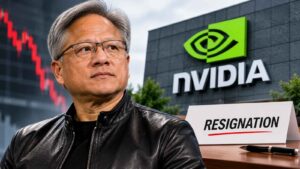
Nvidia stock has lost much of its historic rally. Nvidia shares fell for a second straight session on Wednesday as a broad AI selloff overshadowed Jensen Huang’s return as chief executive.
The chipmaker added close to $1 trillion in Nvidia market value on Monday, its largest one-day gain on record. Within two sessions, a large part of that move had reversed.
Key Facts
- Monday, Nov. 23: Nvidia’s board unanimously reinstated Huang as CEO, president and director, less than two weeks after his resignation. The stock closed up 31.5% at $165.05.
- Tuesday, Nov. 24: Shares fell 5.9% to $155.38. Huang apologized to staff at an all-hands meeting.
- Wednesday, Nov. 25: Nvidia extended losses in early trading, down roughly 5% to 8% at points, while the Nasdaq Composite fell more than 3%.
- Still open: An independent board investigation, an Nvidia Congress hearing in early December, and margin pressure.
Huang Reinstated as CEO: The Rally That Shook Global Markets
The board announced Huang’s reinstatement before the opening bell on Monday. In its filing with the SEC, Nvidia said it had received input from senior levels of the US government and was confident his return poses no national security risk.
Board chair Harvey Jones said the directors believe Huang is the right person to lead the company. Colette Kress, who served as interim CEO, returns to her full-time role as chief financial officer.
The market reaction to Huang’s reinstatement reached well beyond Nvidia stock. Wall Street had its best day since April 2025. Taiwan Semiconductor jumped about 14%, ASML rose roughly 9%, and AMD and Broadcom also gained. For a few hours, the AI trade looked repaired.
Why Nvidia Shares Fell After the Rally
Several pressures returned at once.
Governance questions. Huang left after reports of personal misconduct, including a relationship that US officials reportedly feared could carry counterintelligence risk. No espionage charges have been publicly established. The board’s independent committee says its investigation will run to conclusion, and it has also created a National Security and Export Control Committee.
Political scrutiny. Lawmakers from both parties criticized the speed of the reversal and Washington’s role in it. Huang is expected to face Congress in the first week of December, with reports pointing to a closed-door session on December 1 and a Senate hearing on December 3. President Trump, who publicly backed Huang’s return, has reportedly not ruled out a pardon, though no legal action against Huang has been announced.
A wider AI correction. Strategists note the AI selloff in tech stocks began before the leadership news. Investors are weighing debt-funded data center spending, higher interest rates and fresh tariff concerns. Neocloud names such as CoreWeave fell sharply this week, and the pressure spread across large technology stocks.
Huang Apologizes to Employees
At an hour-long all-hands meeting on Tuesday, Huang struck a somber tone. He told staff he had made serious mistakes, acknowledged violating the company’s code of conduct, and said he is in daily therapy. He also said HR will gather feedback on his conduct and report it to the board every month.
For leaders watching from outside, the meeting shows how a CEO’s return can depend as much on internal trust as on market approval.
The Business Is Still Growing
Nvidia’s operating numbers remain strong. Fiscal third-quarter revenue reached $115.84 billion, up 103.2% from a year earlier, and the company guided to $130 billion for the fourth quarter. Management said its new Vera Rubin platform generated nearly $20 billion in its first shipping quarter.
The risks are also visible. Gross margin guidance for the fourth quarter is 71% to 72%, down from 74.9% last quarter. Supply commitments total about $390 billion, and a few customers account for a large share of revenue.
What This Means for Business Leaders
- Key-person risk is a balance sheet issue. Nvidia’s value moved by hundreds of billions of dollars on one leadership decision.
- Governance is priced in. Analysts say Huang’s return reduces some uncertainty but is not a clean reset.
- AI spending plans need stress tests. If AI stocks stay volatile, partners and suppliers tied to the sector may feel it next.
What to Watch Next
- Huang’s appearances before Congress in early December.
- Any update from the board’s independent investigation.
- Whether fourth-quarter margins bottom as management expects.
- Whether the broader AI selloff stabilizes or spreads.
More coverage is on our Technology, Business and Markets desks. For official disclosures, see Nvidia’s investor relations page and the House Intelligence Committee.
FAQ
1. Why did Nvidia stock surge when Huang was reinstated as CEO?
The board reinstated Jensen Huang as CEO, which removed the most immediate leadership uncertainty. The stock rose 31.5% and added nearly $1 trillion in value.
2. Why are Nvidia shares falling after Jensen Huang’s return?
Governance and political risks remain, and a wider AI selloff is weighing on tech stocks.
3. Who ran Nvidia while Huang was out?
CFO Colette Kress served as interim CEO and now returns to her CFO duties.
4. Will Huang appear at the Nvidia Congress hearing?
Reports say he is due to appear in early December. Dates and formats have varied between reports, so check official committee announcements.