
Explore more expert insights on leadership, AI, entrepreneurship, finance, innovation, and business strategy at GlobeVox Leaders.
UPI charges and changes to the Merchant Discount Rate (MDR) have brought fresh attention to the cost of digital payments for businesses. While customers continue to use UPI without a direct charge, some higher-value merchant transactions now fall under a different payment cost structure. For small businesses, the real question is how much difference it could make to their daily operations.
For millions of small businesses across India, UPI has become part of everyday business.
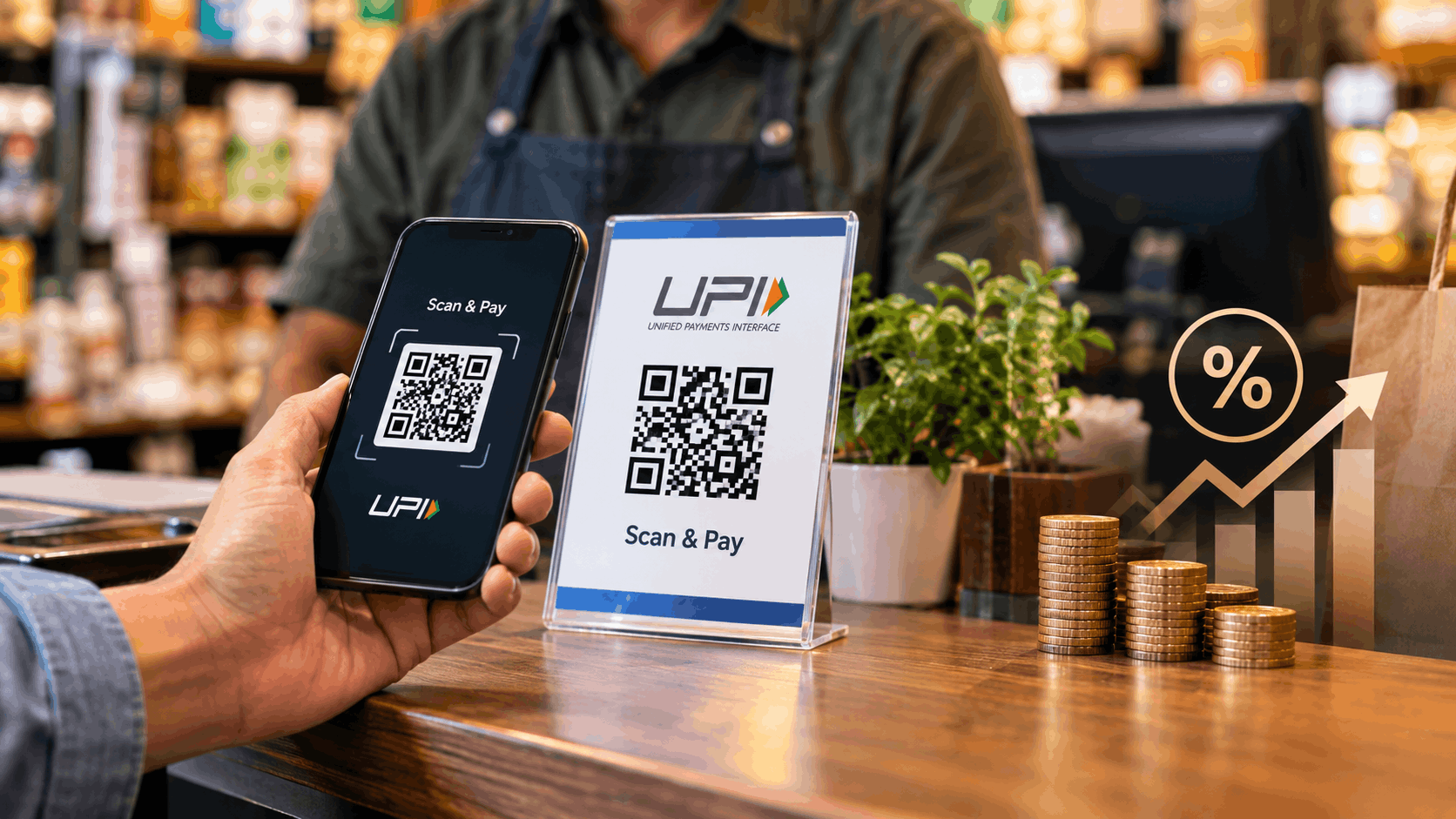
A QR code sits at the counter of a grocery store, restaurant, pharmacy, clothing shop or local service business. A customer scans it, makes the payment and the transaction is completed within seconds.
That simplicity has been one of the biggest reasons behind UPI’s growth in India. But changes around UPI charges for merchants are now making business owners look a little more closely at what happens after a digital payment is made.
What Are the New UPI Charges?
The Latest UPI Merchant Payment Framework
The latest framework does not introduce a direct charge for customers using UPI. Person-to-person payments remain free, while merchant transactions up to ₹2,000 continue without MDR.
Eligibility for Zero-MDR Treatment
Eligible small merchants receiving up to ₹1 lakh per month through UPI QR under the P2PM category also continue to receive zero-MDR treatment.
MDR on Higher-Value Transactions
The change concerns certain merchant transactions above ₹2,000. A Merchant Discount Rate of 0.4% applies to specified transactions, while transactions of ₹75,000 or more have an MDR cap of ₹300.
According to the government, around 96% of merchant transactions will remain unaffected by the change.
How Could UPI Charges Affect Small Businesses?
For many small shops, the immediate impact may be limited.
A grocery store that mainly receives payments of ₹200, ₹500 or ₹1,000, for example, is unlikely to see a significant change because these transactions remain below the ₹2,000 threshold.
Impact of Higher-Value UPI Payments
The situation can be different for businesses that regularly receive larger UPI payments.
Suppose a ₹10,000 transaction falls within the applicable MDR category. At 0.4%, the charge would be ₹40.
₹40 on one transaction may not seem significant. But if a business handles hundreds of similar transactions every month, the total payment cost can become something worth tracking.
Why Small Costs Can Add Up
For businesses operating with narrow margins, recurring expenses can make a difference even when each individual amount appears small.
What Should Small Business Owners Watch?
The important question is not simply whether UPI transaction charges exist.
Business owners need to understand which transactions fall under MDR, whether their business qualifies for the applicable exemption and how much they are paying in payment-related costs over time.
Tracking UPI Transaction Costs
The number and value of UPI transactions can vary considerably from one business to another.
A small retailer dealing mostly in low-value purchases may experience little change. A business receiving larger payments on a regular basis may need to include payment costs in its monthly calculations.
Why UPI Still Matters to Small Businesses
UPI has changed the way small businesses accept payments in India.
Digital Payments for Everyday Businesses
Businesses no longer need to depend entirely on cash or invest heavily in traditional card-payment infrastructure just to accept digital payments. For customers, making a payment has become quick and familiar.
That convenience is unlikely to disappear simply because the payment economics are changing.
Understanding Payment Economics
For merchants, however, understanding those economics is becoming more important.
A business owner may not notice a few rupees or a few dozen rupees on an individual transaction. Over hundreds or thousands of payments, the numbers can tell a different story.
The Cost Behind the QR Code
The QR code at a shop counter looks simple.
What Happens Behind a UPI Payment?
Behind it is a payment network involving banks, payment providers, technology infrastructure and transaction processing.
As UPI continues to handle an enormous volume of payments, the question of how that system is funded will remain relevant to businesses as well as the wider digital-payment ecosystem.
For customers, very little may look different when they scan a QR code.
What Merchants Should Understand
For small businesses, however, the payment notification is only the beginning. The amount that finally settles into the business account, and the costs associated with processing it, are worth understanding too.