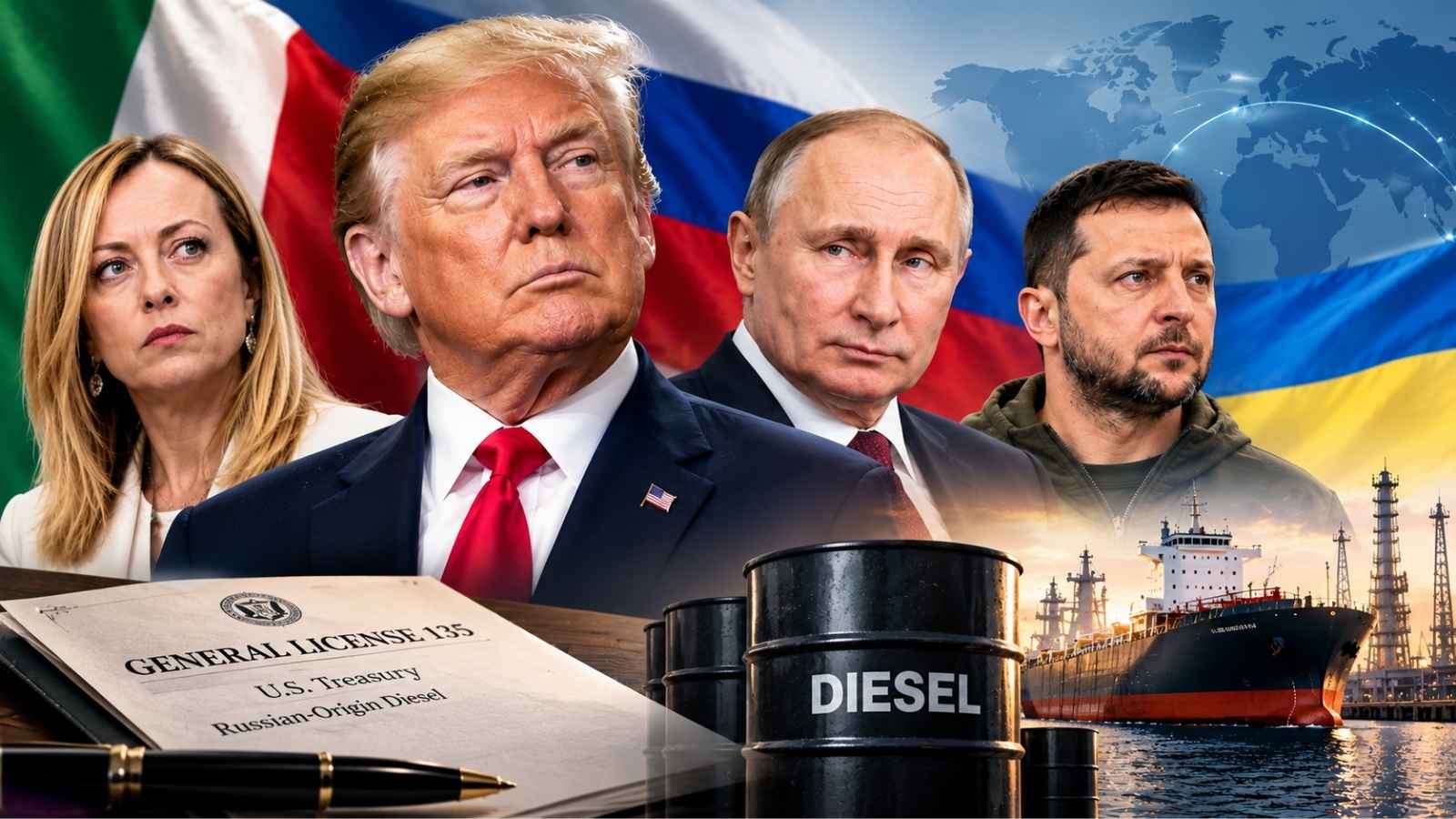
Italy’s prime minister says the arrangement hands Moscow money and legitimacy. Donald Trump says the fuel is meant for world markets, not for the United States. Ukraine, EU leaders and lawmakers in Washington are all pushing back.
US Russia Diesel Deal: What Was Agreed
The Announcement and the Volumes
The US Russia diesel deal was announced on Friday, October 9, after Donald Trump said he had held a highly successful discussion with Vladimir Putin. Russia, he said, would start by supplying more than 300,000 tonnes of diesel to global markets straight away. Another 500,000 tonnes would follow in November, and 1 million tonnes after that.
The Treasury Licence
The Treasury made it legal the same day. It issued General License 135, which allows the sale, delivery, offloading and import of Russian-origin diesel until April 7, 2027. The licence is temporary. It also changes nothing for Europe, because UK and EU sanctions on Russian diesel stay fully in force.
That last detail matters for everything that follows.
Why Washington Turned to Russian Diesel
Diesel prices have stayed near record highs after supply disruptions tied to the Iran war and tension around the Strait of Hormuz. Fuel costs are a political problem for the White House, with midterm elections due in November.
It is not the first time the administration has loosened the rules. In March, the Treasury issued a temporary licence allowing the sale of Russian oil cargoes that were already loaded on ships, running to April 11, as oil prices jumped.
Reactions to the US Russia Diesel Deal
Meloni Calls It a Very Risky Choice
Italian Prime Minister Giorgia Meloni spoke on Wednesday in the Italian parliament, ahead of an EU summit this week. She called the arrangement a very risky choice and said it cuts against the effort to push Putin toward the negotiating table with Ukraine.
Her Three Objections
Her case had three parts. The deal gives Moscow a form of legitimacy while bombs keep falling on Ukrainian cities. It brings in fresh revenue that can help pay for the war. And it quietly weakens sanctions. The outcome is uncertain, she said, but the risks are clear.
Her Call for an EU Negotiator
She also turned to Europe’s own position. Meloni said the 27 EU countries should name an authoritative figure to negotiate for the bloc over the war. She did not rule out giving the E3 group of Germany, France and Britain a formal mandate. If those three believe they can do better alone, she said, they should at least act on behalf of everyone.
Donald Trump Says the Diesel Is Not for the United States
Donald Trump answered the criticism on Tuesday. The diesel, he told reporters, is not being released to the United States. It is meant for the wider world market, which has been hit by high prices.
That sits awkwardly next to the licence itself. Legal commentators note that General License 135 expressly covers imports into the United States as well. Donald Trump’s original announcement also said the move would bring diesel prices down for Americans.
Ukraine Pushes Back
Zelensky’s Criticism
Volodymyr Zelensky hit back hard. He called the deal a birthday gift to Putin and wrote that gifts to Putin will not bring peace. Money from diesel sales, he said, means more money for the war. He also argued that diesel prices do not depend on Ukrainian attacks on Russian refineries and pointed to Hormuz as the real driver. And he suggested that the Ukrainian delegation, in Miami for talks with US officials when the deal landed, was used as a smokescreen.
The Energy Ceasefire Confusion
Then came Sunday. Donald Trump announced an energy ceasefire, a halt to strikes on each other’s energy systems by Ukraine and Russia. Zelensky said it was news to him. Kyiv said it would stop when Moscow does.
By Monday, Zelensky said Ukraine had not hit Russian energy sites for two days, while Russia kept attacking Ukrainian energy and civilian infrastructure, including a high-rise in Kyiv. The Kremlin has not confirmed it will follow the ceasefire. It has said Putin would be ready to stop strikes on election day if Kyiv genuinely intends to hold elections, a call Donald Trump has repeated.
Bipartisan Pushback in Washington
Opposition in Washington came quickly. Over the weekend, seven senators, four of them Republicans, asked the administration to reverse course. On Tuesday, twelve senators, six Republicans and six Democrats, signed a letter led by Richard Blumenthal urging Donald Trump to rescind the deal.
The letter argues that lifting sanctions on Russian diesel will barely lower US fuel prices while funding Moscow’s war and its ties with China, Iran and North Korea. It urges Donald Trump to use the sanctions powers in the Lindsey O. Graham Sanctioning Russia and Iran Act of 2026, named after the late senator who died in July. The timing is tight. The administration must decide within days whether to formally impose new sanctions on Moscow.
Lawmakers also pointed out that Congress banned Russian energy imports in 2022 to keep American dollars from financing the war.
Will the Russian Diesel Actually Lower Prices?
Demand: The Arithmetic
Analysts are sceptical, and the arithmetic explains why. The first 300,000 tonnes equals roughly 2.25 million barrels. The United States uses about 3.7 million barrels of diesel a day. The opening shipment is less than one day of American demand.
Supply: Russia’s Export Ban and Refinery Strikes
Supply on the Russian side is also unclear. Russia has an export ban on diesel by producers that runs to the end of October, and nobody has explained how it applies to the new arrangement. Ukrainian strikes on Russian refineries have tightened the market too. One analyst said the announced volumes, even if Russia can deliver them, do not move the needle much.
Sanctions Rules That Still Apply to the US Russia Diesel Deal
The licence only affects people and companies under US sanctions jurisdiction. It does not create a general international right to buy, finance, insure or ship Russian diesel. EU and UK rules are unchanged, which is exactly the gap Meloni’s warning targets.
A separate licence that allows talks on the sale of Lukoil assets expires on October 22 unless it is extended.
What to Watch Next
Several dates and questions will decide how this plays out. The EU summit this week will show whether Meloni’s call for a single negotiator gets traction. The administration’s sanctions decision is due within days. The first 300,000 tonnes will show whether Russia can deliver at all. Russia’s producer export ban expires on October 31. And the energy ceasefire needs to survive its first real test.
Beyond the Announcement
The split here is not a simple Washington versus Europe story. It runs through Washington itself, where members of Donald Trump’s own party signed the letter against the deal. It also runs through the facts. A leader who says the fuel is not for his own country has just signed a licence that allows exactly that.
Analysis
Strip away the politics and the deal rests on a thin bet. Russian diesel in these volumes will not fix a global shortage, but it will pay Moscow, and it arrives while Europe’s sanctions still say no. That gap is the real risk Meloni named. If the energy ceasefire collapses and Russian exports stay constrained, supporters of the deal will have little to show for the criticism it has absorbed. If prices do fall, the argument will shift again. For now, the numbers favour the sceptics.
Explore more expert insights, leadership stories, and business strategies at GlobeVox Leaders