
Explore more expert insights, leadership stories, and business strategies at GlobeVox Leaders
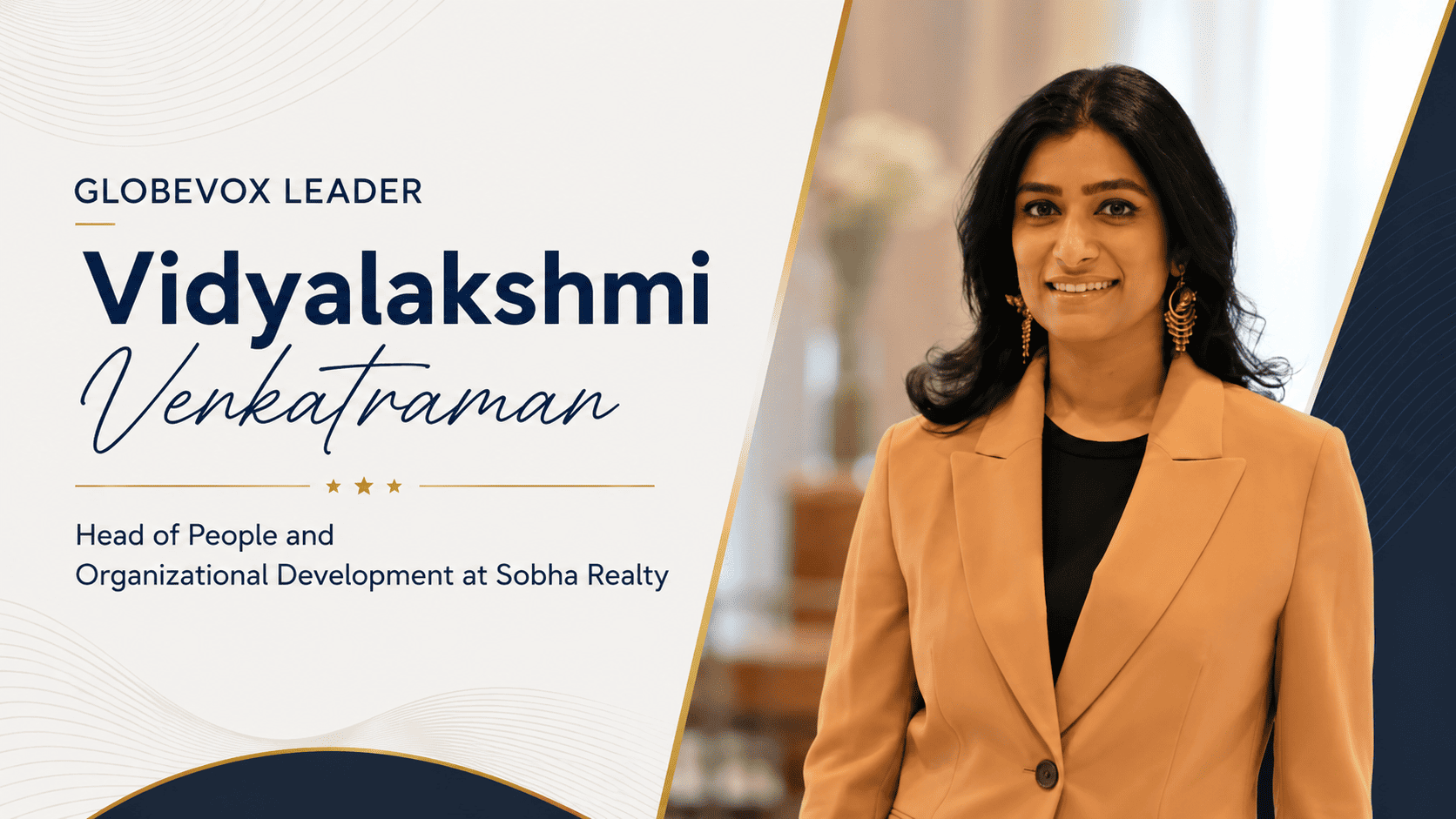
In the conventional narrative of leadership development, the starting point is usually diagnosis, identifying what is wrong with a leader, what gaps exist in their capability, what needs to be fixed. Vidyalakshmi Venkatraman built her career on a radically different premise: that the most transformational leadership development comes not from fixing deficits but from building on existing strengths, and that the language leaders use to think about themselves and their teams either enables or constrains what becomes possible.
As a Chartered MCIPD (Member of the Chartered Institute of Personnel and Development) and Gallup Certified Strengths Coach, Vidyalakshmi Venkatraman has spent years facilitating strengths-based leadership journeys, helping leaders and teams speak the language of strengths. Her core thesis, “The Key to Human Development is to Build on Who You Already Are”, has become the organising principle for how she approaches leadership transformation across some of India’s largest and most transformationally ambitious organisations.
Today, she works as a leadership development facilitator, strengths coach, and organisational transformation partner across some of India’s most significant enterprises, including Sobha Realty, one of the country’s leading real estate developers. She has designed and delivered strengths-based leadership programs at scale, trained multiple cohorts of leaders to shift from deficit-focused to strengths-focused thinking, and helped organisations operationalise what a strengths-based culture actually looks like beyond the language.
Her impact is visible not in individual placements or single transformations, but in the cascading effect of leaders who have learned to see their teams differently, and whose teams, in turn, perform differently as a result.
The Shift From Deficit to Strengths
The work Vidyalakshmi Venkatraman facilitates is rooted in three key takeaways that emerge consistently across her interventions: enhanced self-awareness, empathy and accommodation of others’ talents to win collectively, and the recognition that human development is built on who you already are rather than who you are not.
This represents a fundamental inversion of how most organisations have approached leadership development. The traditional model is psychometric profiling, identify weaknesses through assessment, then send leaders to training programs designed to address those gaps. It is a well-intentioned model that has produced, at best, marginal results. Research consistently shows that when leaders understand their emotional currency and learn to leverage the unique talents of their teams, collaboration improves and collective success becomes the natural outcome.
Vidyalakshmi Venkatraman’s model inverts this entirely. Rather than starting with what a leader lacks, start with what they bring. Rather than coaching leaders to be more like an idealized template, coach them to be more fully themselves, and to see the people around them with the same lens. The research supporting this approach is robust: people perform best when operating in their areas of natural talent rather than trying to overcome fundamental limitations. Teams perform best when they are built around complementary strengths rather than homogeneous competence.
But knowing this intellectually is different from being able to operationalise it. That is where Vidyalakshmi Venkatraman’s work becomes distinct.
Building Strengths-Based Cultures at Scale
One of Vidyalakshmi Venkatraman’s most significant organisational impacts came through her work with Sobha’s TALENT EXCEL Program, a transformative initiative designed to build an exceptional talent pipeline and cultivate a high-performance culture. The program was built not on deficit diagnosis but on the principle of identifying and developing the strengths that each leader already possessed.
The scale of this work is notable. The program brought together leaders across multiple Sobha entities to commit to building an exceptional talent pipeline under the vision of creating a world-class talent ecosystem. Rather than this being a peripheral HR initiative, it was positioned as central to how Sobha would compete, through the deliberate development of its people.
What distinguishes this kind of work from standard leadership development is the intentionality about culture. When leaders complete strengths-based development interventions, the most powerful shift is the language they begin using about their teams and themselves. A leader who has internalised strengths-based thinking no longer talks about “fixing” a team member. They talk about “optimising” the contribution that person can make. They move from “you’re weak at this” to “you’re exceptional at this, and here is where that particular strength can have the most impact.”
That shift in language is not semantic window-dressing. It is structural, it changes who people become when they are seen that way.
The Credentials and the Commitment
Vidyalakshmi Venkatraman’s credentials include Chartered MCIPD status, a designation that places her among the most qualified HR professionals in the world. The MCIPD is not a certificate awarded liberally; it requires demonstrated expertise, professional experience, and a body of work that meets rigorous standards.
Beyond the formal credentials, she holds Gallup Certification as a Strengths Coach, a credential that signals specific expertise in the CliftonStrengths framework and the ability to guide leaders through the profound process of understanding and operationalising their top five talent themes.
These credentials matter, but what matters more is how she has deployed them. Across multiple organisational interventions, including leadership development programs at companies like Mediterranean Shipping Company, Vidyalakshmi Venkatraman has been recognised consistently for the unwavering support and expertise she brings to making transformational sessions possible.
The consistent recognition across different organisations and different contexts suggests something important: this is not about charisma or presentation skill. It is about substance, about a coach who can help leaders genuinely see themselves and their teams differently, and who can hold them accountable to that new vision over time.
The Philosophy Behind the Practice
In her published writing, Vidyalakshmi Venkatraman has engaged directly with one of the most contested questions in professional life: does one need passion for their profession to be successful, or should the profession be one’s passion? The question itself reveals something about her orientation. She is not interested in platitudes about “following your passion.” She is interested in the actual complexity of how people relate to their work, how they build careers, and how they create meaning.
Her answer, grounded in strengths-based thinking, is that success comes when people are operating in their areas of natural talent, not when they are pursuing a pre-defined notion of passion. She frames this through the lens of individual talents: a person with “Activator” as a top strength (which she mentions as one of her own) will naturally activate differently than someone with “Ideation” or “Connectedness.” The goal is not to become someone else’s version of successful. It is to become the best version of who you actually are.
This philosophy, consistently applied across her coaching and development work, creates a coherent narrative. She is not a coach who imposes external models of excellence. She is a coach who helps leaders and teams discover and operationalise their own.
The Cascade Effect
One of the most important but least visible impacts of strength-based leadership development is what happens when one leader shifts, and then that leader’s entire team begins to shift. When a leader learns to see their team through a strength’s lens, understanding that each person has unique talents that should be leveraged, optimized, and celebrated, the entire dynamic of how work gets done changes.
This cascade effect is what Vidyalakshmi Venkatraman has been systematically creating across multiple organizations. She does not work in isolation with individual leaders. She builds programs that create systemic shift, where cohorts of leaders all internalise strengths-based thinking simultaneously, and then carry that thinking back into their teams.
The SOBHA TALENT EXCEL Program represents exactly this kind of cascade: a structured initiative designed to ensure that leadership development is not a one-time event but the beginning of a sustained journey toward building cultures where strength is the language everyone speaks.
The Work Ahead
The most significant opportunity Vidyalakshmi Venkatraman sees is not in individual coaching but in organisational scale. Her vision is to help organisations build entire ecosystems where strength-based thinking is not a training program but an operating principle, where how people are hired, developed, managed, and promoted is fundamentally rooted in what they bring rather than what they lack.
This requires rethinking how performance is measured, how potential is assessed, and how careers are built. It requires systems changes, not just mindset changes. And it requires leaders who can hold that vision while also being pragmatic about the pace of organisational change.
Vidyalakshmi Venkatraman has demonstrated she can do exactly that, across multiple large organisations, with cohorts of leaders at different levels, in different industries, with different organisational maturity around strength-based development.
That is the work that defines her career now: not coaching individual leaders to be better versions of themselves, but helping entire organisations reimagine what leadership development is, and what becomes possible when you build on strength instead of fixing weakness.
Vidyalakshmi Venkatraman, Chartered MCIPD, Gallup Certified Strengths Coach, is a leadership development facilitator and organisational transformation partner working with some of India’s largest enterprises.