

Which industries will grow fastest in the next five years?
The fastest growing industries over the next five years are artificial intelligence, renewable energy, hydrogen and fuel cells, biotechnology, healthcare analytics, anti-obesity drugs, cybersecurity, augmented and virtual reality, fintech and blockchain, and advanced manufacturing and robotics. Market forecasts for these sectors point to compound annual growth rates (CAGRs) from the low teens to well above 25%, far ahead of global GDP growth.
If you are choosing a career, planning a startup, or deciding where to put investment capital, knowing where demand is compounding fastest is a real advantage. This guide ranks ten high-growth industries using forecasts from major research publishers, explains what is driving each one, and flags the risks that headline growth numbers tend to hide.
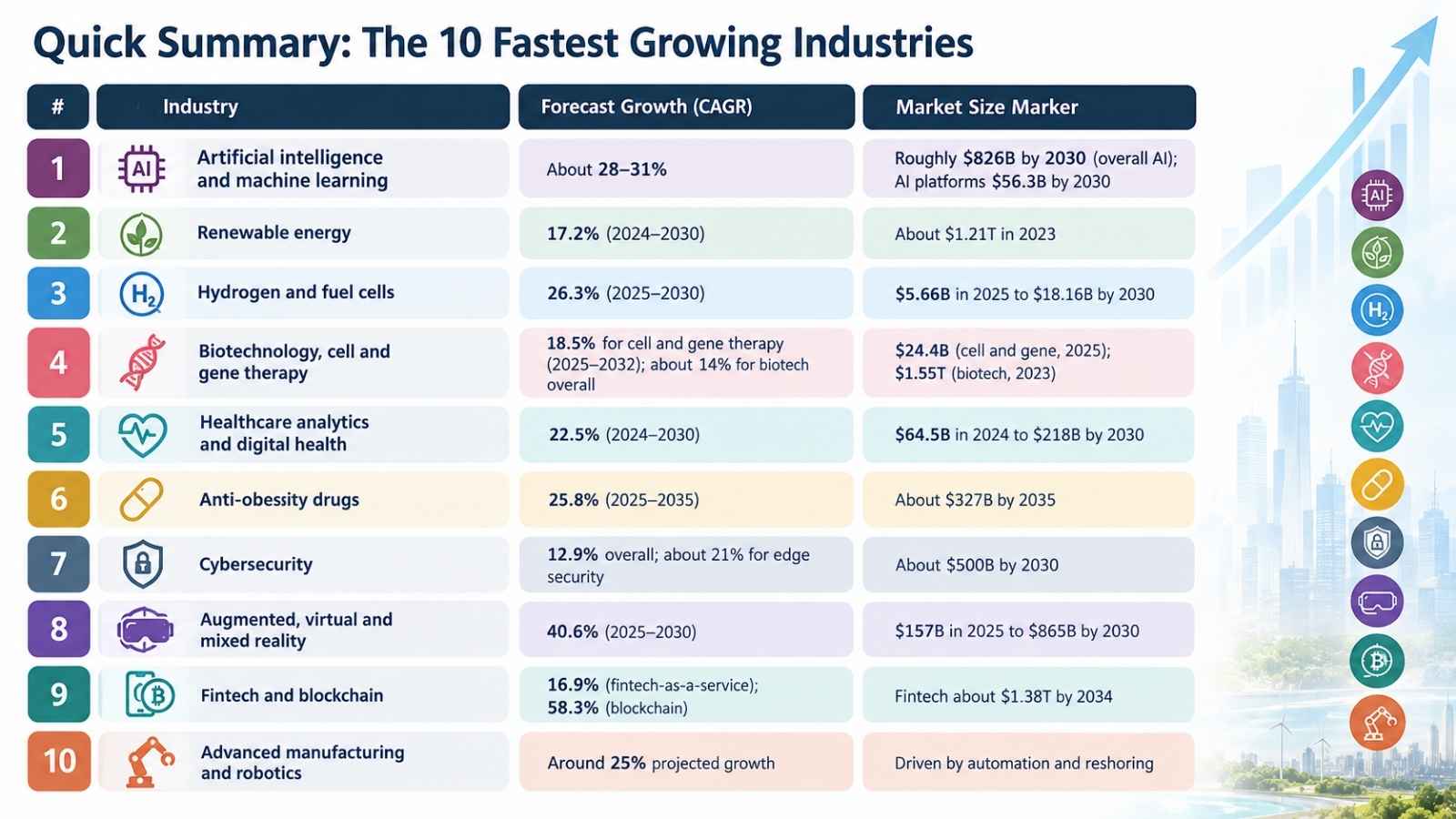
Quick summary: the 10 fastest growing industries
| Industry | Forecast growth (CAGR) | Market size marker |
| Artificial intelligence and machine learning | About 28–31% | Roughly $826B by 2030 (overall AI); AI platforms $56.3B by 2030 |
| Renewable energy | 17.2% (2024–2030) | About $1.21T in 2023 |
| Hydrogen and fuel cells | 26.3% (2025–2030) | $5.66B in 2025 to $18.16B by 2030 |
| Biotechnology, cell and gene therapy | 18.5% for cell and gene therapy (2025–2032); about 14% for biotech overall | $24.4B (cell and gene, 2025); $1.55T (biotech, 2023) |
| Healthcare analytics and digital health | 22.5% (2024–2030) | $64.5B in 2024 to $218B by 2030 |
| Anti-obesity drugs | 25.8% (2025–2035) | About $327B by 2035 |
| Cybersecurity | 12.9% overall; about 21% for edge security | About $500B by 2030 |
| Augmented, virtual and mixed reality | 40.6% (2025–2030) | $157B in 2025 to $865B by 2030 |
| Fintech and blockchain | 16.9% (fintech-as-a-service); 58.3% (blockchain) | Fintech about $1.38T by 2034 |
| Advanced manufacturing and robotics | Around 25% projected growth | Driven by automation and reshoring |
Figures come from different publishers, time windows and definitions, so treat them as directional rather than perfectly comparable.
How we chose these industries
We reviewed recent industry rankings and market reports from sources including HubSpot’s Hypergrowth Startup Index, Insider Monkey’s analysis of Grand View Research and Fortune Business Insights forecasts, MarketResearch.com’s roundup of publisher reports, Gedeth Network’s 2026 sector outlook and IBISWorld’s global revenue-growth rankings. We then filtered for four things:
- A strong forecast growth rate. Sectors forecast to compound at double-digit rates through 2030 and beyond.
- Real scale. Some niches post eye-catching percentages from a tiny base. For example, neuromorphic computing is forecast to grow nearly 90% a year, but from a market of only about $28.5 million in 2024. We favoured industries where high growth meets meaningful size.
- Clear demand drivers. Ageing populations, decarbonisation policy, cyber threats and automation needs are structural forces, not fads.
- Staying power. We looked for demand that should still be there at the end of the forecast period, not a one-year spike.
A caution before the list: a CAGR is a forecast, not a promise. Different research firms define the same industry differently, which is why two reports on the same sector can disagree by several percentage points.
1. Artificial intelligence and machine learning
Forecast growth: about 28–31% a year
AI tops almost every list of fastest growing industries, and the numbers explain why. HubSpot’s startup research puts AI’s forecast growth at a 28.46% CAGR through 2030, with the overall market expanding from roughly $50 billion in 2023 to more than $184 billion in 2024 and potentially reaching $826 billion by 2030, citing Statista. For the narrower AI platforms segment, a report listed on MarketResearch.com values the market at $11.3 billion in 2024 and forecasts $56.3 billion by 2030, a 30.8% CAGR.
What is driving it:
- Generative AI is being embedded into core business strategy; the same report notes that over 80% of companies are building AI into their plans.
- Automation lets businesses cut repetitive work and redeploy teams to higher-value tasks.
- Data volumes from connected devices and digital channels keep growing, and AI platforms are built to process them.
- Investment is enormous. Gedeth Network projects global AI investment reaching about $500 billion in 2026, and cites PwC’s estimate that AI could lift global GDP by up to 15% by 2035.
Where the opportunities are: AI-powered SaaS products, implementation consulting, predictive analytics, and AI inside other industries such as healthcare, finance and logistics.
Risks to watch: talent shortages, data privacy, ethical and regulatory scrutiny, and the possibility that some segments are priced ahead of their revenue.
2. Renewable energy and clean technology
Forecast growth: 17.2% a year (2024–2030)
Grand View Research estimates the global renewable energy market at about $1.21 trillion in 2023 and forecasts a 17.2% CAGR through 2030. The International Energy Agency expects global renewable electricity generation to rise by nearly 90% by 2030 compared with 2023.
What is driving it:
- Decarbonisation policy and net-zero commitments in most major economies.
- Falling costs for solar panels and wind technology, which improve the economics against fossil fuels.
- Rising electricity demand, including from data centres that power AI.
- Solar leads the pack, accounting for about 31% of the market in 2023.
Gedeth Network expects China, the United States and India to lead, with Germany, Spain and other European countries continuing to grow. Beyond generation, the supporting ecosystem is expanding too: battery storage, grid modernisation, and electrification.
Where the opportunities are: solar and wind development, energy storage, grid technology, and clean-tech startups. HubSpot highlights Generate Capital, which has raised over $7 billion by financing everything from storage to EV charging, as an example of diversification paying off.
Risks to watch: high upfront capital costs, grid infrastructure gaps, and dependence on government incentives.
3. Hydrogen and fuel cell technology
Forecast growth: 26.3% a year (2025–2030)
Hydrogen is moving from pilot projects to commercial deployment. MarketsandMarkets projects the global fuel cell market will grow from $5.66 billion in 2025 to $18.16 billion by 2030, a 26.3% CAGR. Industry commentary suggests hydrogen engines and fuel cells could grow at over 25% as transport and heavy industry look for ways to decarbonise.
What is driving it:
- Supportive policy and decarbonisation targets.
- Hydrogen infrastructure being built out.
- Better efficiency, new materials and falling costs in fuel cell technology.
- Hard-to-electrify uses, such as heavy transport and industrial processes.
Where the opportunities are: fuel cell manufacturing, green hydrogen production, refuelling infrastructure and stationary power for data centres and industry.
Risks to watch: the market is still small, costs remain high compared with alternatives, and progress depends on policy and infrastructure that is still being built.
4. Biotechnology, cell therapy and gene therapy
Forecast growth: 18.5% for cell and gene therapy; about 14% for biotech overall
The broad biotechnology market was valued at about $1.55 trillion in 2023 and is forecast by Grand View Research to grow at close to 14% a year through 2030. Within it, the sub-sectors are growing even faster. Coherent Market Insights values cell and gene therapy at $24.4 billion in 2025 with an 18.5% CAGR through 2032, while CAR-T cell therapy is forecast at over 35% a year in some reports. Related research tools are climbing too: 3D cell culture is forecast to grow at about 19.8% a year to roughly $8.16 billion by 2029.
What is driving it:
- Treatments that act at the genetic and cellular level are reaching patients.
- Government support for modernised regulation, faster approvals and standardised clinical research.
- AI-assisted drug discovery and genomics.
- Ageing populations and rising chronic disease.
Asia Pacific is expected to grow fastest, while North America holds the largest share.
Where the opportunities are: biotech startups, contract research and manufacturing, genomics tools and personalised medicine.
Risks to watch: very high R&D costs, long regulatory timelines and the binary nature of clinical trial outcomes.
5. Healthcare analytics and digital health

Forecast growth: 22.5% a year (2024–2030)
Healthcare is turning into a data business. Global Industry Analysts estimates the healthcare analytics market at $64.5 billion in 2024, growing to $218 billion by 2030 at a 22.5% CAGR, with financial analytics at 23.8% and clinical analytics at 22.4%. Grand View Research’s narrower healthcare predictive analytics estimate is even higher, at 24.4%. Telemedicine adds to the picture, forecast by Fortune Business Insights to grow from $87.41 billion in 2022 to $286.22 billion by 2030 (17.2% CAGR). Allied Market Research projects the wider healthtech sector at $3.14 trillion by 2033, a 13.1% CAGR.
What is driving it:
- Pressure to cut costs without hurting care quality.
- Predictive models that spot high-risk patients early and reduce hospital readmissions.
- Growing public and private healthcare spending and a shift to preventive care.
- Remote care that became normal during the pandemic.
Where the opportunities are: clinical decision-support software, hospital operations tools, telehealth platforms, robot-assisted surgery (forecast at 13.54% a year) and AI diagnostics.
Risks to watch: patient data privacy rules, integration with legacy hospital systems and clinician adoption.
6. Anti-obesity drugs
Forecast growth: 25.8% a year (2025–2035)
Few markets have changed as quickly as weight-loss medicine. Market Research Future forecasts the global anti-obesity drugs market will reach about $327 billion by 2035, a 25.82% CAGR over 2025–2035. The shift is led by GLP-1 receptor agonists and newer dual-receptor drugs such as tirzepatide, which are producing weight loss at levels earlier treatments could not match. Eli Lilly and Novo Nordisk are the main drivers, and both are targeting fast-growing obesity markets in Asia and Latin America.
What is driving it:
- Rising global obesity rates.
- Clinically effective new drugs and a pipeline of follow-ons.
- Demand for non-invasive weight management and metabolic health improvement.
- Geographic expansion into new markets.
Where the opportunities are: drug development, manufacturing capacity, supply chain, digital coaching and adherence tools, and diagnostics.
Risks to watch: pricing pressure, insurance coverage decisions, supply constraints, patent competition and long-term safety data.
7. Cybersecurity
Forecast growth: about 12.9% overall; roughly 21% for edge security
Every other industry on this list increases the attack surface, so cybersecurity grows alongside them. Grand View Research forecasts the global market at a 12.9% CAGR, reaching about $500 billion by 2030. A narrower segment is growing faster: Expert Market Research puts edge security at roughly $23 billion in 2024 and forecasts $155 billion by 2034, a 21% CAGR, as more data processing moves to devices and the network edge.
What is driving it:
- More cyberattacks as e-commerce, smart devices and cloud services spread.
- Remote and hybrid work widening the perimeter that has to be defended.
- Stricter privacy and compliance rules.
- Large enterprises demanding stronger cloud security.
Asia Pacific is forecast to grow quickest, at over 15% a year in some estimates.
Where the opportunities are: cloud security, identity and password management, AI-powered threat detection, ethical hacking and consulting. HubSpot points to 1Password and Abnormal Security as examples of startups that reached multi-billion-dollar valuations.
Risks to watch: a persistent skills gap, fast-evolving threats and crowded product categories.
8. Augmented, virtual and mixed reality
Forecast growth: 40.6% a year (2025–2030)
Mordor Intelligence estimates the combined VR, AR and mixed reality market at $157.44 billion in 2025, reaching $865.36 billion by 2030 at a 40.61% CAGR. Big technology companies including Apple, Google, Microsoft and Amazon continue to invest heavily in the hardware and software behind it.
What is driving it:
- Commercial and enterprise use, such as training, design, remote assistance and retail visualisation, not only gaming.
- Improvements in headsets and AR glasses.
- Neighbouring technologies such as neuromorphic computing, which aims for faster and more energy-efficient processing at the edge.
Where the opportunities are: enterprise training platforms, spatial computing software, hardware components and content tooling.
Risks to watch: consumer adoption has historically been slower than forecasts, and hardware costs and comfort remain hurdles.
9. Fintech and blockchain
Forecast growth: 16.9% (fintech-as-a-service); 58.3% (blockchain)
Financial services are being rebuilt on software. Gedeth Network projects the fintech market will reach $1.38 trillion by 2034, and a Market Research analysis expects fintech-as-a-service to hit $681.6 billion by 2028 at a 16.9% CAGR. HubSpot cites a blockchain market growing at 58.3% a year to about $306 billion by 2030, and cryptocurrency at 13.1%. The broader financial services industry is more modest, at around 7.2% a year through 2033, which shows how much faster the technology layer is moving.
What is driving it:
- Mobile payments, digital banking, online insurance and robo-advisory replacing branch-based models.
- Traditional lenders adopting fintech infrastructure.
- Financial inclusion in emerging markets.
- Blockchain’s value for secure, traceable data beyond finance, including telecoms.
Where the opportunities are: payments infrastructure, digital lending, embedded finance, compliance tech and enterprise blockchain.
Risks to watch: regulation, fraud, and volatility, especially in cryptocurrency.
10. Advanced manufacturing and robotics
Forecast growth: around 25% projected
Gedeth Network projects advanced manufacturing to grow about 25%, powered by automation, robotics, AI and smart supply chains. The shift is structural: companies are reshoring and nearshoring production to reduce dependence on distant suppliers, and factories are becoming more digital and connected.
What is driving it:
- Labour shortages and the need for precision and productivity.
- Supply chain resilience after years of disruption.
- Smart manufacturing software and AI-driven forecasting.
- Leading robotics nations, including Japan, South Korea, Germany and the United States, pushing industrial automation forward.
Where the opportunities are: industrial and service robots, automation software, smart factory systems and integration services.
Risks to watch: high capital costs and the difficulty of integrating new systems with existing plants.
Honourable mentions other fastest growing industries to watch

Several sectors just missed the top ten, either because forecasts are less consistent or growth is slower from a larger base.
- Digital education (EdTech): Persistence Market Research forecasts the sector growing from $19.2 billion in 2023 to $95.7 billion by 2030, a 25.8% CAGR, driven by internet access and demand for lifelong skills.
- Data science platforms: Fortune Business Insights projected 29% annual growth to roughly $484 billion by 2029.
- E-commerce logistics: forecast at 18.2% a year to about $1.4 trillion by 2030, with last-mile delivery and AI-driven routing leading.
- Cloud computing and SaaS: steadier but still strong, with software at 11.3% and SaaS at about 12% a year through 2030.
- Electric vehicles and charging: supported by incentives and battery advances, with strong opportunities in charging infrastructure and battery recycling.
- Sustainable agriculture and food technology: precision farming and smart agriculture, forecast at 13.7% a year, as climate pressure meets a growing population.
- Infrastructure in India: the government’s capital investment outlay in the 2026 budget was Rs 11.21 lakh crore, or 3.1% of GDP, up from 1.7% of GDP over fiscal 2016–2020, according to Crisil. It supports the goal of a $30 trillion economy by 2047, with growth expected in renewables, green hydrogen, grid modernisation, data centres and multimodal logistics.
- Defence shipbuilding: IBISWorld’s global ranking, which measures revenue growth rather than forecast CAGR, recorded 12.2% growth in 2024–2025 for military shipbuilding and submarines amid rising geopolitical tensions.
Fastest growing versus biggest: why the difference matters
A small industry can post a huge percentage while adding little in absolute dollars. IBISWorld’s global rankings show how different the picture looks when you measure recent revenue growth rather than forecasts. Reinsurance carriers topped its 2024–2025 list at 16.6%, followed by military shipbuilding at 12.2% and tourism at 11.6%. These are older, larger industries growing steadily, not emerging technologies.
The practical takeaway is to check both numbers: the growth rate and the dollar value of the market. The best opportunities tend to combine strong growth with enough scale to support many employers and companies.
Common themes across the fastest growing industries
- AI is a multiplier. It appears inside healthcare, cybersecurity, manufacturing, fintech and clean energy. Growth in one area feeds the others.
- Energy demand is rising on two fronts. Electrification and data centres need more power, which pulls renewables, storage and hydrogen forward together.
- Demographics matter. Ageing populations and rising chronic disease sustain demand across biotech, analytics, telehealth and obesity treatment.
- Security and trust become products. As systems digitise, cybersecurity and compliance grow in step.
- Resilience is now a strategy. Reshoring, automation and infrastructure spending all reflect a push for supply chains that are harder to disrupt.
How to use this list
- If you are choosing a career: look for roles where growth meets skills you can build. Data science, cybersecurity, healthcare analytics and automation engineering all appear in multiple fastest growing industries, which gives you options if one segment cools.
- If you are starting a business: consider building for these industries rather than inside them. HubSpot notes that many startups win by selling tools to other businesses, such as software for data, security or compliance, instead of competing for consumers.
- If you are investing: diversify. A fast-growing industry does not guarantee profitable companies, and valuations can run ahead of fundamentals. This article is general information, not financial advice, and you should consult a qualified adviser before making investment decisions.
Conclusion
Over the next five years, the fastest growth is concentrated where technology, demographics and energy transition meet: AI, renewables and hydrogen, biotech and healthcare analytics, anti-obesity drugs, cybersecurity, immersive technology, fintech and advanced manufacturing. They differ in scale and risk, but they share durable demand drivers.
The smartest approach is to treat the forecasts as a map rather than a guarantee. Pick the industry that fits your skills and risk tolerance, check the numbers against more than one source, and revisit the picture each year, because the rankings will keep shifting.
Frequently asked questions
1. Which industry will grow the fastest in the next five years?
By forecast CAGR among large categories, artificial intelligence is the most consistent answer, at roughly 28–31% a year. Augmented and virtual reality shows a higher forecast, at about 40% a year, but from a smaller base and with a history of slower-than-expected adoption.
2. What are the fastest growing industries for jobs?
AI and data science, cybersecurity, healthcare and biotechnology, and renewable energy are the most commonly cited. Each combines strong market growth with persistent skills shortages, which tends to support hiring and wages.
3. Is renewable energy still a good industry to enter?
Forecasts point to growth of about 17% a year through 2030, with global renewable electricity generation expected to rise by nearly 90% compared with 2023. Opportunities extend beyond generation into storage, grid technology and hydrogen. Policy changes and high upfront costs are the main risks.
4. Which healthcare sectors are growing fastest?
Anti-obesity drugs, cell and gene therapy, healthcare analytics and telemedicine are among the fastest-growing segments, with forecast CAGRs between roughly 17% and 26% depending on the report.
5. Are traditional industries going to disappear?
No. Established industries tend to evolve rather than vanish, adopting AI, automation and digital tools to stay competitive. Financial services, manufacturing and agriculture all appear on this list because technology is reshaping them.
6. Is it too late to enter these industries?
Most of the sectors above are still early in their growth curves, with large parts of their forecast expansion ahead. The harder question is not whether there is room, but where you can offer a skill or product that is hard to replace.
7. How reliable are industry growth forecasts?
Use them as directional guides. Forecasts depend on how each firm defines an industry, which years it covers, and what assumptions it makes about policy and technology. Cross-checking several sources, as we have done here, gives a more balanced picture.
Explore more expert insights, leadership stories, and business strategies at GlobeVox Leaders