

You started the company. You wrote the first line of code, closed the first customer, and answered every support ticket at midnight. Then the team grew, the stakes rose, and a quiet question appeared: am I actually the right person to run this?
If that sounds familiar, you are in the middle of the founder to CEO transition, one of the hardest shifts in business. It is also one of the most important. Plenty of startups with great products stall because the person who built the company never learned to lead it.
This guide explains what changes when you are moving from founder to CEO, the mistakes that trip up even brilliant founders, and a practical 90-day plan to make the shift with confidence.
Founder vs. CEO: What Is the Real Difference?
A founder creates something from nothing. A CEO builds a system that works without them in every room.
The founder role rewards speed, intuition, and hands-on effort. The CEO role rewards clarity, delegation, and judgment. Neither is better, but they require different skills, and the skills that got you to ten employees rarely get you to a hundred. Bain & Company’s analysis of what makes founder-led companies outperform shows that the best leaders keep the founder’s ownership mindset while building the structure to scale it. The exclusive interviews on GlobeVox Leaders show the same pattern in founders across industries.
| Founder mode | CEO mode | |
| Focus | Building the product | Building the company |
| Decisions | Made personally and fast | Made through people and process |
| Success metric | Personal output | Team and company results |
| Information | You know everything | You rely on reliable reporting |
| Time horizon | This week | This quarter and next year |
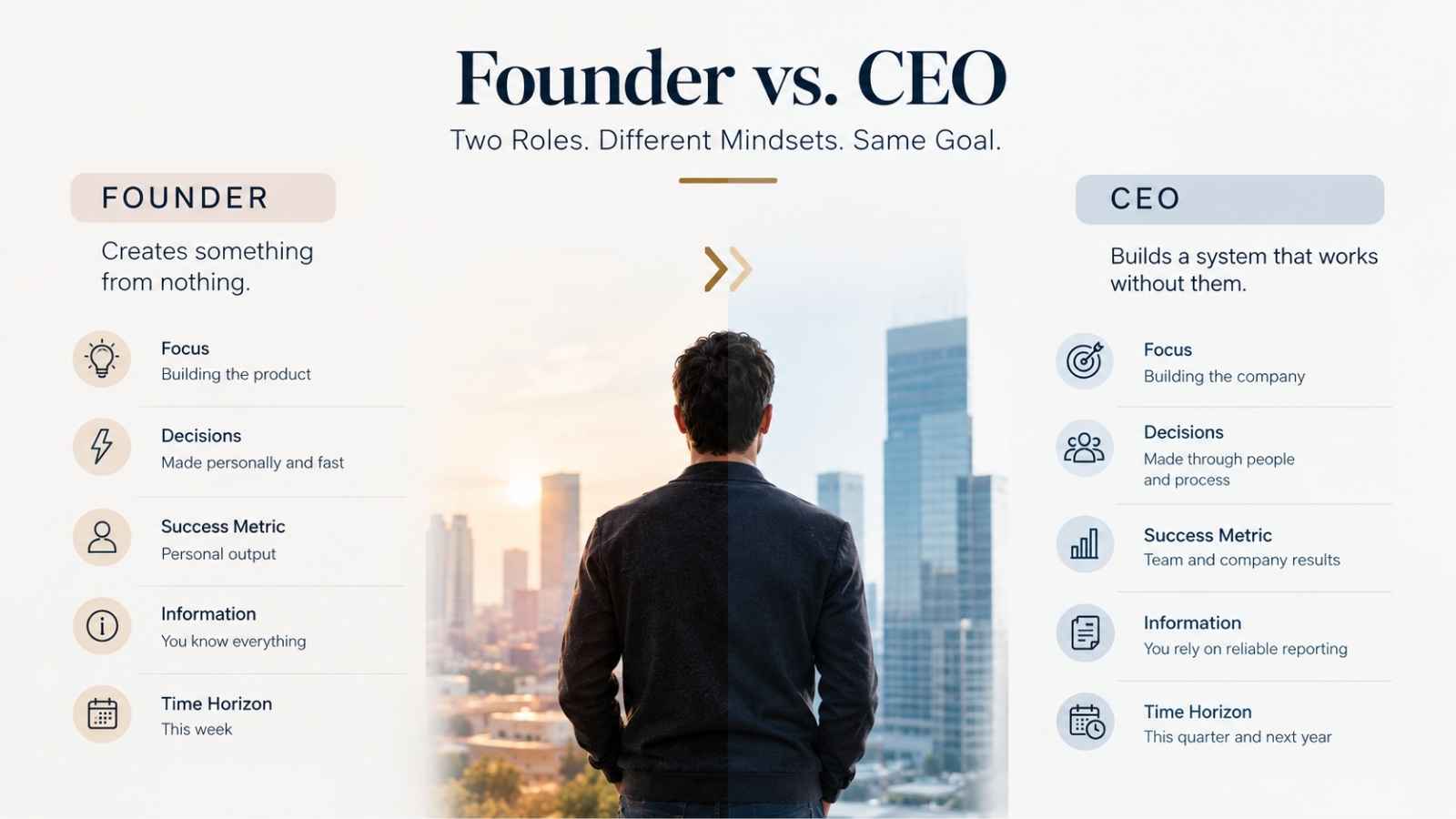
Understanding this gap is the first step in transitioning from founder to CEO deliberately instead of by accident.
Signs You Are Ready for the Founder to CEO Transition
You may be at the transition point if:
- You are the bottleneck on most decisions
- Your calendar is full, but strategic work never gets done
- Your team waits for your approval before acting
- You still handle tasks you hired people to own
- Growth is slowing even though demand is strong
- You feel like you are working harder while the company moves slower
If you nodded at three or more, the transition is not optional anymore. It is the next stage of growth. If slowing growth is your main symptom, our breakdown of business growth trends and strategies shaping 2026 can help you see what scaling companies are doing differently.
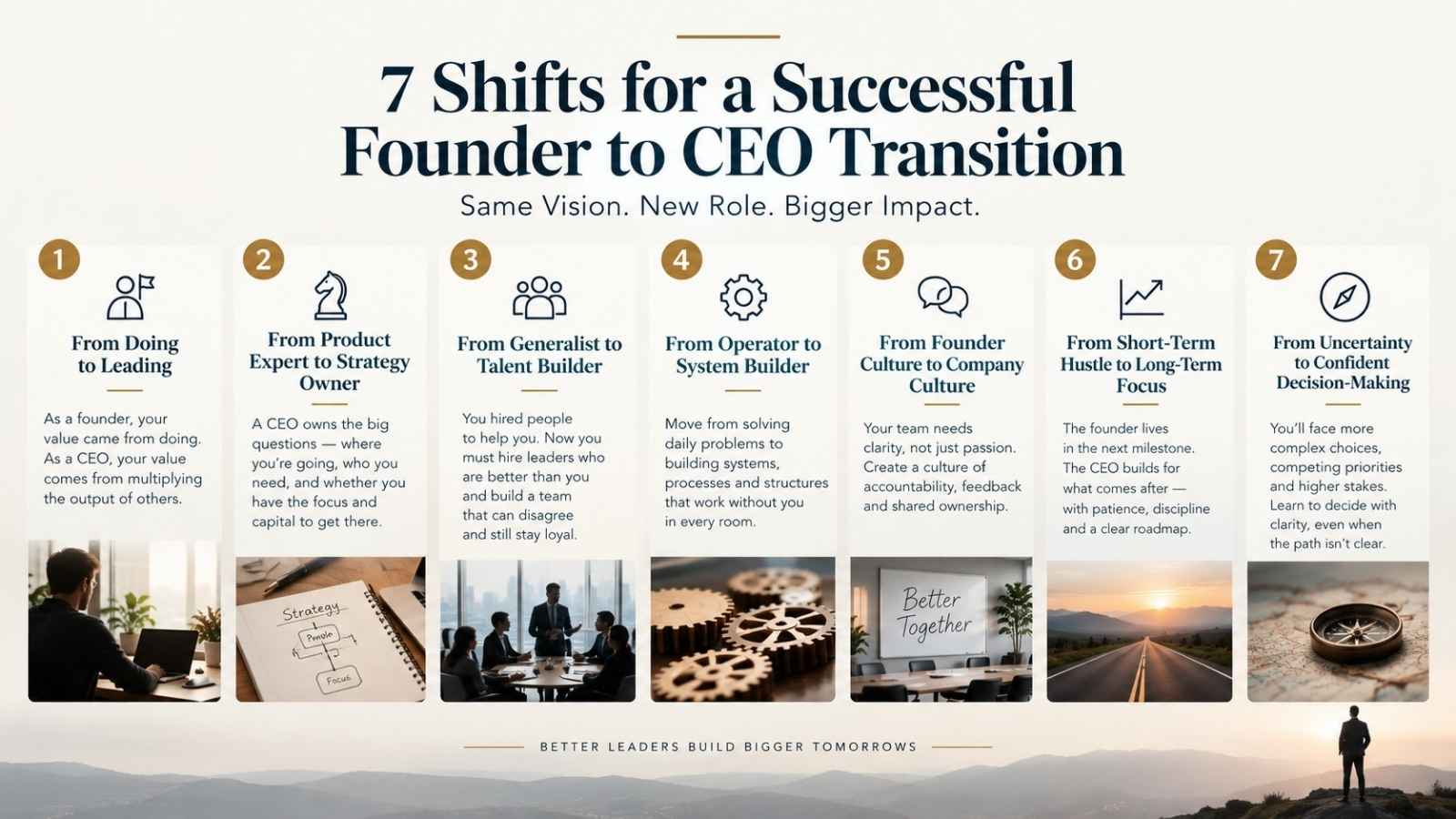
7 Shifts for a Successful Founder to CEO Transition
1. Shift from Doing to Leading
This is the hardest shift. As a founder, your value came from doing. As a CEO, your value comes from multiplying the output of others.
A simple test: if a task can be done 80% as well by someone else, hand it off. That 20% gap is the price of scaling, and it shrinks quickly with good coaching. Software entrepreneur Jason Cohen goes a step further in his essay why scaling by delegation alone isn’t enough, arguing that the real job is building teams, not just assigning away small tasks.
2. Shift from Product Expert to Strategy Owner
A CEO owns three questions that nobody else can answer for them:
- Where are we going, and why?
- Who do we need to get there?
- Do we have the money and focus to make it happen?
If you are spending most of your week in the weeds of the product, you are probably neglecting these three. For a framework you can apply right away, read our digital transformation strategy guide for business leaders.
3. Shift from Generalist to Talent Builder
Early on, you hired people to help you. Now you must hire people who are better than you at their function. Great CEOs build a leadership team strong enough to disagree with them and still be loyal to the mission. Hiring leaders is a craft of its own, as seen in this conversation with executive search leader Jaidin McCann on people-first leadership.
Practical steps:
- Hire a head of every critical function before you are desperate
- Define the outcomes you expect, not the tasks
- Let new leaders own decisions in their area, even when you would choose differently
4. Shift from Intuition to Systems
Gut instinct built the company. Systems will scale it. As you move from founder to CEO, put simple structures in place:
- Weekly leadership meeting with a fixed agenda
- Quarterly goals such as OKRs, visible to everyone
- A single dashboard with the five to ten numbers that matter
- Documented processes for hiring, onboarding, and customer handoffs
Systems are not bureaucracy. They are how you keep quality high without being everywhere. Our Apple case study on design, ecosystem and focus is a strong example of a company that scaled by running hardware, software and services as one disciplined system.
5. Shift from Being Liked to Being Clear
Founders often lead through friendship and shared grind. That works at five people. At fifty, clarity matters more than closeness.
Be direct about priorities, expectations, and performance. Have the hard conversations early. Teams do not resent clear leaders. They resent confusion. Our cover stories on global business leaders regularly highlight how top executives balance warmth with direct, accountable leadership.
6. Shift from Holding Information to Sharing Vision
Your team cannot execute a strategy they cannot see. A strong CEO becomes the company’s chief storyteller, repeating the mission, the strategy, and the priorities until they feel almost boring to say.
When employees can explain the plan in their own words, you know the message has landed.
7. Shift from Personal Identity to Company Identity
This one is emotional. Many founders tie their self-worth to the company’s every win and loss, and to being the hero who saves the day. Transitioning from founder to CEO means accepting that the company must be able to succeed without your constant rescue.
That is not losing control. It is building something that outlasts you. Harvard Business Review makes the same point in The Founder’s Final Act, which argues that founders who plan early protect both their legacy and the business. For a founder who built a firm early and led it through growth, see our profile of Alyssa Klimuszka, the HR leader who built her own firm.
Common Mistakes When Moving from Founder to CEO
Avoid these traps that slow many first-time CEOs:
- You hire talent, then redo their work. Good people leave.
- The opposite error: handing off so completely that you lose touch with reality.
- Hiring too late. Waiting until a role is on fire leads to rushed, poor choices.
- Ignoring culture. Culture forms whether you shape it or not. Our Starbucks case study shows how a founder-era culture can be carried into a global company.
- Going it alone. CEO is a lonely job. Without a coach, mentor, or peer group, blind spots grow.
- Neglecting your own energy. Burnout is a business risk, not a personal failing.
Your 90-Day Founder to CEO Transition Plan
Days 1 to 30: Audit and Reset
- Track your time for two weeks and mark each task as founder work or CEO work
- List every task you could delegate, and to whom
- Ask five trusted people for honest feedback on your leadership
- Write down your top three priorities for the next year
Days 31 to 60: Delegate and Build
- Hand off at least three recurring responsibilities with clear outcomes
- Start a weekly leadership meeting and a one-page company dashboard
- Identify the one or two leadership hires that would change the most
- Hold regular one-on-ones with direct reports
Days 61 to 90: Lead and Scale
- Share the strategy with the whole company, and repeat it often
- Set quarterly goals tied to your top priorities
- Spend at least half your week on CEO-level work: strategy, people, capital, and culture
- Review progress, and adjust what is not working
How Long Does the Founder to CEO Transition Take?
Most founders need 12 to 24 months to fully grow into the CEO role, though meaningful change often shows up in the first quarter. The speed depends on your company’s growth rate, your willingness to delegate, and the quality of support around you.
Do You Need a Coach or Mentor?
Often, yes. The best founders treat leadership as a skill to be trained, just like sales or engineering. An experienced coach, board member, or peer group of other CEOs gives you perspective you cannot get from inside your own company. SeedLegals co-founder Anthony Rose and executive coach Craig Revord cover this in their talk on building the mindset to scale your startup. You can also learn from peers by reading the leader stories in the GlobeVox Leaders magazine.
Final Thoughts
The founder to CEO transition is not about giving up what made you great. It is about growing into the leader your company needs next. Founders who make this shift stop being the busiest person in the room and start being the person who makes the whole room better.
Start small this week: pick one task to delegate, one system to build, and one honest conversation to have. Each step takes you further from founder mode and closer to a CEO your team, your investors, and your company can count on.
Frequently Asked Questions
1. What is a founder to CEO transition?
It is the shift from being the hands-on builder of a startup to leading it as a strategic executive. It means moving from doing the work to setting direction, building teams, and creating systems for growth.
2. Why is moving from founder to CEO so hard?
The skills that make a great founder, such as speed, personal effort, and deep product focus, are different from those that make a great CEO. You must let go of habits that once made you successful, which is uncomfortable.
3. Should every founder become CEO?
Not always. Some founders choose to become CTO, chief product officer, or another role and bring in an outside CEO. What matters is that the company has the right leader for its stage, and an honest self-assessment helps you decide.
4. What skills does a founder need to become a CEO?
Key skills include delegation, strategic thinking, hiring and developing leaders, financial literacy, clear communication, and the ability to build repeatable systems.
5. When should a founder start transitioning to CEO?
Start as soon as you notice you are the bottleneck, which is often between 10 and 30 employees. Starting early is easier than fixing a company that has already outgrown its founder.
Ready to share your leadership journey? Explore more stories on GlobeVox Leaders,