Part 1: The Genesis – Understanding Starbucks’ Foundation (1971-1987)
1.1 The Original Vision
Unlike most modern businesses, Starbucks wasn’t founded with aspirations of global domination. The founders’ original mission was profoundly simple: bring premium coffee to the American public.
The Context (1971):
- American coffee culture was dominated by weak, mass-produced coffee
- Instant coffee (Folgers, Maxwell House) dominated households
- Coffee shops didn’t exist in American suburban culture
- Specialty coffee was limited to ethnic communities (Italian, Turkish)
- No “third place” (neither home nor work) existed for casual coffee consumption
What Made Starbucks Different:
The founders made a radical decision: they would focus on quality over volume. They imported the finest Arabica beans, roasted them in-house, and refused to compromise on flavor. This was revolutionary in 1970s America, when most coffee businesses competed on price and convenience, not quality.
Early Strategy:
- Sourced directly from coffee farms (vertical integration from day one)
- Roasted beans in-house (controlled quality)
- Educated customers about coffee origins and flavors
- Created an experience around coffee, not just a transaction
- Premium pricing ($0.40/cup when competitors charged $0.15)
Market Position: Specialty coffee for enthusiasts, not mass-market commodity.
1.2 The Slow Growth Years (1971-1987)
For 16 years, Starbucks remained a Seattle institution. While successful, growth was measured:
- 1971: 1 store in Pike Place Market
- 1980: 4 stores in Seattle area
- 1987: 6 stores in Pacific Northwest
Why so slow?
- Founder focus: Quality over growth
- Limited capital: Early bootstrapping mentality
- No franchise model: Company-owned stores only
- Local reputation building: Word-of-mouth expansion
- Intentional restraint: Refused to compromise values for speed
“Starbucks’ greatest early achievement was building unshakeable brand reputation for quality. Every customer experienced consistent excellence, creating powerful word-of-mouth that would later fuel explosive growth.” – Industry Observer

Part 2: The Transformation – Howard Schultz and the “Third Place” Concept (1987-1995)
2.1 The Game-Changing Vision
In 1987, Howard Schultz, who had joined Starbucks as marketing director, experienced an epiphany while visiting Italy. He observed Italian espresso bars—not as coffee shops, but as vibrant community gathering spaces where people spent hours, conducted business, and built relationships.
Schultz’s Revolutionary Insight:
Americans don’t just want coffee. They want an escape from home and work a “third place” where they can relax, work, or socialize in a premium environment. This insight transformed Starbucks from a specialty retailer into a lifestyle brand.
2.2 The Pivot: From Coffee Retailer to Experience Provider
What Changed:
| Aspect | Before Schultz (Pre-1987) | After Schultz (1987+) |
|---|---|---|
| Core Identity | Premium coffee shop | “Third Place” destination |
| Product Focus | High-quality beans | Comfortable, aspirational environment |
| Customer Interaction | Brief transaction | Extended social space |
| Store Environment | Minimal aesthetics | Carefully designed, premium |
| Brand Promise | Great coffee | “Come be yourself, connect, experience premium living” |
2.3 Building the Expansion Machine (1987-1995)
Store Design Innovation:
Schultz transformed Starbucks stores from simple coffee shops to carefully crafted environments:
- ✅ Warm, inviting aesthetics designed to feel like a “living room”
- ✅ Comfortable seating (sofas, armchairs, not just standing bar)
- ✅ Strategic lighting (intimate but energetic, encouraging lingering)
- ✅ Music curation (carefully selected playlists that match brand)
- ✅ Aroma design (fresh-roasted coffee smell as brand signature)
- ✅ Customer amenities (WiFi, electrical outlets, newspapers for work/relaxation)
Product Expansion:
- Espresso-based drinks (lattes, cappuccinos, macchiatos)
- Pastries and food items complementing coffee
- Merchandise (mugs, beans for home brewing)
- Seasonal specialty drinks (later: Pumpkin Spice Latte)
Rapid Expansion Strategy:
- 1987: Took over original 6 stores with expansion vision
- 1989: Expanded to California (Los Angeles, San Francisco)
- 1991: National expansion begins aggressively
- 1992: First IPO (NASDAQ: SBUX) at $17/share funding for acceleration
- 1995: 1,000 stores milestone achieved
Growth Rate: From 6 to 1,000 stores in 8 years. Extraordinary by any measure.
Part 3: The Coffee Culture Revolution – Redefining an Industry (1995-2005)
3.1 Creating New Market Categories
Starbucks didn’t just enter the coffee market. They created entirely new categories:
Category 1: Premium Espresso Drinks
- Before: Coffee meant drip coffee (black, simple)
- After: Lattes, cappuccinos, macchiatos became mainstream
- Market creation: $30+ billion global espresso market today
Category 2: Coffee as Lifestyle
- Before: Coffee was functional beverage
- After: Coffee became identity statement and status symbol
- Example: “I’m a Starbucks person” became personality descriptor
Category 3: Coffee Shops as Offices
- Before: Offices required desks and formal spaces
- After: Remote workers, freelancers, students used Starbucks as secondary office
- Impact: Completely changed coffee shop economics and real estate strategy
Category 4: Seasonal Coffee Experiences
- Before: Coffee was static, unchanging product
- After: Pumpkin Spice Latte created annual cultural events
- Market impact: PSL sells 600+ million cups lifetime, creating $1+ billion in revenue
3.2 Brand Positioning Evolution
Starbucks Positioned Themselves As:
- Accessible luxury (premium quality at relatively affordable price)
- Consistent experience globally (same drink everywhere, same aesthetic)
- Status symbol (carrying Starbucks cup became aspirational)
- Community platform (gathering place, not just transaction)
- Ethical brand (fair trade coffee, sustainability focus)
Price Strategy:
Starbucks priced coffee at premium levels ($2-5 per drink vs. $0.75 for competitors). Customers willingly paid more because they valued:
- Superior quality
- Experience and environment
- Status and identity
- Consistency and reliability
- Connection to premium lifestyle
This pricing power generated exceptional profit margins (40-50%) the highest in coffee industry.
3.3 International Expansion (1995-2005)
Starbucks’ international strategy was methodical and culturally sensitive:
Market Entry Strategy:
- Target affluent urban centers (where customers understood premium coffee)
- Partner with local operators (understand cultural nuances)
- Adapt menu slightly (while maintaining brand consistency)
- Build brand slowly (premium positioning requires trust, not rush)
Key Markets & Results:
- Japan (1996): Became second-largest market. Japanese consumers embraced premium, consistent experience.
- UK (1998): Initial resistance (“We have tea culture”), but urban professionals adopted it rapidly.
- China (1999): Slow start (tea culture deeply ingrained), but massive potential recognized early.
- Europe (2000s): Faced strong local coffee cultures, adapted with premium positioning.
Growth Timeline:
- 1995: 2,000 stores, North America only
- 2000: 3,500 stores, beginning international presence (5%+ revenue)
- 2005: 8,500+ stores, 36+ countries (25%+ revenue international)

Part 4: The Business Model – Understanding Starbucks’ Economics
4.1 Revenue Streams (Diversified & Profitable)
Primary Revenue (85%):
- Company-operated stores (direct sales to customers)
- Company owns ~55% of stores globally
- Highest margins, full control, consistency
Secondary Revenue (15%):
- Licensed stores (inside grocery, airports, hotels)
- Licensed partners operate stores
- Lower margins, high volume, market penetration
- Partner revenue: Licensing fees, royalties
Product Mix (By Sales):
- Beverage sales: 75% of revenue
- Food: 20% of revenue
- Merchandise/Packaged goods: 5% of revenue
4.2 Profitability Metrics (Exceptional)
Store Economics:
- Average unit volume (AUV): $1.5-2 million per store annually
- Gross margin: 60-65%
- Operating margin: 12-15% per store
- Payback period: 3-4 years per location
Company-Wide (2023):
- Annual revenue: $32-35 billion
- Operating income: $4-5 billion
- Net profit margin: 12-14%
- Return on equity: 25-30%
These margins are EXCEPTIONAL for retail:
- McDonald’s: 8-10% operating margin
- Restaurant industry average: 5-7%
- Starbucks: 13-14%
- Advantage: 2-3X higher margins than competitors
Part 5: The Digital Transformation – Modern Starbucks (2008-2023)
5.1 Mobile Ordering & Loyalty Program Revolution
In 2008, when everyone was focused on recession survival, Starbucks launched initiatives that would transform retail:
Starbucks Card (1997-2008):
- Prepaid loyalty program enabling repeat purchases
- Tracked customer preferences and behavior
- Enabled detailed data collection on customer habits
- Created repeat purchase behavior (convenience of pre-loaded card)
- By 2008: 20+ million active users
Starbucks Mobile App (2009-2013):
- Mobile payment integration (revolutionary for 2009)
- Order-ahead functionality (no waiting in line)
- Loyalty points tracking
- Personalized recommendations
- Revolutionary for retail industry now copied by all major chains
Current Mobile Penetration (2023):
- Mobile orders: 25-30% of transactions
- Loyalty members: 20+ million in US alone
- App daily active users: 15+ million
- Estimated mobile revenue lift: $5-10 billion annually
5.2 Omnichannel Integration
Starbucks became a master of omnichannel retail:
Physical + Digital Integration:
- In-store pickup of mobile orders
- Delivery partnerships (DoorDash, Uber Eats)
- CPG packaged goods in retail stores (Starbucks at grocery)
- Starbucks Reserve roasteries (premium experience locations)
- Drive-through optimization (fastest growing format)
Delivery Growth:
- Pre-2020: Minimal delivery presence
- 2020-2023: Explosive delivery growth during pandemic
- Current: Estimated 25%+ of revenue from delivery/pickup
- Delivery expansion drove: $5+ billion new revenue

Part 6: Starbucks’ Competitive Moat
6.1 Brand Equity
What Makes Starbucks Unbeatable:
- Top-of-mind awareness: 85%+ globally
- Brand loyalty: 60%+ of customers visit monthly
- Brand value: $50+ billion (among top 50 brands globally)
- Pricing power: Customers pay 300-400% premium over commodity coffee
Why competitors can’t replicate:
- Built over 50+ years (not something you achieve overnight)
- Emotional connection (lifestyle brand, not just coffee)
- Consistent experience (not just product, but entire experience)
- First-mover advantage (owned “third place” concept before others)
6.2 Operational Excellence
Standardization & Quality:
- 36,000 stores with consistent experience globally
- Barista training and certification programs
- Supply chain excellence and consistency
- Real estate expertise (optimal location selection)
6.3 Real Estate Dominance
Starbucks’ Secret Weapon: Real Estate Strategy
- Controls 80%+ of premium coffee shop real estate globally
- When Starbucks wants a location, they get it (landlords prefer them)
- High traffic locations = customer convenience
- Network effect: More stores = more convenience = more visits
6.4 Data & Customer Insights
Starbucks’ Competitive Advantage through Data:
- 20+ million loyalty members in US alone
- Transaction data: What each customer orders, when, how much
- Behavioral insights: Customer preferences, seasonal patterns
- Predictive analytics: Forecast demand, optimize inventory
- Personalization: Recommendations based on purchase history
Data Value:
- Better understand customers than competitors
- Optimize menu offerings based on actual data
- Targeted marketing (location, time, customer segment)
- Inform new product development
- Competitive intelligence
Part 7: Challenges & How Starbucks Overcame Them
7.1 The Saturation Challenge (2010s)
The Problem:
- Starbucks had become “everywhere” in United States
- Growth slowing as easy expansion opportunities exhausted
- Competitive pressure from specialty coffee shops (Blue Bottle, local roasters)
- Customer fatigue with ubiquity and commoditization concern
Starbucks Response (Brilliant):
- Premium tier creation: Starbucks Reserve roasteries
- Format diversification: Pickup-only, drive-through only, pickup-focused stores
- International acceleration: China, emerging markets growth
- Digital innovation: Mobile ordering, delivery expansion
- Product innovation: Seasonal drinks, healthier options, functional beverages
Result: Managed to return to double-digit growth despite market saturation.
7.2 The COVID-19 Disruption (2020)
The Challenge:
- Store closures across multiple markets
- Cafe seating eliminated or restricted
- Supply chain disruptions
- Consumer spending uncertainty
Starbucks Response (Brilliant):
- Accelerated digital transformation: Mobile orders, curbside pickup
- Drive-through expansion: Fastest growing format during lockdown
- At-home coffee sales: Packaged goods, retail distribution
- Employee support: Maintained healthcare, hazard pay
- Channel diversification: Partnered with delivery aggressively
Result: Revenue rebounded faster than competitors. Crisis accelerated digital advantage.
Part 8: Financial Analysis – The Numbers Behind Success
8.1 Revenue Growth (50 Years)
| Year | Revenue | Store Count | Context |
|---|---|---|---|
| 1971 | $0.1 million | 1 store | Launch year |
| 1990 | $100 million | 140 stores | Schultz expansion |
| 2000 | $2 billion | 3,000 stores | IPO aftermath |
| 2010 | $10 billion | 18,000 stores | Digital transformation begins |
| 2020 | $28 billion | 33,000 stores | Pandemic year |
| 2023 | $35 billion | 36,000+ stores | Current |
CAGR 1971-2023: 27%
Context: 27% CAGR over 50 years is extraordinary. Most companies achieve 2-5% CAGR. Starbucks achieved 5-10X higher growth.
8.2 Profitability Metrics
Operating Margin Evolution:
- 1990: 8% (building brand, investing in growth)
- 2000: 10% (scale achieved, margins improving)
- 2010: 13% (operational excellence realized)
- 2020: 14% (digital disruption, efficiency gains)
- 2023: 13-14% (pressured by labor costs, competition)
Return Metrics:
- ROE: 25-30% (exceptional for retail)
- ROIC: 20-25% (capital efficiency)
- Net margin: 12-14% (exceptional for retail/food)

Part 9: Key Strategic Lessons for Business Leaders
9.1 Own the Experience, Not Just the Product
Lesson: Starbucks’ genius was understanding customers don’t just want coffee they want an experience.
Application:
- Define the full customer experience (not just product)
- Create emotional connection
- Build lifestyle brand
- Design physical spaces intentionally
- Create “Instagram-worthy” moments
9.2 Premium Positioning Enables Profitability
Lesson: Competing on price destroys margins. Competing on premium positioning creates extraordinary profitability.
Application:
- Focus on quality, not volume
- Build brand equity before scaling
- Price for value (not cost + margin)
- Invest in brand building continuously
- Accept lower volume for higher margins
9.3 Network Effects Create Unbeatable Moat
Lesson: More locations → More convenience → More visits → More locations justified.
Application:
- Build network effects in your business model
- Dense distribution in key markets
- Each location reinforces others
- Create switching costs for customers
- Network effects compound over time
9.4 Embrace Digital Transformation While Maintaining Brand
Lesson: Starbucks integrated technology seamlessly without losing the “third place” feeling.
Application:
- Digital should enhance, not replace, experience
- Use data to personalize (not to manipulate)
- Maintain human connection
- Technology enables efficiency, not experience
- Balance convenience with community
9.5 Invest in People (They’re Your Competitive Advantage)
Lesson: Starbucks’ employee focus was strategic, not just humanitarian.
Application:
- Invest in employee development
- Better employees = Better customer experience
- Lower turnover = Consistency
- Employee advocacy = Marketing
- Culture as competitive advantage
Conclusion: The Starbucks Blueprint for Building Global Empires
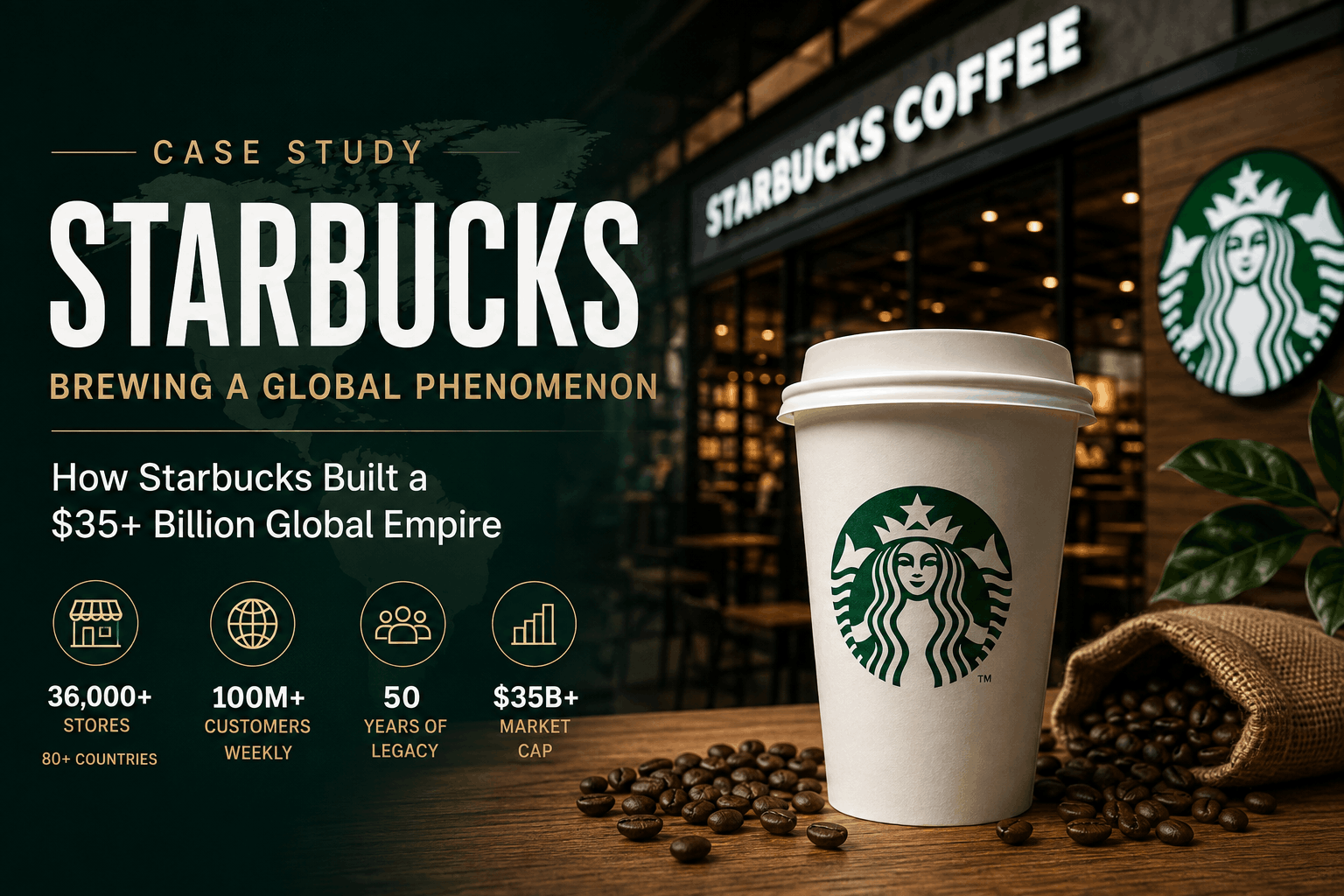
Starbucks‘ journey from a single Seattle coffee shop to a global $35 billion empire wasn’t accidental. It resulted from:
- Uncompromising Quality – Started premium, stayed premium
- Vision Beyond Product – Sold experience, not just coffee
- Strategic Patience – 16 years before major expansion
- Operational Excellence – Standardized quality at scale
- Premium Positioning – Created willingness to pay
- Network Effects – Location strategy created dominance
- Data & Technology – Used insights for personalization
- Global Adaptability – Respected local cultures while maintaining brand
- People Investment – Employees as competitive advantage
- Continuous Innovation – Evolved to stay relevant
For entrepreneurs and business leaders, Starbucks offers a masterclass in:
- Building premium brands in commodity categories
- Creating category expansion (premium espresso drinks didn’t exist)
- Scaling while maintaining quality
- Leveraging technology without losing human connection
- International expansion with local sensitivity
- Building sustainable competitive advantage
The Starbucks story isn’t just about coffee it’s about how vision, strategy, and relentless execution can transform an entire industry and create a global empire worth $35+ billion.