

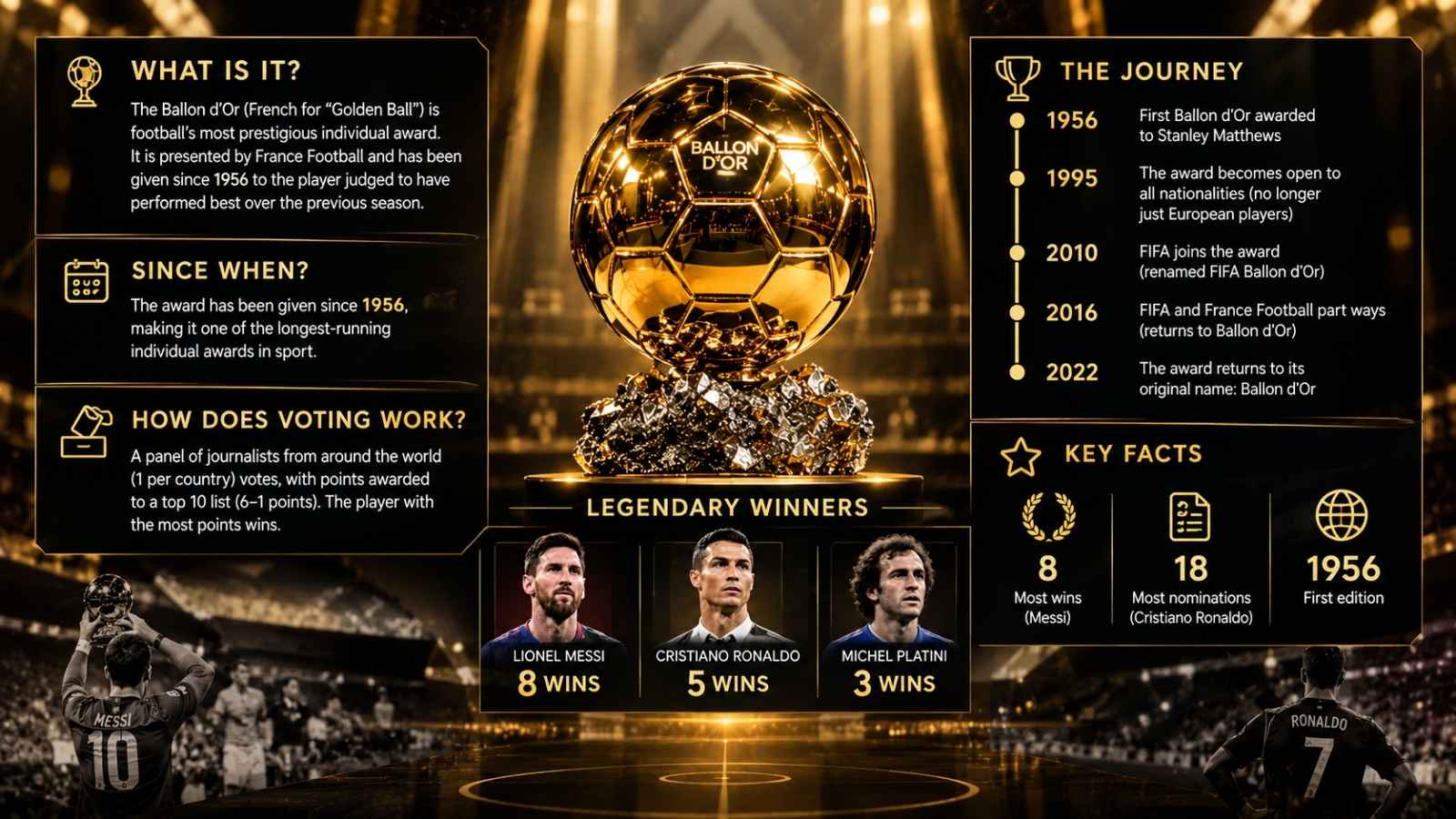
The Ballon d’Or (French for “Golden Ball”) is football’s most prestigious individual award. It is presented by the French magazine France Football and has been given since 1956 to the player judged to have performed best over the previous season. Lionel Messi has won it a record eight times, and Cristiano Ronaldo has the most nominations with eighteen. The 70th edition was held at the London Palladium on 26 October 2026, the first ceremony outside France. Harry Kane won the men’s award and Alexia Putellas won the women’s award.
2026 Ballon d’Or Winners: Full Results
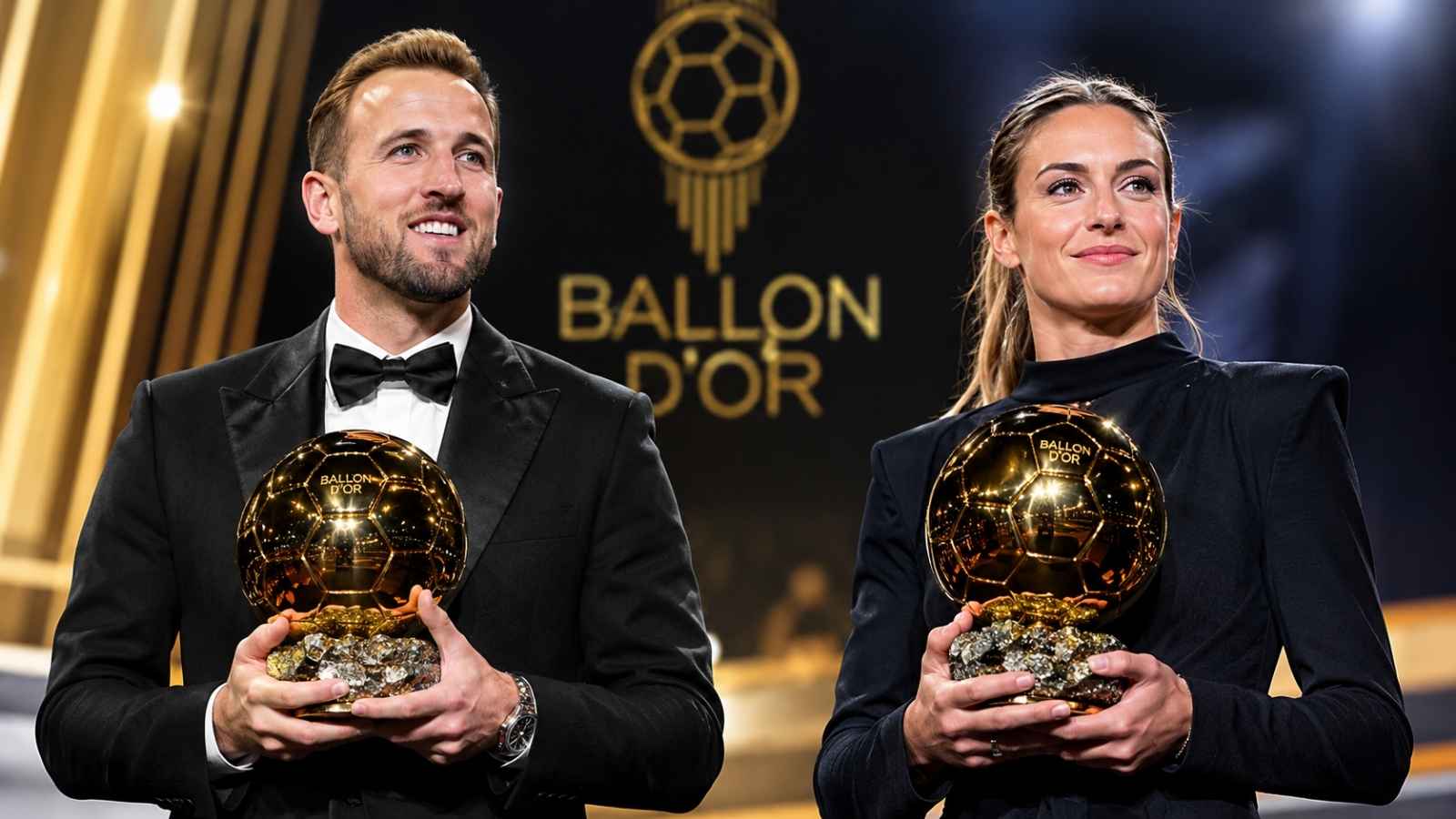
The 70th Ballon d’Or ceremony took place at the London Palladium on 26 October 2026. Harry Kane (Bayern Munich, England) won the men’s award, and Alexia Putellas (London City Lionesses, Spain) won the women’s award. For a quick summary of every prize, see our Ballon d’Or 2026 winners: full list and results, and for the schedule, read our ceremony start time and how to watch guide.
Award |
2026 winner |
| Men’s Ballon d’Or | Harry Kane (Bayern Munich, England) |
| Women’s Ballon d’Or | Alexia Putellas (London City Lionesses, Spain) |
| Men’s Young Talent of the Year | Lamine Yamal (Barcelona, Spain) |
| Women’s Young Talent of the Year | Vicky López (Barcelona, Spain) |
| Men’s Coach of the Year | Luis de la Fuente (Spain) |
| Women’s Coach of the Year | Pere Romeu (Barcelona) |
| Men’s Goalkeeper of the Year | Unai Simón (Athletic Club, Spain) |
| Women’s Goalkeeper of the Year | Cata Coll (Barcelona, Spain) |
| Men’s Striker of the Year | Harry Kane (Bayern Munich, England) |
| Sócrates Award | Bukayo Saka |
| Women’s Club of the Year | FC Barcelona |
| Men’s Club of the Year | Paris Saint-Germain (France) |
| Women’s Striker of the Year | Charlyn Corral (Pachuca, Mexico) |
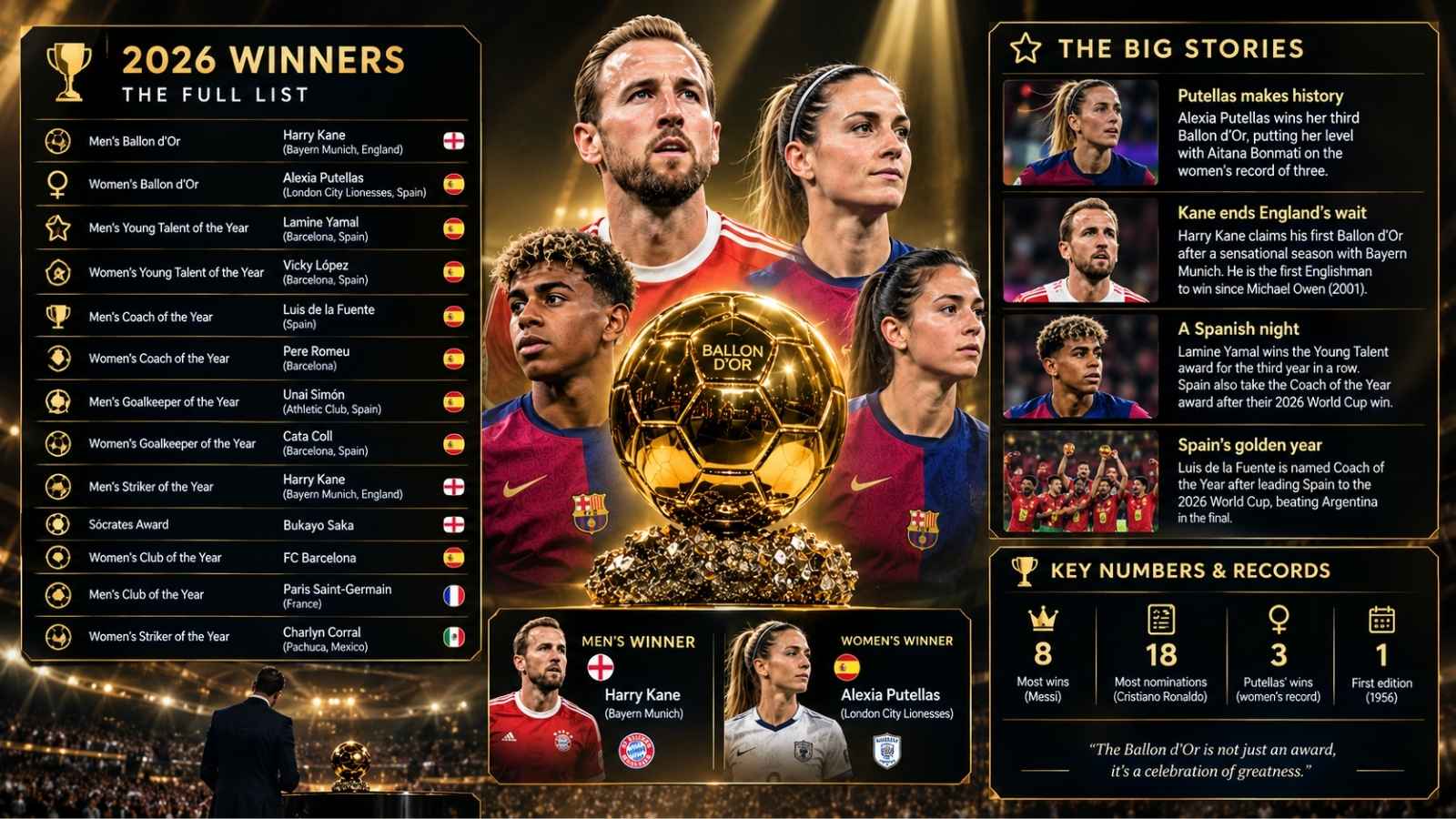
Putellas wins a third Ballon d’Or. The official live coverage describes her as a three-time winner after a season of 20 goals and 15 assists, having left FC Barcelona for London this summer. Her third award puts her level with Aitana Bonmatí on the women’s record of three.
Kane ends England’s long wait. Kane was the bookmakers’ favourite after a season of 61 goals in 51 appearances for Bayern Munich, who won a domestic treble. DAZN counts 73 goals for club and country across 2025-26. England also finished third at the World Cup. He is the first Englishman to win since Michael Owen in 2001.
A Spanish night. The ceremony live blog shows Spanish players and coaches taking the early awards, including Yamal’s third straight Young Talent award. De la Fuente’s Coach of the Year award came after Spain won the 2026 World Cup, beating Argentina in the final.
What Is the Ballon d’Or?
The Ballon d’Or is an annual association football award that honours the best player of the season. It is widely regarded as the most prestigious individual award in football. It was conceived by sports writers Gabriel Hanot and Jacques Ferran of France Football. The first winner was England’s Stanley Matthews in 1956.
A women’s award, the Ballon d’Or Féminin, was added in 2018. The gala now also presents several other prizes, covered later in this article.
Why Is the Ballon d’Or Given?
The award exists to recognise individual excellence in a team sport. France Football created it to name the standout player of each season. Voters weigh three criteria:
- Individual performances, with a decisive and impressive character.
- Team performances and achievements.
- Class and fair play.
In practice, big-stage success weighs heavily. World Cup and Champions League runs have often decided close votes. Critics have also called the award a “popularity contest” and noted a bias toward attacking players.
History: How the Ballon d’Or Changed Over 70 Years
Period |
What changed |
| 1956 to 1994 | Open only to European players. Voted by football journalists. Also known as the European Footballer of the Year award. |
| 1995 | Expanded to any player active at a European club. George Weah became the first non-European winner. |
| 2007 | Became a global award, open to all professional footballers. National team coaches and captains also got votes. |
| 2010 to 2015 | Merged with FIFA’s World Player of the Year as the FIFA Ballon d’Or. |
| 2016 | The FIFA partnership ended, and voting reverted to journalists only. |
| 2020 | Not awarded because of the COVID-19 pandemic. |
| 2022 | Switched from a calendar year to a football season. An international jury was introduced. |
| 2024 | UEFA began co-organising the gala. France Football kept the voting system and the name. |
| 2026 | First ceremony outside France, held in London. |
The 2020 edition was cancelled because of the COVID-19 pandemic. Many argued that Robert Lewandowski would have won it.
How the Winner Is Chosen Today
Since 2022, an international jury of specialised journalists decides the winner. The jury has one representative per country from the top 100 countries in the latest FIFA Men’s World Ranking. The women’s jury draws on the top 50 countries in the FIFA Women’s rankings.
The period considered is the season, not the calendar year. For 2026, the eligibility window ran from 3 August 2025 to 19 July 2026.
Complete List of Men’s Ballon d’Or Winners (1956 to 2026)
The list below covers every men’s winner since 1956. Nationalities follow standard football records.
Year |
Winner |
Country |
Club |
| 2026 | Harry Kane | England | Bayern Munich |
| 2025 | Ousmane Dembélé | France | Paris Saint-Germain |
| 2024 | Rodri | Spain | Manchester City |
| 2023 | Lionel Messi | Argentina | Inter Miami |
| 2022 | Karim Benzema | France | Real Madrid |
| 2021 | Lionel Messi | Argentina | Paris Saint-Germain |
| 2020 | Not awarded | ||
| 2019 | Lionel Messi | Argentina | Barcelona |
| 2018 | Luka Modrić | Croatia | Real Madrid |
| 2017 | Cristiano Ronaldo | Portugal | Real Madrid |
| 2016 | Cristiano Ronaldo | Portugal | Real Madrid |
| 2015 | Lionel Messi | Argentina | Barcelona |
| 2014 | Cristiano Ronaldo | Portugal | Real Madrid |
| 2013 | Cristiano Ronaldo | Portugal | Real Madrid |
| 2012 | Lionel Messi | Argentina | Barcelona |
| 2011 | Lionel Messi | Argentina | Barcelona |
| 2010 | Lionel Messi | Argentina | Barcelona |
| 2009 | Lionel Messi | Argentina | Barcelona |
| 2008 | Cristiano Ronaldo | Portugal | Manchester United |
| 2007 | Kaká | Brazil | AC Milan |
| 2006 | Fabio Cannavaro | Italy | Real Madrid |
| 2005 | Ronaldinho | Brazil | Barcelona |
| 2004 | Andriy Shevchenko | Ukraine | AC Milan |
| 2003 | Pavel Nedvěd | Czech Republic | Juventus |
| 2002 | Ronaldo | Brazil | Real Madrid |
| 2001 | Michael Owen | England | Liverpool |
| 2000 | Luís Figo | Portugal | Real Madrid |
| 1999 | Rivaldo | Brazil | Barcelona |
| 1998 | Zinedine Zidane | France | Juventus |
| 1997 | Ronaldo | Brazil | Inter Milan |
| 1996 | Matthias Sammer | Germany | Borussia Dortmund |
| 1995 | George Weah | Liberia | AC Milan |
| 1994 | Hristo Stoichkov | Bulgaria | Barcelona |
| 1993 | Roberto Baggio | Italy | Juventus |
| 1992 | Marco van Basten | Netherlands | AC Milan |
| 1991 | Jean-Pierre Papin | France | Marseille |
| 1990 | Lothar Matthäus | West Germany | Inter Milan |
| 1989 | Marco van Basten | Netherlands | AC Milan |
| 1988 | Marco van Basten | Netherlands | AC Milan |
| 1987 | Ruud Gullit | Netherlands | AC Milan |
| 1986 | Igor Belanov | Soviet Union | Dynamo Kyiv |
| 1985 | Michel Platini | France | Juventus |
| 1984 | Michel Platini | France | Juventus |
| 1983 | Michel Platini | France | Juventus |
| 1982 | Paolo Rossi | Italy | Juventus |
| 1981 | Karl-Heinz Rummenigge | West Germany | Bayern Munich |
| 1980 | Karl-Heinz Rummenigge | West Germany | Bayern Munich |
| 1979 | Kevin Keegan | England | Hamburg |
| 1978 | Kevin Keegan | England | Hamburg |
| 1977 | Allan Simonsen | Denmark | Borussia Mönchengladbach |
| 1976 | Franz Beckenbauer | West Germany | Bayern Munich |
| 1975 | Oleh Blokhin | Soviet Union | Dynamo Kyiv |
| 1974 | Johan Cruyff | Netherlands | Barcelona |
| 1973 | Johan Cruyff | Netherlands | Barcelona |
| 1972 | Franz Beckenbauer | West Germany | Bayern Munich |
| 1971 | Johan Cruyff | Netherlands | Ajax |
| 1970 | Gerd Müller | West Germany | Bayern Munich |
| 1969 | Gianni Rivera | Italy | AC Milan |
| 1968 | George Best | Northern Ireland | Manchester United |
| 1967 | Flórián Albert | Hungary | Ferencváros |
| 1966 | Bobby Charlton | England | Manchester United |
| 1965 | Eusébio | Portugal | Benfica |
| 1964 | Denis Law | Scotland | Manchester United |
| 1963 | Lev Yashin | Soviet Union | Dynamo Moscow |
| 1962 | Josef Masopust | Czechoslovakia | Dukla Prague |
| 1961 | Omar Sívori | Italy | Juventus |
| 1960 | Luis Suárez | Spain | Barcelona |
| 1959 | Alfredo Di Stéfano | Spain | Real Madrid |
| 1958 | Raymond Kopa | France | Real Madrid |
| 1957 | Alfredo Di Stéfano | Spain | Real Madrid |
| 1956 | Stanley Matthews | England | Blackpool |
The 2026 men’s winner, Harry Kane, appears in the first row of the table above.
Who Has Won the Most Ballon d’Or Awards?
Lionel Messi holds the record with eight wins, followed by Cristiano Ronaldo with five. Johan Cruyff, Michel Platini and Marco van Basten have won it three times each. Five more players have won it twice.
Player |
Wins |
Winning years |
| Lionel Messi | 8 | 2009, 2010, 2011, 2012, 2015, 2019, 2021, 2023 |
| Cristiano Ronaldo | 5 | 2008, 2013, 2014, 2016, 2017 |
| Johan Cruyff | 3 | 1971, 1973, 1974 |
| Michel Platini | 3 | 1983, 1984, 1985 |
| Marco van Basten | 3 | 1988, 1989, 1992 |
| Alfredo Di Stéfano | 2 | 1957, 1959 |
| Franz Beckenbauer | 2 | 1972, 1976 |
| Kevin Keegan | 2 | 1978, 1979 |
| Karl-Heinz Rummenigge | 2 | 1980, 1981 |
| Ronaldo (Brazil) | 2 | 1997, 2002 |
Messi also finished on the podium a record fourteen times, including eleven in a row from 2007 to 2017. He is the only player to win it with three clubs, and the only one to win while playing outside Europe.
For the commercial side of football’s biggest star, read our feature: Lionel Messi’s Business Empire: Inside the $1.1 Billion Brand Playbook.
Who Has Been Nominated the Most?
Cristiano Ronaldo has the most nominations, with eighteen. Messi’s run of consecutive podium finishes shows how long both players stayed at the top. 2007 was the first year both men reached the top three, and neither won. Kaká took it, and Messi and Ronaldo then dominated most years until Luka Modrić broke the run in 2018.
Records and Milestones
- First winner: Stanley Matthews in 1956. He is also the oldest winner, at 41 years and 321 days.
- Youngest winner: Ronaldo of Brazil, aged 21 years and 96 days, in 1997.
- First non-European winner: George Weah of Liberia in 1995. He remains the only African winner.
- Only goalkeeper: Lev Yashin in 1963.
- Last defender to win: Fabio Cannavaro in 2006.
- Three in a row: Michel Platini (1983 to 1985). Messi later won four in a row (2009 to 2012).
- Only year not awarded: 2020
- Most winning country: France and Argentina have eight wins each. The Netherlands, Germany and Portugal have seven each.
- Most winning clubs: Barcelona and Real Madrid have twelve wins each. Spain’s La Liga has produced the most winners overall, with twenty-four wins.
- Podium sweeps: AC Milan players took the top three in 1988 and 1989.
Women’s Ballon d’Or Winners
The women’s award began in 2018. Aitana Bonmatí and Alexia Putellas share the record with three wins each.
Year |
Winner |
Country |
Club at the time |
| 2026 | Alexia Putellas | Spain | London City Lionesses |
| 2025 | Aitana Bonmatí | Spain | Barcelona |
| 2024 | Aitana Bonmatí | Spain | Barcelona |
| 2023 | Aitana Bonmatí | Spain | Barcelona |
| 2022 | Alexia Putellas | Spain | Barcelona |
| 2021 | Alexia Putellas | Spain | Barcelona |
| 2020 | Not awarded | ||
| 2019 | Megan Rapinoe | United States | OL Reign |
| 2018 | Ada Hegerberg | Norway | Olympique Lyonnais |
Other Awards Presented at the Ballon d’Or Gala
The ceremony now includes several prizes beyond the main two. The 2025 winners were:
Award |
What it recognises |
2025 winner |
| Kopa Trophy (Young Talent) | Best player under 21 | Lamine Yamal (men), Vicky López (women) |
| Yashin Trophy | Best goalkeeper | Gianluigi Donnarumma (men), Hannah Hampton (women) |
| Gerd Müller Trophy | Top scorer | Viktor Gyökeres (men), Ewa Pajor (women) |
| Johan Cruyff Trophy | Best coach | Luis Enrique (men), Sarina Wiegman (women) |
| Club of the Year | Best club | Paris Saint-Germain (men) |
| Sócrates Award | Solidarity and social causes | Fundación Xana |
The Kopa Trophy is now titled Young Talent of the Year, and its voting panel is made up of former Ballon d’Or winners.
Special and Honorary Ballon d’Or Awards
France Football has also given one-off honours:
- Super Ballon d’Or (1989): Presented to Alfredo Di Stéfano.
- Golden Ballon d’Or (1995): An honorary award for Diego Maradona.
- Player of the Century (1999): Pelé, chosen by former winners.
- Retrospective reevaluation (2016): France Football said 12 of the 39 pre-1995 awards would have gone to South American players, including seven to Pelé and two to Maradona. The original winners were not changed.
- Ballon d’Or Dream Team (2020): An all-time team published in December 2020.
Criticism and Controversy
The award has drawn regular criticism over its voting process, a bias toward attackers, and the idea of singling out one player in a team sport. In 2024 the result leaked before the ceremony began, and Vinícius Júnior and Real Madrid skipped the event. A similar error occurred before the 2026 ceremony, when the Ballon d’Or website published an article in error naming Harry Kane as winner.
The 2026 Ballon d’Or: How the Night Unfolded
The 70th ceremony took place on 26 October 2026 at the London Palladium. It started about 30 minutes late because of heavy traffic in London, according to the live blog. London was chosen to honour Stanley Matthews, the first winner in 1956. Harry Kane, Kylian Mbappé and Lamine Yamal were the leading contenders, with Messi and holder Dembélé also nominated. The men’s top 10 also included Erling Haaland, Khvicha Kvaratskhelia, Michael Olise, Rodri and Fabián Ruiz.
Planning to watch the next ceremony? Our Ballon d’Or ceremony time guide explains the start time, red carpet and time zones, including India.
See every 2026 prize in our Ballon d’Or 2026 winners: full list and results.
Analysis
The Ballon d’Or’s history is a story of widening scope. It began as a European writers’ prize, became global in 2007, and now runs as a UEFA co-organised gala with a season-based calendar. Each change moved it closer to a global brand, and the 2026 move to London pushes that further. The records show a different pattern, though. Messi and Ronaldo won eleven of the twelve awards between 2008 and 2019, a concentration few honours match. The winners list also shows how narrow the pool became: since 1995 only England, France, Germany, Italy, Spain and the United States have supplied winners’ leagues. Kane’s win adds to a list that has rewarded attackers on dominant teams far more often than defenders, goalkeepers or players at smaller clubs.
Frequently Asked Questions
What does Ballon d’Or mean?
It is French for “Golden Ball”.
Who created the Ballon d’Or?
Sports writers Gabriel Hanot and Jacques Ferran, for France Football.
Who won the first Ballon d’Or?
Stanley Matthews of England, in 1956.
Who has won the most Ballon d’Or awards?
Lionel Messi, with eight.
Who has the most Ballon d’Or nominations?
Cristiano Ronaldo, with eighteen.
Who won the 2026 Ballon d’Or?
Harry Kane won the men’s award and Alexia Putellas won the women’s award.
Who won the Ballon d’Or in 2025?
Ousmane Dembélé won the men’s award in 2025, and Aitana Bonmatí won the women’s award.
Why was there no Ballon d’Or in 2020?
The organisers cancelled it because of the COVID-19 pandemic.
Who votes for the Ballon d’Or?
An international jury of journalists, one per country from the top 100 in the FIFA Men’s World Ranking.
Has a goalkeeper won the Ballon d’Or?
Yes. Lev Yashin is the only one, in 1963.
Which club has produced the most winners?
Barcelona and Real Madrid, with twelve each.