Explore more expert insights, leadership stories, and business strategies at GlobeVox Leaders
Lionel Messi has just walked away from the Argentina national team. On 31 August 2026, he announced his international retirement, weeks after Argentina lost the World Cup final to Spain. For business leaders, the more interesting story is what he is building for the day he stops playing altogether. At 39, Lionel Messi is a billionaire, the world’s third-highest-paid athlete, and the owner of a portfolio that runs from boutique hotels to Silicon Valley start-ups to a Spanish football club.
This is the full commercial story: the contracts, the equity, the brands, the investments, the misses and the lessons.
Lionel Messi’s net worth in 2026: the headline numbers
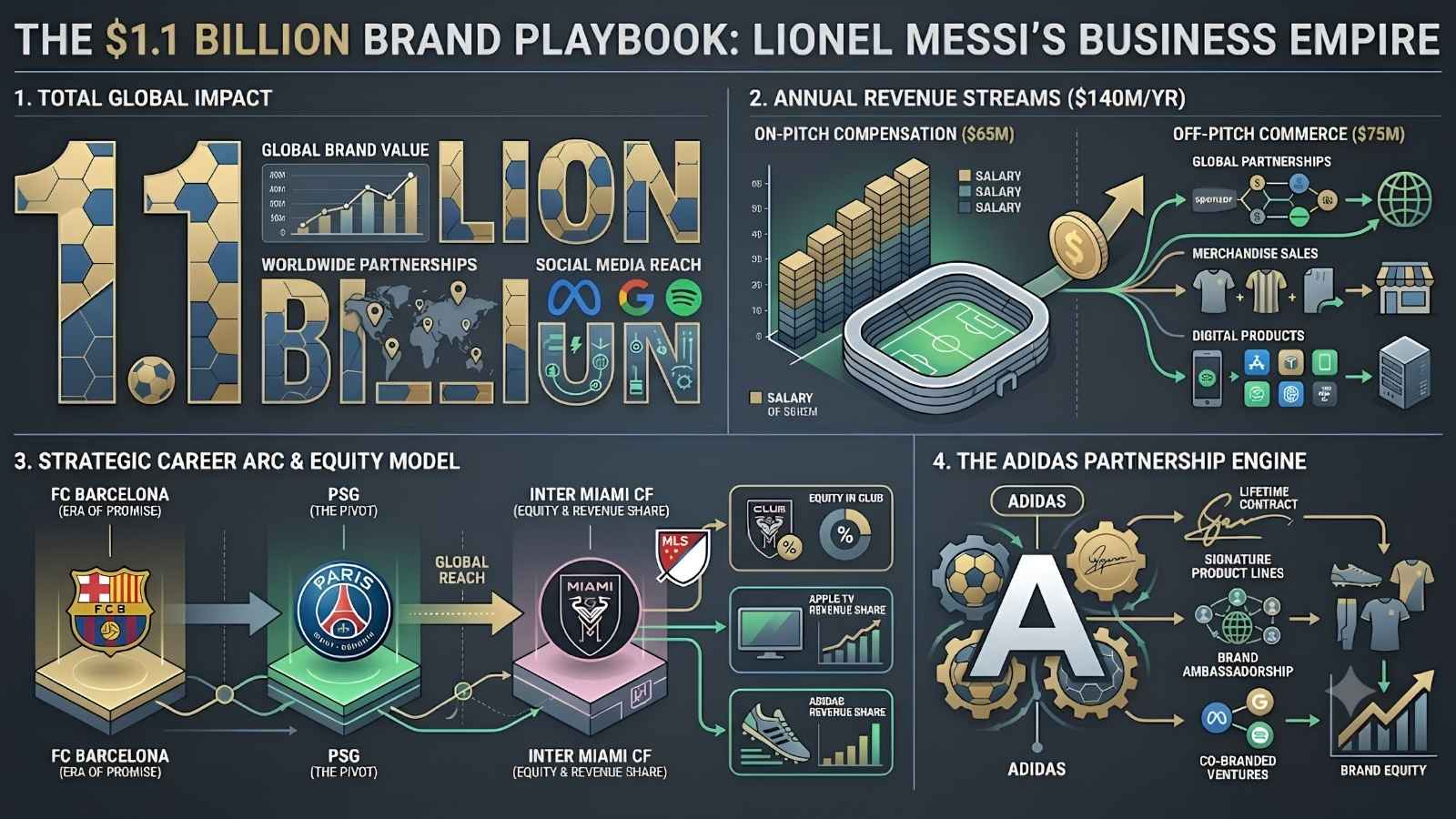
Forbes puts Lionel Messi’s net worth at about $1.1 billion and estimates he has earned roughly $1.8 billion on and off the pitch across his career, before taxes and agents’ fees. Bloomberg reported in 2026 that his fortune had passed the $1 billion mark, and he appeared on the World’s Billionaires list for the first time this year.
On annual income, Forbes’ 2026 ranking of the world’s highest-paid athletes places Lionel Messi third, at $140 million, split evenly between $70 million in salary and $70 million in endorsements. Cristiano Ronaldo led the list at $300 million, followed by boxer Canelo Álvarez at $170 million. Forbes had also ranked Lionel Messi the world’s top earner in 2019 and 2022.
Two points matter for readers of this magazine. First, half of Lionel Messi’s annual income now comes from commercial deals, so his earning power no longer depends on a single contract. Second, Forbes’ income window runs from May 2025 to May 2026. That window includes the Inter Miami title run but excludes most of the new business activity of 2026.
The contract timeline: Barcelona, PSG and Inter Miami
Barcelona (2004–2021): the contract that rewrote sport’s pay scale
Lionel Messi’s first professional deal, signed in February 2004, ran to 2012 and carried a buyout clause of €30 million. It rose automatically to €80 million once he debuted for Barcelona B. On his 18th birthday he signed his first senior contract, with a release clause of €150 million. Further renewals followed in 2009, 2013 and 2017.
The 2017 deal became the most discussed contract in sport after Spain’s El Mundo published it in January 2021. The paper reported a maximum value of about €555 million over four seasons, including variable pay, and a reported signing bonus of €115 million. Barcelona said it regretted the publication of a confidential document and denied responsibility for the leak. Treat the figure as a ceiling rather than guaranteed pay, because it depends on conditions being met. El Mundo also noted that roughly half of it would go to Spanish tax.
The ending was a lesson in club finance. Messi agreed in 2021 to a pay cut of around 50 percent, but Barcelona said it could not re-register him because of financial constraints and La Liga’s spending rules. He left in August 2021 after 17 years.
Paris Saint-Germain (2021–2023): a step down in salary, a step up in brand reach
Lionel Messi joined PSG on a two-year deal with an option for a third year. Reported pay was around €35 million a year, about $41 million with bonuses, far below his Barcelona terms. PSG gained a shirt that sold worldwide. Messi gained a European Ligue 1 title, a second one in 2023, and time to set up new business entities, including his San Francisco investment vehicle.
The Saudi offer he declined
In 2023 Lionel Messi reportedly turned down a Saudi Arabian offer, widely cited as about $400 million a year from Al Hilal, and chose Major League Soccer. He had been a Saudi tourism ambassador since 2022, a role that drew criticism over the country’s human rights record. The lesson for commercial leaders is that his decisions around the biggest offers have often favoured long-run equity and brand position over the largest immediate cheque.
Inter Miami (2023–2028): the equity-and-revenue-share template
Inter Miami announced Lionel Messi’s signing on 15 July 2023. Sportico reported a package worth up to $150 million over the initial two-and-a-half years, covering salary, signing bonus and equity. The structure was the real innovation:
- Guaranteed pay was modest. MLS Players Association figures showed about $20.4 million guaranteed at the time. Reporting for 2026 puts his guaranteed compensation near $28.3 million.
- Apple revenue share. Messi receives a share of new MLS Season Pass subscription revenue from Apple, the league’s broadcast partner. Apple TV reported more than 110,000 Season Pass sign-ups on the day of his Miami debut, according to Fast Company.
- Adidas revenue share. He benefits from Adidas sales linked to the MLS relationship, on top of his existing Adidas deal.
- Equity option. Messi can take an ownership stake in Inter Miami once he retires. Reuters confirmed in January 2026 that the deal includes a future minority stake.
On 23 October 2025 he extended his contract through the 2028 season, when he will be 41. The club did not disclose financial terms. Inter Miami co-owner Jorge Mas has said Messi’s total annual take, including equity and side arrangements, sits between $70 million and $80 million.
The club’s value has moved with him. Goal reported a valuation of about $1.45 billion, up around 22 percent in a year, making Inter Miami the most valuable franchise in MLS. Reporting from early 2025 had put it near $1.19 billion. Messi also won MLS MVP in 2024 and 2025 and led Miami to its first MLS Cup in December 2025.
Endorsements and sponsorships
Forbes lists Lionel Messi’s sponsors as Adidas, Anheuser-Busch InBev, Apple, Beats by Dre, Epic Games, Hard Rock Cafe, Konami, Lowe’s, Mastercard, Panini, PepsiCo and YPF. Michelob Ultra, an Anheuser-Busch brand, used Messi and Brazil’s Ronaldo Nazário in a World Cup advertisement in May 2026.
Adidas: the anchor deal
Adidas has sponsored Messi since 2006, and he became its leading brand endorser. He was the first footballer to receive his own Adidas boot sub-brand, in 2015. Adidas sold out of his Argentina number 10 shirt worldwide during the 2022 World Cup. Forbes describes the relationship as a lifetime endorsement deal. Press reports have estimated the 2017 agreement at around $1 billion over its life. Neither company has published the terms, so treat that number as an estimate.
Other notable commercial deals
- Hard Rock Cafe: a five-year brand ambassador deal signed in June 2021.
- Saudi Arabia tourism: an ambassador role from 2022.
- Turkish Airlines: a 2013 advertisement with Kobe Bryant became the most-watched ad on YouTube at the time, with 137 million views.
- Video games: long-running face-of-the-franchise roles with Konami’s Pro Evolution Soccer and EA Sports’ FIFA series.
- Luxury and consumer brands: earlier ambassadorships included Dolce & Gabbana, Audemars Piguet, Gillette, Ooredoo and Tata Motors.
The breadth is deliberate. His brand was originally built on performance rather than glamour. Since 2010, his deals have moved into luxury, travel, finance and technology.
Cup money and match fees: what the numbers do and don’t show
Readers often ask what Lionel Messi “earns” from World Cups and Copa América. The honest answer is that prize money does not go to him personally in any disclosed way.
FIFA pays World Cup prize money to national federations, not to players. The 2026 tournament had a record total prize fund, with champions Spain receiving about $50 million. Runners-up Argentina received about $33 million, although some outlets report $34 million once preparation payments are included. Argentina’s 2022 title was worth $42 million. How much of that reaches the squad is set by the Argentine Football Association’s own bonus arrangements. Individual bonus figures for Lionel Messi have not been publicly verified, and this article does not guess at them.
A few other cash-adjacent facts are on the record:
- A set of shirts Messi wore at the 2022 World Cup sold at auction in December 2023 for $7.8 million.
- Items worn by Messi appear in Christie’s July 2026 “One Goal” auction supporting the FIFA Global Citizen Education Fund.
- A gold replica of his left foot, valued at $5.3 million, went on sale in Japan in 2013 to raise funds for earthquake relief.
- His Inter Miami arrival drove sell-out crowds, record jersey sales in MLS and rising ticket prices for visiting clubs, which is the commercial effect clubs pay him for.
A cautionary footnote on appearance fees: a February 2024 exhibition in Hong Kong, in which Messi stayed on the bench, caused a backlash in Hong Kong and China. One Messi commercial was pulled there, and the Chinese Football Association temporarily halted its partnership with the Argentine federation. Star power carries delivery risk.
The investment portfolio, company by company
Lionel Messi’s businesses are run largely through a family structure. His oldest brother Rodrigo manages the holding company Limecu España 2010, which reported about $275 million in assets for 2023. His father Jorge was his agent and manager from 2000 until his death on 8 August 2026.
1. Edificio Rostower SOCIMI: the listed real-estate vehicle
In late 2024 Messi listed his Spanish property holdings on a small Spanish exchange through Edificio Rostower, a SOCIMI (Spain’s REIT-style structure). Bloomberg valued the company at about $232 million. Other sources cite figures from roughly €223 million (equity valuation) to more than €240 million or $270 million (assets), depending on the measure and the date, so quote the source when you use a number. The portfolio includes hotels, offices, shops and homes across Spain, Andorra, London and Paris.
2. MiM Hotels
MiM, short for “Majestic i Messi“, was created in 2017 with Majestic Hotel Group, and the first property was MiM Sitges near Barcelona. The group now covers six boutique hotels in destinations such as Ibiza, Mallorca, Sitges, Baqueira, Sotogrande and Andorra. Lionel Messi acquired MiM Ibiza Es Vivé in 2018. In late 2025, Meliá Hotels International took over operations and added the hotels to its Meliá Collection. Meliá operates them, but that does not mean Messi sold the real estate. Argentine press has put the chain’s value at more than $100 million, though no audited figure is public.
3. Inter Miami equity (future)
Covered above. This is arguably the most strategically important asset because it converts his on-field influence into permanent ownership in the fastest-growing franchise in US soccer. The size of the stake has not been disclosed.
4. Play Time Sports-Tech HoldCo
Lionel Messi set up this San Francisco-based investment vehicle while at PSG, focused on sports, media, entertainment and technology. Reporting attributed to WIRED lists investments including FieldAI, Fish Audio, World Labs, Perceptron, Intangible, SuperAnnotate, Matchday and the collectibles platform AC Momento. That makes it a venture portfolio, not a merchandising arm. Individual stake sizes are not public.
5. UE Cornellà
On 16 April 2026 Lionel Messi acquired full ownership of Spanish club UE Cornellà, a lower-division side near Barcelona known for developing players. The price was not disclosed. The move places him alongside Cristiano Ronaldo, who bought a stake in UD Almería in February 2026, in the business of club ownership.
6. Deportivo LSM
In 2025 Messi joined Luis Suárez in founding Deportivo LSM, a Uruguayan professional club. Argentine business media report it was promoted in its first season. Ownership shares have not been published.
7. 525 Rosario
Launched on 19 September 2024 as a joint venture with Smuggler Entertainment, which co-produced the Apple TV+ series Messi’s World Cup: The Rise of a Legend. It develops films, sports coverage and branded content for athletes. The name nods to Rosario’s area code, his hometown.
8. Food, retail and lifestyle
Messi is a partner in the Argentine restaurant chain El Club de la Milanesa (2025) and reportedly an investor in the Spanish burger start-up Vicio. He also has The Messi Store, a perfume line, and wine projects. Property holdings include a $10.75 million waterfront house in Fort Lauderdale reported by the Miami Herald, plus several Miami-area condos.
The miss: Más+ by Messi
Not every venture worked, and a fair profile should say so. Más+ was a low-sugar hydration drink co-founded with Mark Anthony Brands, the maker of White Claw. It launched in Miami in June 2024 and expanded into grocery stores and Canada. It also drew a trademark dispute with Logan Paul’s Prime Hydration, which the parties later settled with all claims dismissed. Mark Anthony announced in January 2026 that Más+ had been discontinued, and trade press reported it was phased out after objectives were missed. Several wealth-ranking websites still list it as an active business, so check dates before repeating that claim.
The takeaway: celebrity-founded consumer goods face brutal shelf competition, and a famous name does not guarantee velocity.
Risk and governance: the tax case and the family-office model
Messi’s business history includes a serious compliance chapter. Spanish authorities investigated him in 2013 over image-rights income routed through offshore companies in Uruguay, Switzerland and Belize between 2007 and 2009. He paid €5.1 million in arrears voluntarily in August 2013. In July 2016, he and his father were convicted of tax fraud and received suspended 21-month sentences, with fines of €1.7 million and €1.4 million. Messi told the court he had trusted his father and the lawyers. A Panama shell company set up in 2012 later appeared in the Panama Papers leak.
The structures he uses today are listed, audited and based in regulated jurisdictions, which is a visible shift from that period. With his father’s death in August 2026, the family office faces a succession and governance test. The role of manager and chief negotiator is now open. How Rodrigo Messi and professional executives divide responsibility will be worth watching.
Philanthropy and reputation capital
The Leo Messi Foundation, launched in 2007, funds health care, education and sport for children. Messi has been a UNICEF Goodwill Ambassador since 2010. He received the US Presidential Medal of Freedom in January 2025 for his contributions to children’s health and education. In August 2026 he donated €80,000 towards reconstruction after wildfires in the Sierra Oeste region near Madrid. For sponsors, this record of charity and humility is a major part of why his brand has stayed safe in a polarised media environment.
What business leaders can learn from Lionel Messi
- Take equity, not just salary. At Inter Miami, he traded a larger guaranteed paycheque for ownership and revenue shares tied to league growth.
- Anchor with one long-term partner. Two decades with Adidas gave him stability while other deals came and went.
- Diversify by asset class. Real estate, hospitality, venture capital, media, sport clubs and restaurants spread the risk.
- Use professional operators. Meliá runs the hotels, Mark Anthony ran Más+ operations, and Play Time invests in start-ups with specialist founders.
- Admit and learn from misses. Más+ ended quickly. The tax case was costly. Neither stopped the wider portfolio.
- Plan for the end of the playing career early. Cornellà, Deportivo LSM, 525 Rosario and the Miami stake all point to a post-retirement identity as an owner.
Frequently asked questions
1. What is Lionel Messi’s net worth in 2026?
Forbes estimates about $1.1 billion, and Bloomberg reported that his fortune passed $1 billion in 2026. Wealth estimates vary because many of his stakes are private.
2. How much does Messi earn per year?
Forbes estimates $140 million for the 12 months to May 2026, with $70 million from salary and $70 million from endorsements. Inter Miami’s co-owner has said the club package is worth $70–80 million a year including equity and revenue shares.
3. How long is Messi’s Inter Miami contract?
His extension runs through the 2028 MLS season. The financial terms were not disclosed.
4. Does Messi own part of Inter Miami?
He has an option to acquire a minority stake after he retires. The stake size has not been made public.
5. What does Messi own?
He owns UE Cornellà outright, controls Edificio Rostower through his family holding, co-founded Deportivo LSM, runs Play Time Sports-Tech HoldCo, is a partner in MiM Hotels and 525 Rosario, and has restaurant and retail interests.
6. Did Lionel Messi retire?
He retired from the Argentina national team on 31 August 2026. He remains under contract at Inter Miami.
7. How much did Argentina earn at the 2026 World Cup?
About $33 million in prize money as runners-up, paid to the federation rather than to individual players.