

Startup founder leadership is nothing like managing a mature company. There is no playbook, no budget cushion, and no org chart to hide behind. One day you are the product manager, the next you are the head of sales, the support desk and the person who orders the pizza. And through all of it, a handful of people are watching you to decide whether this crazy bet is worth their careers.
So what does it really take to lead at this stage? In this guide, we break down the leadership style early-stage companies demand, using real stories from the founders of Airbnb, Amazon, Slack, Instagram, SpaceX and Spanx. You will also find founder voices from GlobeVox’s exclusive interviews that show how these lessons play out in practice.
Key Takeaways
- Startup leadership is hands-on: you do the work, set the vision and build the culture at the same time.
- Clarity beats certainty. Your team needs a clear direction, not a guarantee of success.
- The best founders stay close to customers, move fast on imperfect information and pivot without ego.
- Your job changes as you grow. Learning to let go of hats is a core leadership skill.
What Makes Startup Founder Leadership Different?
At a large company, leaders manage systems. At a startup, founders create the systems while the plane is already in the air. Resources are thin, roles are blurry, and the information you need to make a decision is almost never complete. Venture investor Paul Graham sums up the underlying engine in his essay Startup = Growth, arguing that what defines a startup is not its size but its rate of growth. That pressure shapes everything about how a founder has to lead.
| Startup stage | Scale-up stage | |
| Role of the leader | Player-coach who does the work | Manager of managers who sets direction |
| Decision style | Fast, intuitive, reversible | Structured, data-backed, delegated |
| Team communication | Constant and informal | Scheduled and layered |
| Biggest risk | Running out of time or money | Losing speed and culture |
| Source of authority | Vision and credibility | Systems and leadership team |
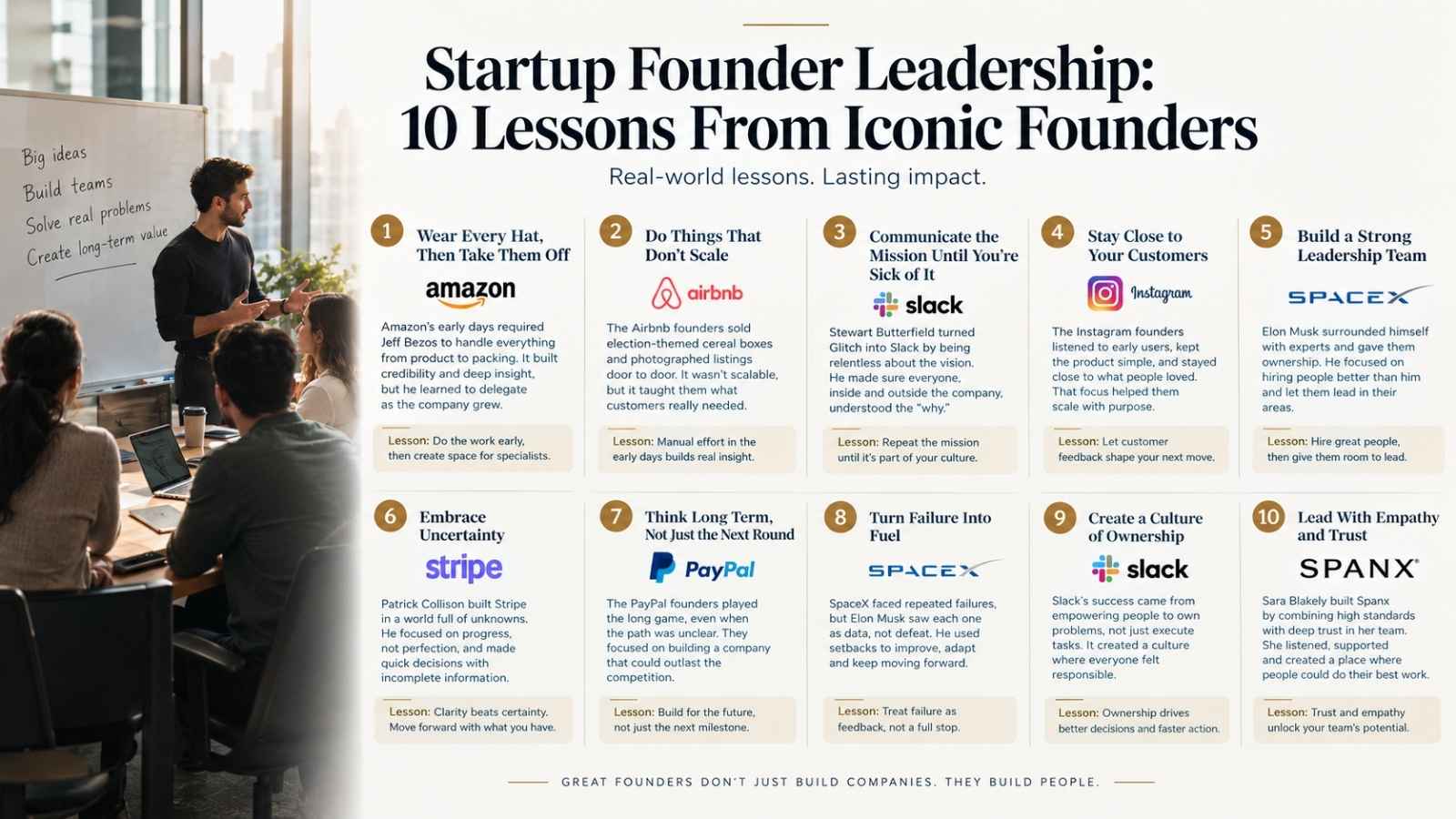
10 Startup Founder Leadership Lessons From Iconic Founders
1. Wear Every Hat, Then Deliberately Take Them Off
In the early days, nobody is too senior for any task. Amazon began in 1994 as a garage-based online bookstore, and its early team packed and shipped orders themselves. Sara Blakely launched Spanx in 2000 with about $5,000 of her own savings and no outside investors, handling product, pitching and sales on her own.
The lesson: doing everything builds credibility and deep product knowledge. But set a trigger for handing each hat to a specialist, otherwise you become the bottleneck.
2. Do Things That Don’t Scale
In 2008, the Airbnb founders funded their young company by selling election-themed cereal boxes. They also went door to door in New York to photograph hosts’ listings, a story Paul Graham highlights in his essay Do Things That Don’t Scale. These were not scalable tactics, but they taught the team what customers really needed.
The lesson: manual effort in the early days is a leadership tool. It shows your team that no job is beneath the founders, and it gives you insight no dashboard can.
3. Communicate the Mission Until You’re Sick of It
When uncertainty is high, a clear mission is the one thing that stays constant. Stewart Butterfield did this when his team shut down its game, Glitch, and pivoted to build what became Slack. He explained the new direction to the team and to the world in terms of the problem being solved, not just the product being built.
The lesson: repeat the “why” in all-hands meetings, one-on-ones and hiring pitches. Teams forgive missing features faster than they forgive a missing direction.
4. Stay Obsessively Close to Your Customers
Founders who build iconic companies rarely outsource customer understanding. Jeff Bezos wrote in his 2016 letter to Amazon shareholders about “Day 1” thinking, and he put customer obsession at the heart of staying fast and alert. Airbnb’s founders did the same by visiting hosts in person.
The lesson: schedule direct customer contact into your own calendar every week, even when you have a team to do it for you.
5. Pivot Without Ego
Instagram started as a cluttered check-in app called Burbn. Its founders noticed that people loved only the photo feature, stripped everything else away, and built a product that Facebook acquired in 2012 when the team numbered just 13 people. Slack’s story is a similar example of a team that let go of its original idea.
The lesson: separate your identity from your first idea. Your team will follow you through a pivot if you show them the evidence and the reasoning.
6. Stay Calm When Everything Is on Fire
By 2008, SpaceX had seen its first three Falcon 1 launches fail, and the fourth finally reached orbit in September of that year. Around the same time, Tesla was also running desperately short of cash. The company survived, and the way Elon Musk kept his teams working through that period is often cited as a case study in founder resilience.
The lesson: your team reads your emotional temperature. You do not have to pretend everything is fine, but you do have to show that you have a plan and that you are not panicking.
7. Hire Slowly and Hire for Range
Early hires shape everything that follows. Instagram’s tiny team punched far above its weight because each person could own a large surface area. In a startup, a great generalist who learns fast is often worth more than a narrow expert with a long resume.
The lesson: hire people who raise the bar, are comfortable with ambiguity and share your values. A wrong early hire costs far more than an empty seat.
8. Build Culture on Purpose, Not by Accident
Culture forms from your first ten hires, whether you plan it or not. Airbnb’s Brian Chesky became well known for arguing that founders should define and protect their company’s values early, before growth makes it harder. Write down how you make decisions, how you give feedback and what you will never compromise on.
The lesson: culture is the set of behaviours you reward and tolerate. Decide those behaviours early, and model them yourself.
9. Decide Fast With Imperfect Information
In that same 2016 shareholder letter, Bezos argued that most decisions should be made with roughly 70 percent of the information you wish you had, because waiting for 90 percent usually means moving too slowly. He also stressed that you should be good at spotting and correcting bad decisions quickly.
The lesson: sort decisions into reversible and irreversible. Move fast on the first kind, and slow down only for the second.
10. Grow Your Own Leadership as the Company Grows
The skills that carry you from zero to ten people will not carry you from ten to a hundred. The founders who last are those who invest in coaches, mentors and a strong leadership team, and who are willing to hand over decisions they once made themselves. Resources such as Y Combinator’s Startup School offer free lessons from founders who have already made this transition.
The lesson: treat your own growth as a core business priority. Your ceiling as a leader becomes the ceiling of the company.
Common Leadership Mistakes Early-Stage Founders Make
- Micromanaging because you can do it faster. It works until the team is bigger than your attention span.
- Hiding bad news. Teams cope better with honest problems than with surprises.
- Avoiding hard conversations. A poor fit left unaddressed damages morale and speed.
- Confusing busyness with progress. Pick a few metrics that matter and say no to the rest.
- Neglecting your own energy. Burnout in a founder is a company-level risk.

Hear It Straight From Founders: GlobeVox Interviews
Case studies are useful, but nothing beats hearing founders describe these moments in their own words. Our exclusive interviews at GlobeVox give you primary-source insight into how real founders handle hiring, pivots and pressure:
- Jaidin McCann: The Executive Search Leader Who Chose to Transform Work Culture
- Anuvamshi Shetty: The Engineer Who Chose to Light the Way Between Founders and Capital
- Ashley M. Lands: Why Standards Outlast Visibility
Explore more in our Founder Interviews hub and Startup / Entrepreneurship category sections.
Final Thoughts
Great startup founder leadership is less about charisma and more about clarity, consistency, and courage. The founders behind Airbnb, Amazon, Slack, Instagram, and SpaceX did not have perfect information either. They stayed close to customers, decided quickly, communicated their mission, and kept growing as leaders.
Frequently Asked Questions About Startup Founder Leadership
1. What leadership style works best for startup founders?
Most successful founders use a hands-on, visionary style that blends coaching with clear decision-making. They stay close to the work and customers, communicate the mission constantly and adapt as the company grows.
2. How do you lead a team through uncertainty?
Be transparent about what you know and don’t know, repeat the mission, set short-term goals the team can actually win, and stay visibly calm. People can handle uncertainty when they trust the person steering.
3. What is the biggest leadership challenge for first-time founders?
Letting go. Many first-time founders struggle to delegate, hire senior talent or step back from work they used to do. Learning to trust your team is usually the hardest transition.
4. When should a founder stop doing everything themselves?
When a task consistently prevents you from doing higher-value work such as hiring, fundraising or strategy, it is time to hand it off. Start with the tasks that someone else can already do at least 80 percent as well as you.