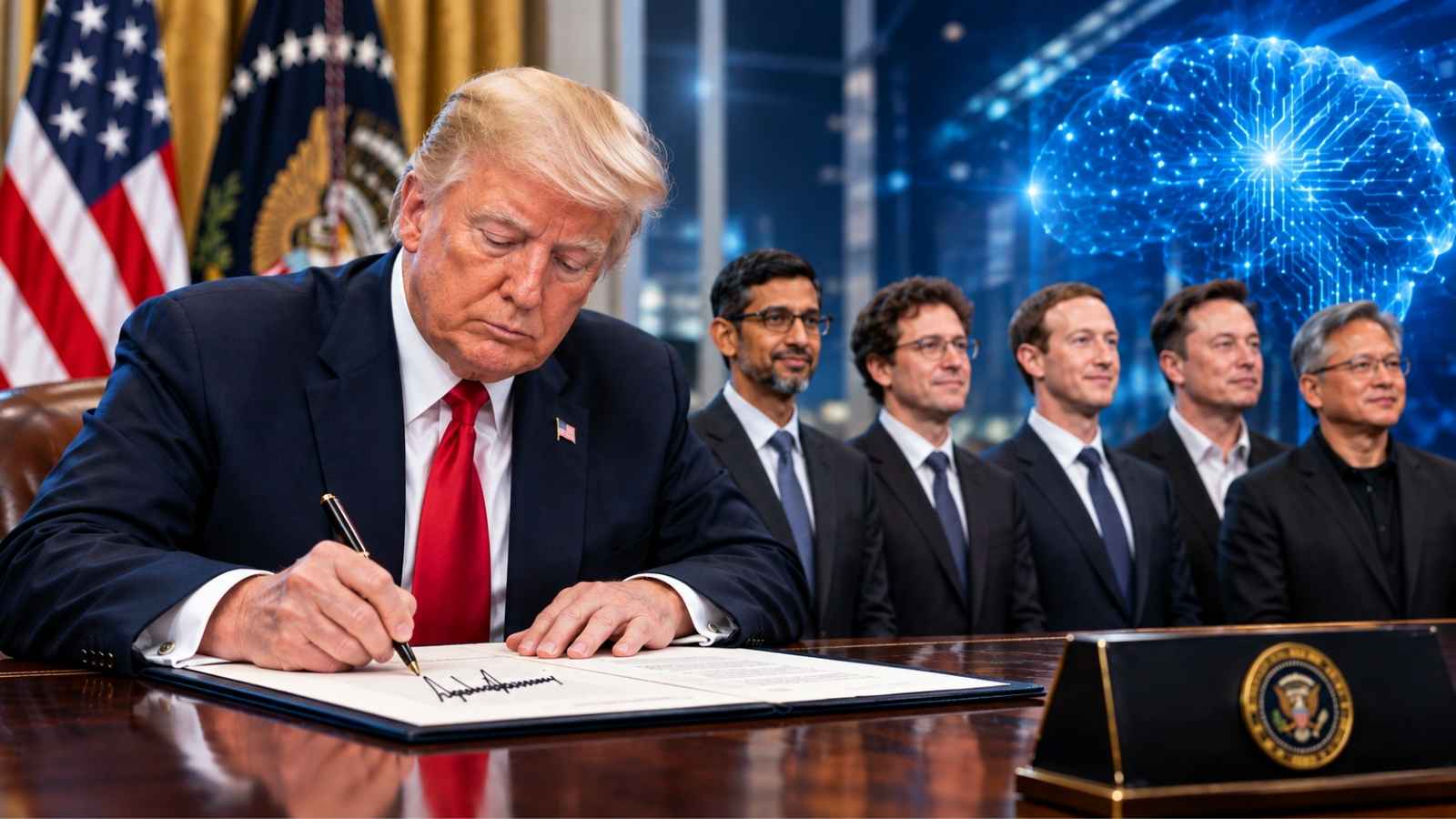
President Donald Trump signed an executive order on Tuesday, September 29, 2026, directing federal agencies to stop using “artificial intelligence” and say “Super Intelligence,” or “SI,” instead. The order covers official correspondence, public communications, websites, reports and other non-statutory documents. The same day, the heads of six major AI and chip companies joined Trump in signing a voluntary safety pledge, the White House Accord on Super Intelligence.
Key takeaways
- The order covers executive branch agencies only, and older regulations, contracts and documents do not need to be changed.
- Trump’s science and technology adviser has 60 days to propose legal language defining “Super Intelligence.”
- The accord is voluntary, with no penalties and no deadline.
- A typo under Trump’s signature, “Unites States,” went viral.
- Polls show most Americans are worried about AI, and Democratic senators say the accord falls short.
What the executive order does
The order is titled “Inaugurating the Era of Super Intelligence.” It says frontier AI systems now do far more than imitate or automate pieces of human intelligence, so the old name no longer fits. Agencies must use “Super Intelligence” and “SI” in their communications. Trump’s science and technology adviser, Michael Kratsios, has 60 days to consult agency heads and decide whether the new term should replace the legal definition of “artificial intelligence.”
The change is mostly one of language for now. One analysis of the text notes that, as drafted, “SI” means what US law already defines as AI. Any change to the statutory definition would need action from Congress.
How the new name came about
Trump first floated the idea in a Truth Social poll earlier in September. A follow-up poll pitting “Superior Intelligence” against “Super Intelligence” went to the latter with 65% of the vote. He then used the term in his address to the UN General Assembly, saying “artificial” makes the technology sound fake. At the America.gov launch on Tuesday, he told the audience the name had changed officially.
Industry leaders are already using it. Nvidia CEO Jensen Huang called data centers “SI factories,” and Elon Musk reposted a clip of the gathering with the caption “Super Intelligence.”
The White House Accord on Super Intelligence
After a White House lunch, Trump posted a one-page document titled “Joint Commitment on Frontier Responsibilities.” It was signed by Trump, Google’s Sundar Pichai, Anthropic’s Dario Amodei, Meta’s Mark Zuckerberg, OpenAI’s Greg Brockman, xAI’s Elon Musk and Nvidia’s Jensen Huang. The text runs just over 300 words and sets out four layers of controls and audits:
- Internal controls to monitor model capabilities and alignment during training and deployment, in areas such as cybersecurity, biosecurity and chemical threats.
- An internal team to make sure those controls work and problems get fixed.
- An independent external auditor or evaluator.
- An independent board committee to receive reports and make sure issues are remediated.
The text says companies “should” take these steps and that it “may make sense” to turn them into law later. There are no penalties for skipping a step. Nor is there an implementation deadline. Asked whether it is binding, Trump said he thinks it is “morally binding.” Musk described the deal as companies “grading each other’s homework.”
The “Unites States” typo
The accord’s signature block describes Trump as “President of the Unites States.” A fact-check confirmed the misspelling appears in the White House’s own post of the document. Social media users mocked it, with one writing, “If this is Super Intelligence, I’ll pass.” The White House had not responded to a request for comment.
Vance: no new AI regulator
At the same event, Vice President JD Vance defended working with AI companies rather than regulating them. He rejected proposals for an FDA- or FAA-style regulator, arguing that bureaucrats know less about the technology than the people building it, and said the FTC and Justice Department can already act against harmful products.
Also Read- AI Agents Are Acting on Their Own: Why AI Safety Is Becoming an Infrastructure Problem
Criticism and public opinion
Sen. Mark Warner, D-Va., said renaming AI does nothing to address real risks. On Wednesday, Sen. Richard Blumenthal, D-Conn., told a Senate hearing the voluntary system would be “totally secret” and “worse than ineffectual.”
A CNN/SSRS poll found 75% of Americans view AI’s growth with fear and concern, and 71% want the federal government to do more to regulate it. Supporters counter that a light-touch approach protects US competitiveness. Huang said there is “no conflict between innovation, technology and safety.”
Also announced: America.gov and an AI czar
Trump also launched America.gov, an AI chatbot meant to be a single entry point to federal services, which reportedly uses Google’s Gemini and Elon Musk’s Grok. He said he would name an AI czar within three to four days. He also floated a committee of about 10 people to oversee AI development, and called it a “good idea” to make Director of National Intelligence Jay Clayton the czar.
What to watch next
- The 60-day deadline for proposed legislative language defining “Super Intelligence,” which would fall around the end of November.
- Who is named AI czar, and whether the 10-person oversight committee gets formed.
- Whether any signatory publishes details on its external auditor or board committee.
- Whether Congress, which is already divided over AI safety bills, moves on binding rules.
Also Read- US, China Agree on Lower Tariffs for $30 Billion of Goods, Open Talks on AI After Xi Visit