

Nearly two in three U.S. business establishments launched in 2013 were gone a decade later. The Bureau of Labor Statistics reports that only 34.7 percent of private-sector establishments born in March 2013 were still operating in March 2023, and the sharpest drop, more than 20 percentage points, came in year one.
So what separates the founders who survive, and then scale, from everyone else? Capital, timing and talent all play a part. But one pattern keeps surfacing in the leaders we profile at GlobeVox Leaders: a disciplined entrepreneur growth mindset built on three things: resilience, calculated risk-taking and vision clarity.
This guide turns those three ideas into seven concrete habits, each tied to research, a real-world founder story and, where it fits, a leader from our cover stories and exclusive interviews. One honest caveat first: mindset on its own does not build a company. The evidence says it works only when it shows up in what you do. That is the lens for everything below.
| THE 7 HABITS AT A GLANCE
Resilience • Habit 1: Separate the setback from your identity • Habit 2: Treat failure as data and keep a failure log • Habit 3: Build four kinds of resilience before you need them Calculated risk-taking • Habit 4: Decide your affordable loss before you leap • Habit 5: Sort decisions into one-way and two-way doors Vision clarity • Habit 6: Write your vision down, make it specific and communicate it • Habit 7: Turn vision into goals and a weekly learning loop |
What Is an Entrepreneur Growth Mindset?
An entrepreneur growth mindset is the belief that your skills, judgment and even your tolerance for risk can be developed through effort, feedback and experience, paired with the daily habits that put that belief to work. The idea comes from Stanford psychologist Carol Dweck’s research on how people think about ability: as fixed, or as something that can be built.
For founders and CEOs, the practical version is simple. When something goes wrong, you ask “what does this teach me?” before you ask “what does this say about me?”
Does Mindset Really Predict Entrepreneurial Success? What the Research Says
Be wary of anyone who sells mindset as a magic lever. A widely cited pair of meta-analyses by Sisk and colleagues, published in Psychological Science, pooled data from hundreds of thousands of students and found weak overall effects of growth mindset on academic achievement, though somewhat stronger effects for students from low-income backgrounds or at academic risk.
That is education research, not entrepreneurship research, but the lesson travels. Believing you can grow is not enough. The belief has to be backed by hard challenges, good strategy and action. Dweck herself has warned against a “false growth mindset” that praises effort while ignoring results.
The entrepreneurship research is more encouraging, and it points the same way: what predicts outcomes is how founders decide, recover and communicate.
- Baum and Locke tracked 229 entrepreneur-CEOs over six years in a single industry. Goals, self-efficacy and a communicated vision each had direct effects on later venture growth.
- Saras Sarasvathy studied 27 expert entrepreneurs and found a shared decision logic built around limiting downside rather than chasing the biggest payoff.
- Hayward and colleagues argue that highly confident entrepreneurs are better positioned to start, and succeed with, another venture because they can build emotional, cognitive, social and financial resilience.
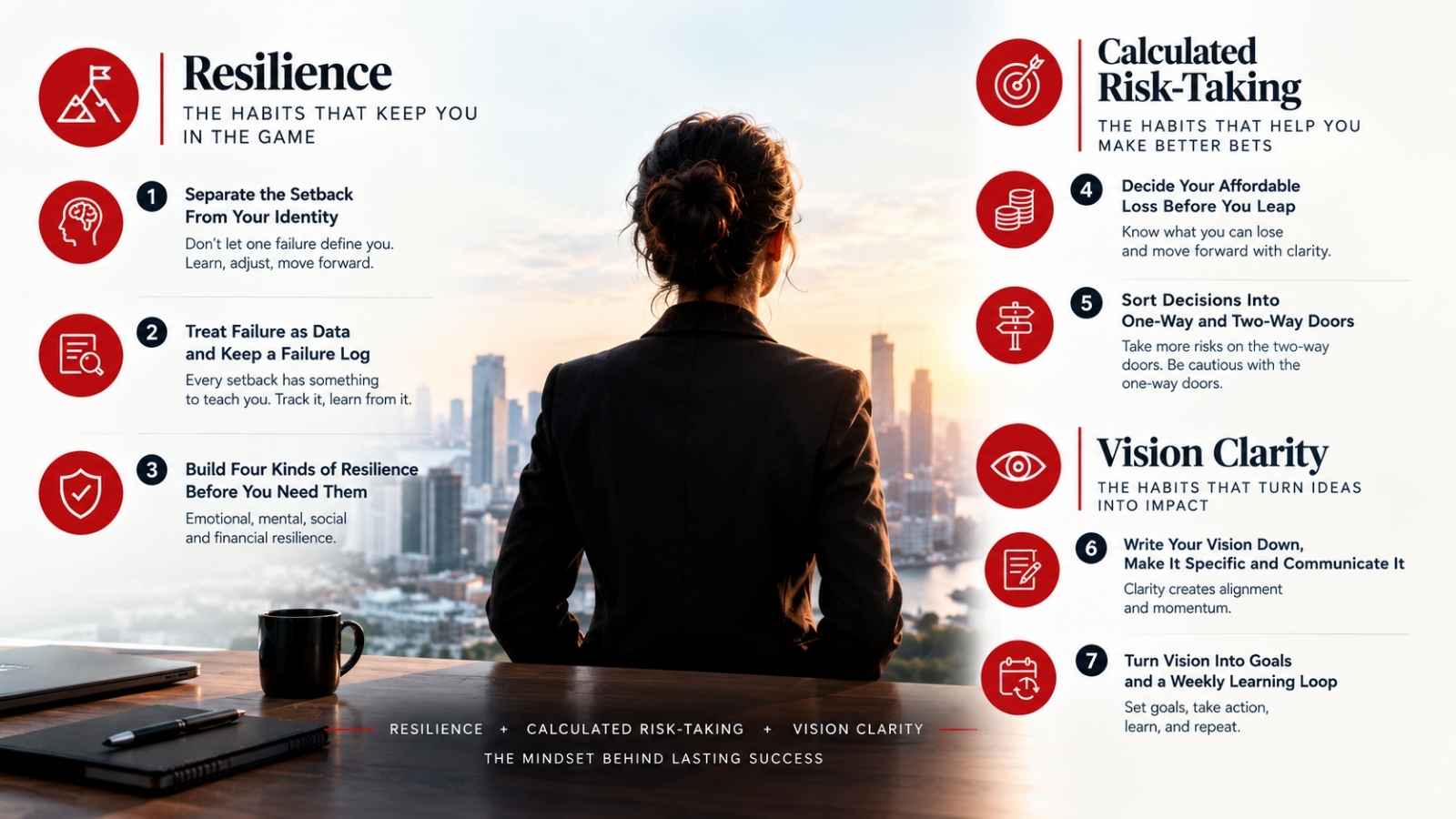
So the seven habits below are behaviors, not affirmations. You can do them this week, and you can check whether you did.
Pillar 1: Resilience, the Habits That Keep You in the Game
Resilience matters because the early years are brutal, as the BLS numbers above show. These three habits keep you in business long enough for your strategy to work.
Habit 1: Separate the Setback From Your Identity
Every founder fails. The difference is what they conclude about themselves afterward. A founder who reads a lost deal as proof of personal inadequacy stops taking swings. A founder who reads it as an event with causes can analyze it, adjust and go again.
Hayward and colleagues make a related argument: highly confident entrepreneurs are better placed to start again after a failed venture, because that confidence helps them build resilience they can reuse.
| GLOBEVOX SPOTLIGHT
Anuvamshi Shetty, Founder, The Lighthouse Capital An early finance job left her questioning whether she belonged in the field. She quit, cried, felt embarrassed and told people she had “randomly quit.” The next morning she started looking for her next role. Years later, she defines success as being able to watch something go wrong without letting it redefine how she sees herself. Her firm’s first deal took roughly six months to close. Read her full interview. |
| TRY THIS WEEK
After your next setback, write exactly two sentences: “What happened?” and “What will I do differently?” If a third sentence starts with “I am,” delete it. |
Habit 2: Treat Failure as Data and Keep a Failure Log
Spanx founder Sara Blakely has said her father asked his kids at the dinner table what they had failed at that week, and was disappointed if they had nothing to report, according to CNBC. He was rewarding attempts, not outcomes. She launched Spanx in 1998 with $5,000 in savings.
James Dyson is the extreme case. He spent five years and built 5,127 prototypes before his bagless vacuum worked, and he was more than $1 million in debt along the way, as Entrepreneur reports. Established manufacturers turned the design down, so he built the business himself, and by the mid-1990s the Dyson Dual Cyclone was the top-selling vacuum cleaner in Britain.
The pattern in both stories is not stubbornness. It is a feedback loop: every failure produced information that shaped the next attempt. Companies recover the same way. Our Apple case study traces how Apple went from near-bankruptcy in 1997 to a $4 trillion company through design, ecosystem and focus.
| GLOBEVOX SPOTLIGHT
Spencer Stevenson, Founder and CEO, SpexHair (Cover Story) His first hair transplant was a disaster, and twelve more procedures followed, some good and some bad. Instead of keeping the experience private, he turned it into more than two decades as an independent patient advocate, built on telling people the truth before a clinic tells them what they want to hear. Read his cover story. |
| TRY THIS WEEK
Start a one-page failure log with five columns: date, what I tried, what happened, what I learned, what I will change. Review it with your leadership team once a month. |
Habit 3: Build Four Kinds of Resilience Before You Need Them
Hayward and colleagues describe four forms of resilience that entrepreneurs can build and carry from one venture to the next. Most founders invest in one or two. Audit all four before the crisis, not during it.
| Type | What it looks like | How to build it |
| Emotional | Recovering energy and optimism after a loss | Protect sleep and routines; join a peer group of founders who have been through it |
| Cognitive | Learning from failure instead of rationalizing it | Run a written post-mortem within a week of every major miss |
| Social | Relationships that outlast any single venture | Treat investors, advisers, staff and customers well, especially when things go wrong |
| Financial | Runway and personal buffers that buy time | Know your runway in months; keep personal reserves separate from the business |
| GLOBEVOX SPOTLIGHT
Ashley Lands, Founder, AML Hospitality (Cover Story) From 2018 she lived through months of unexplained health episodes, and over the next three years one symptom would fade as another appeared. She kept working through all of it, negotiating contracts, moving countries and launching new ventures. She counts that endurance as her biggest milestone and describes strength as rarely loud, but consistent. Read her cover story. |
Pillar 2: Calculated Risk-Taking, Bold Without Being Reckless
The popular image of the entrepreneur is a gambler. The research says otherwise. Sarasvathy’s study of 27 expert entrepreneurs, each with more than 15 years of experience, multiple ventures and at least one company taken public, found that they did not chase the largest possible upside. They asked what they could afford to lose.
Habit 4: Decide Your Affordable Loss Before You Leap
Sarasvathy calls this the affordable loss principle: decide how much you can lose, then let that number, not a forecast of returns, drive the decision. It is an honest way to take risk because you can know your downside, while you can only guess at your upside.
Blakely’s start fits the pattern. She began Spanx with $5,000 of her own savings, in effect capping her downside at an amount she could absorb. The same logic applies at CEO level when you fund a new product line, enter a market, or make a senior hire: name the worst case first.
| TRY THIS WEEK
Write an affordable loss statement for your next big bet: “I am willing to lose up to $__ and __ months. I will stop or restructure if __ has not happened by __.” If you cannot survive the number, shrink the bet by piloting, phasing or finding a partner. |
Habit 5: Sort Decisions Into One-Way and Two-Way Doors
Amazon founder Jeff Bezos set out the most useful risk filter in business in his 2015 and 2016 shareholder letters, as summarized by Farnam Street. Some decisions are consequential and nearly irreversible, “one-way doors,” and deserve slow, careful deliberation. Most are reversible “two-way doors” and should be made quickly by small groups, often with around 70 percent of the information you wish you had. As organizations grow, he warned, they tend to apply heavyweight process to everything.
Calculated risk-taking is mostly the discipline of knowing which door you are standing in front of. Founders who treat every decision as irreversible stall. Founders who treat every decision as reversible eventually walk through a door that locks behind them.
Ashley Lands shows both speeds. Her move to Italy followed weeks of conversation with her closest friend, a one-way ticket to Rome, and four months of contractors, meetings and talks with local mayors and business owners to test whether the idea held up.
| GLOBEVOX SPOTLIGHT
Dr. Amish Purohit, Co-Founder, President and Chief Health Officer, Arkos Health His profile notes that military medicine taught him triage: making high-stakes calls with incomplete information. He then spent roughly 25 years moving through every layer of the healthcare system before co-founding Arkos Health in 2020 by merging three organizations. It now spans five states and more than 600,000 covered lives. Read as a playbook, the sequence is clear: learn the terrain first, then make the one-way-door move. Read his interview. |
| TRY THIS WEEK
Before your next leadership meeting, label every pending decision “one-way” or “two-way.” Give each two-way decision one owner and a deadline of 48 hours. Save the long debates for the one-way doors. |
Pillar 3: Vision Clarity, the Habit That Turns Effort Into Direction
In their six-year study of 229 entrepreneur-CEOs, Baum and Locke found that communicated vision, goals and self-efficacy had direct effects on later venture growth, and that these factors mediated the effects of passion, tenacity and new-resource skill. In plain terms, passion and persistence mattered in that study largely because they fed clear goals, self-belief and a vision people could understand.
Habit 6: Write Your Vision Down, Make It Specific and Communicate It
A vision is not a slogan. It is a picture of the future specific enough that people can make decisions with it. Anuvamshi Shetty built her firm’s name around the idea: as she puts it, a lighthouse doesn’t sail the ship, it provides visibility so others can navigate uncertainty.
Test your own vision against four questions:
- Specific: Can a new hire repeat it in one sentence?
- Who: Does it name who you serve and what changes for them?
- Boundaries: Does it make clear what you will not do?
- Horizon: Does it carry a time frame, such as three to five years?
Communication matters as much as the content. A colleague describes Alyssa Klimuszka, founder of HerHR Solutions, as someone who paints a clear picture of the future state and then guides people through the change so they feel part of the solution. That is vision communication in practice.
| GLOBEVOX SPOTLIGHT
Jaidin McCann, Executive Search Leader Her profile opens on the moment she realized her industry had been solving the wrong problem, the kind of clarity that turns a career into a company. She went on to build a people-first approach to executive search aimed at transforming work culture. Read her interview. |
| TRY THIS WEEK
Write your vision in 25 words or fewer. Read it to three people outside your company and ask them to repeat it back. If they cannot, rewrite it. |
Habit 7: Turn Vision Into Goals and a Weekly Learning Loop
A vision without goals is a poster. Baum and Locke found that goals and self-efficacy had direct effects on growth alongside communicated vision, and that communicated vision was related to goals. Translate the vision into staged targets, then review them on a fixed rhythm.
Build the loop in three steps:
- Monday: Pick the one goal that moves the vision furthest this week.
- Midweek: Check one leading indicator, not just revenue.
- Friday: Hold a 15-minute review. What did we learn, and what changes next week?
Learning is the part founders skip. Shetty says entrepreneurship made her less fixated on having perfect answers and more focused on asking better questions. For how these habits shift as you move from founder to chief executive, see our guide to the founder-to-CEO transition, and for the wider market backdrop, our analysis of business growth trends.
| GLOBEVOX SPOTLIGHT
Alyssa Klimuszka, Founder and President, HerHR Solutions She reached executive-level HR leadership before turning 30, then founded HerHR Solutions to give small and mid-sized businesses senior HR thinking without the overhead of a permanent hire. Her stated ambitions are staged: become the trusted HR partner of choice across Western New York first, then expand nationally. Read her profile. |

Your 30-Day Growth Mindset Plan
Do not try to adopt all seven habits at once. Use this sequence.
| Week | Focus | Action |
| Week 1 | Resilience (Habits 1 and 2) | Start your failure log. Use the two-sentence reset after every setback. |
| Week 2 | Resilience (Habit 3) | Score yourself 1 to 5 on emotional, cognitive, social and financial resilience. Fix your lowest score first. |
| Week 3 | Risk (Habits 4 and 5) | Write one affordable loss statement and sort every open decision into one-way or two-way doors. |
| Week 4 | Vision (Habits 6 and 7) | Write your 25-word vision, test it on three people, then set up the Monday-to-Friday loop. |
Where a Growth Mindset Goes Wrong (and How to Avoid It)
Confusing confidence with evidence. Confidence helps founders rebound, but Hayward, Shepherd and Griffin also argue that founders who are overconfident can starve their ventures of resources and resourcefulness, raising the odds of failure. Pair every bold call with a pre-mortem: imagine the venture failed in a year and write down why.
Praising effort while ignoring results. This is the “false growth mindset” Dweck cautions against. Effort matters only when it is aimed at the right problem and measured against outcomes.
Copying survivors. The BLS data is a reminder that we mostly hear from the founders who made it. Treat any founder story, including the ones in this guide, as a hypothesis to test in your own context, not a formula.
Conclusion: Mindset Is Built, Not Found
The founders in this guide span medicine, finance, hospitality, HR and consumer products, and none of them followed a perfect plan. What they share is a set of habits: they recover from setbacks without losing themselves, take risks they can afford, and keep the destination clear enough to steer by. None of that is genetic. All of it can be practiced, starting with one habit this week.
Frequently Asked Questions About the Entrepreneur Growth Mindset
What is the growth mindset of an entrepreneur?
It is the belief that skills, judgment and resilience can be developed through effort and feedback, combined with habits that act on that belief: learning from failure, taking affordable risks and pursuing a clear vision.
Can you develop an entrepreneurial mindset, or are you born with it?
The research on expert entrepreneurs suggests their decision logic is learned. Sarasvathy’s effectuation work is taught as a learnable method, and the habits in this guide are practices you can start and measure.
How do successful entrepreneurs handle failure?
They separate the event from their identity, extract lessons from it and change the next attempt. Founders from Sara Blakely to James Dyson describe failure as an input to the process rather than a verdict on it.
What is the difference between calculated risk and gambling?
A calculated risk has a defined downside you can survive, a decision process matched to how reversible the choice is, and a learning plan if it fails. A gamble has none of these. The affordable loss and one-way-door habits above turn gambles into calculated risks.
Why does vision clarity matter for business growth?
In a six-year study of entrepreneur-CEOs, communicated vision had a direct effect on venture growth, alongside goals and self-efficacy. A clear vision gives teams a way to make decisions without waiting for you.
Where can I read real founder stories that show these habits?
GlobeVox Leaders publishes cover stories, exclusive interviews and Inspiring Women profiles of founders and CEOs across industries and continents. You can also browse our latest magazine issues.
| KEEP GOING WITH GLOBEVOX LEADERS
Meet the leaders living these habits in our cover stories, exclusive interviews and Inspiring Women series, or pick up the latest magazine issue. Building something worth telling the world about? Contact the GlobeVox Leaders team to get featured, or learn about our mission. |
Further Reading From GlobeVox Leaders
- Founder to CEO Transition: 7 Shifts That Decide Whether You Scale or Stall
- Startup Founder Leadership: 10 Lessons From Founders Who Built Iconic Companies
- Business Growth Trends: 10 Powerful Strategies Shaping Success in 2026
- Apple Case Study: How Apple Built a $4 Trillion Empire Through Design, Ecosystem and Focus
- Digital Transformation Strategy: The Executive Blueprint for Building Future-Ready Businesses