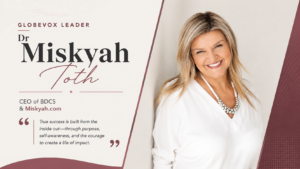
There is a particular type of leader that a workforce needs not when the existing systems are functioning adequately, but when an entire profession has quietly settled for being treated as a support function rather than the strategic driver it actually is. Dr. Miskyah Toth reached that realization early in her career in South African human resources, and rather than adapting to the limitation, she built an organization designed to prove it wrong.
As CEO and Owner of Business Directive Contract Services and founder of the Miskyah.com platform, Dr. Miskyah Toth has become one of the most influential voices on workforce leadership across the African continent. Her path there was not a straight line. It was, by her own account, a conscious and rigorous process of finding the gaps in how organizations manage their people and closing them at a scale large enough to matter, work that has since provided employment to thousands of individuals.
A Foundation Built on Watching Systems Fail
Dr. Miskyah Toth’s career did not begin in consulting or executive leadership. It began inside Human Resources itself, in the roles where she first encountered the problem she would eventually spend her career solving. Too many organizations, she observed, treated HR as a support function rather than a strategic driver of business success, managing talent reactively with little structured development, alignment, or attention to long-term impact.
That observation was not an abstract critique for her. It became the defining moment of her career. She watched organizations make workforce decisions without any real framework for understanding the downstream consequences, watched people get placed without purpose and potential go undeveloped, and watched entire business operations run below their capacity because the human infrastructure holding them together had never been built with intention. Rather than simply naming the problem, she built a company to close it.
Founding Business Directive Contract Services
Dr. Miskyah Toth founded Business Directive Development Group in 2012 with the explicit purpose of repositioning workforce solutions as a strategic pillar within organizations, rather than a peripheral service handled after the fact. Eight years later, at the outset of the global pandemic, an opportunity arose to purchase a workforce contract from a leading South African online retailer, a company that, at that stage, employed more than 250 people. Rather than treat the moment’s uncertainty as a reason for caution, Dr. Toth used it to think bigger, creating Business Directive Contract Services as a dedicated entity to manage the contract and expand the model.
That decision, made at what would have been an understandably difficult time to expand, reflects a pattern that recurs throughout her career: treating disruption as room to build rather than a reason to retreat. BDCS has since grown into an all-in-one workforce management partner specializing in supply chain and logistics staffing, powered by technology and a people-first approach that has become the firm’s signature.
Building for Scale, Not Just for Placement
What distinguishes Dr. Miskyah Toth’s model from conventional HR consulting is its orientation toward systems rather than individual transactions. She did not build BDCS simply to place people in jobs one at a time; she built it to influence entire organizations simultaneously, designing structured workforce frameworks that connect talent with opportunity in ways that are intentional, measurable, and aligned with long-term business performance. Through a structured model operating at that scale, she is able to support not just individuals but entire teams and organizations at once, developing business performance and individual growth in parallel rather than treating them as separate goals.
That scale carries weight for her personally as much as strategically. Every person on the BDCS payroll represents a livelihood supported, a family affected, and an opportunity created that might not otherwise have existed, and she holds that awareness deliberately, because it is precisely that sense of consequence that keeps her standards exacting.
The growth of BDCS also forced a shift in how Dr. Miskyah Toth defines her own leadership. In the company’s earliest stages, leadership meant direct involvement in nearly every operational detail. As the organization scaled, she made the transition many founders struggle to complete, from operational control to strategic direction, a shift that required trust, delegation, and internal structures strong enough to function without her presence in every room. Leadership today, in her framing, is about alignment: making sure every decision, process, and person is moving with clarity and shared purpose.
The Cost of Being Underestimated
Dr. Miskyah Toth has been candid that the path to this point required more than good strategy; it required repeatedly proving her domain was strategic at all. Coming from an HR background carried a built-in perception, in some rooms, that her role was supportive rather than strategic, and she had to consistently demonstrate through results that workforce strategy is business strategy, not an adjunct to it.
That demonstration, sustained over years rather than delivered in a single pitch, became the discipline underlying how she runs BDCS today: staying focused when progress felt slow, making difficult calls under pressure, and remaining patient when outcomes were not guaranteed. She has distilled the lessons of that period into four guiding values that now anchor her leadership: integrity, which drives decisions aligned with long-term purpose even when easier shortcuts exist; resilience, which sustains focus through uncertainty; accountability, which demands full ownership of outcomes whether they are favorable or not; and empathy, which ensures every situation is approached with genuine understanding of the other side’s perspective.
A Platform That Extends Beyond One Company
Dr. Miskyah Toth has never positioned her work as locally bounded. She deliberately maintains exposure to international workforce trends and emerging business models specifically so her approach to the South African market stays forward-thinking rather than insular, treating global perspective as a discipline rather than an accident of exposure.
Her platform, Miskyah.com, extends that reach well beyond BDCS itself, offering initiatives including Let’s Talk Business alongside a structured coaching and mentoring program that gives aspiring professionals, particularly women, access to guidance, visibility, and the kind of sponsorship that changes the trajectory of a career. Those platforms run parallel to BDCS and amplify its impact, built around the same conviction that drives everything else she has built: that every individual she works with represents potential worth developing, whether that potential leads to growth, to leadership, or simply to meaningful change in someone’s own life.
Recognition That Followed the Work, Not the Other Way Around
The recognition Dr. Miskyah Toth has accumulated reflects the breadth and consistency of her impact rather than a deliberate campaign to earn it. She holds an Honorary Doctorate, was named among IAOTP’s Top 50 Fearless Leaders, was recognized as a Power List 2025 Defining Voice of the Year, received the Asian African Chamber of Commerce and Industry’s Woman Leader of the Year in Human Resource Management for 2024, and was honored with a Standard Bank Top Women Award, among other international distinctions. She has been featured in the White Page International Coffee Table Book and profiled across global media platforms reaching multiple continents.
She receives all of it with gratitude rather than expectation, since none of it was the goal she was building toward in the first place; it was never something she actively pursued, but a reflection of consistent effort recognized after the fact. The milestone she returns to most readily is not a trophy. It is the thousands of people employed through BDCS, and the individual stories of confidence and growth folded inside that number.
What Makes a Leader Like This
It is worth pausing on what makes Dr. Miskyah Toth’s career, taken as a whole, more distinctive than it might first appear. The conventional narrative for an HR leader emphasizes staying within the function’s traditional lane: managing people processes competently, supporting the business rather than driving it. Dr. Miskyah Toth inverted that model by refusing to accept the premise, building an organization explicitly designed to prove that workforce strategy is business strategy, then scaling it large enough that the argument became undeniable.
That inversion required specific skills: the discipline to keep demonstrating strategic value through measurable results rather than argument alone, the operational maturity to shift from doing everything herself to building systems and people who could carry the mission without her, and the steadiness to treat setbacks and slow periods as part of the discipline rather than as evidence she was on the wrong path. Dr. Miskyah Toth has built all of these, and the throughline connecting the early HR practitioner who saw the gap, the founder who bet on expansion during a pandemic, and the CEO now recognized across continents is the same: a conviction that people, treated with intention rather than managed reactively, are an organization’s actual strategic asset.
The Road Ahead
The work continues to expand. Miskyah.com continues to grow its coaching, mentoring, and thought-leadership reach, extending Dr. Miskyah Toth’s influence well past the organizations BDCS directly serves and into the careers of individual professionals navigating their own paths. Her memoir, Iron in Silk, stands as a personal counterpart to that public work, not a business book but a reflection on the resilience required to build something meaningful, and the story beneath every professional milestone she has earned.
When she describes the legacy she wants to leave, she does not reach for growth figures or market position. She measures her journey by the people she has encountered along the way: the individuals who trusted her, the teams that grew through shared effort, and the moments, even small ones, where genuine change occurred.
More than a decade into a career built on refusing to accept that HR had to be a supporting function, Dr. Miskyah Toth remains exactly what she has always been at heart: proof that the people holding an organization together were the strategic asset all along.