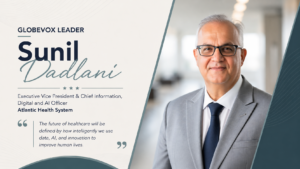
There is a particular type of leader that a healthcare system calls not when the infrastructure is stable, but when the entire industry around it is being disrupted at once by regulation, by cyber threats, by data volumes doubling every few months, and by a workforce and patient population that both expect technology to simply work. Sunil Dadlani has spent more than two decades being that leader, across five continents, inside some of the largest and most heavily regulated organizations in the world.
As Executive Vice President, Global Chief Information and Digital Officer, and Chief Cybersecurity Officer at Atlantic Health System, one of the most credible and integrated healthcare systems in the country, Sunil Dadlani sits at the intersection of three roles that most executives would consider full-time jobs on their own: technology strategy, digital transformation, and cybersecurity, applied simultaneously across seven hospitals, more than 400 ambulatory sites, and a network serving over six million patients. It is not a role he arrived at by accident. It is the product of a career built, deliberately, across industries that most technology leaders never cross.
A Foundation Built Across Industries and Continents
Sunil Dadlani’s career began in telecommunications, at Siemens and Motorola, before he moved into software with Novell and then into media and entertainment as Global Head of Enterprise Business Applications and Digital Transformation at Sony. That sequence alone would be an unusual résumé for most technology executives. For Dadlani, it was preparation. Over more than twenty years, he worked across four continents and more than twenty countries, for Fortune 100 companies spanning telecom, software, and media before he ever set foot in healthcare.
To sharpen the leadership skills that would carry him through increasingly complex mandates, Dadlani pursued multiple master’s degrees and executive leadership programs at Harvard, Wharton, MIT, Cornell, and Columbia Business School, alongside an MBA in Global Management and a master’s in Computer Science and Information Systems, a combination of technical depth and strategic breadth that would prove essential once he moved into an industry where both are non-negotiable.
The Turn Toward Public Health at Scale
Dadlani’s move into healthcare came through public service, when he became Chief Information Officer for the New York State Department of Health. It was there, leading what would become the largest public-sector digital business technology transformation in the state’s history, that he oversaw the delivery of digital health care services to nineteen million New Yorkers a scale of impact that reframed how he thought about the purpose of his work.
That reframing, an interest in science and medicine combined with a growing sense of purpose around improving people’s lives through high-quality care, would define the rest of his career. It was not a lateral move from public service into private healthcare; it was a deepening of the same mission at a different altitude.
Atlantic Health System: Building the World’s Most Credible and Integrated Health System
Since joining Atlantic Health System in September 2020, Dadlani has overseen technology systemwide, with a particular focus on the continued growth of the organization’s electronic medical record platform and the development of cloud-based enterprise data and analytics infrastructure. His mandate spans four distinct disciplines simultaneously: setting technology strategy aligned with the system’s mission, overseeing electronic health record and patient management systems, building state-of-the-art analytics platforms while protecting patient data under HIPAA, and leading a comprehensive cybersecurity program that monitors network traffic and manages incident response across the entire system.
Beyond infrastructure, Dadlani has led the organization’s digital transformation efforts directly, including the implementation of telemedicine, remote patient monitoring, wearables, and connected devices, along with AI and machine learning-enabled clinical and non-clinical transformations. His stated vision for Atlantic Health System is unambiguous: to become the world’s most credible and integrated health system, delivering the highest quality of care and wellness to the communities it serves.
That work has not gone unrecognized. Dadlani was named a CIO 100 award winner in both 2022 and 2023, was named to Becker’s Hospital Review’s list of 100 Hospital and Health System CIOs to Know, and was nominated for the New York CIO of the Year ORBIE Award, distinctions that place him among a small group of healthcare technology leaders whose organizations have been formally recognized for combining innovation with measurable operational results.
A Philosophy Built for Constant Disruption
Dadlani has been direct about what makes healthcare technology leadership distinct from the private-sector roles that preceded it. The industry is heavily regulated and in a state of near-constant disruption, driven by shifting regulations, workforce shortages, rising costs, new market entrants, and rising rates of data breaches and cyberattacks, compounded by the fact that healthcare data alone now makes up roughly a third of the world’s data and doubles in volume every 73 days.
Rather than treat that complexity as a burden, Dadlani has built his leadership philosophy around meeting it directly. Adaptability is not a nice-to-have in his framing; it is the only sustainable posture available to a leader in an industry where the ground keeps shifting. He has put it plainly: the more open a leader is to change, the more easily they navigate the disruptions the industry throws at them. He has also been candid that leaders should disrupt themselves before someone else in the industry does it first, a mindset he applies as readily to his own team’s roadmap as to the broader system he oversees.
What Makes a Leader Like This
It is worth pausing on what makes Sunil Dadlani’s career, taken as a whole, more distinctive than it might first appear. The conventional narrative for a hospital system CIO emphasizes healthcare-specific experience built over decades within the industry. Dadlani inverted that model. He built his technical and strategic foundation across telecom, enterprise software, and global media, then applied that cross-industry fluency to an industry that, more than almost any other, needs leaders who have seen how technology gets built and scaled somewhere else first.
That inversion shows up directly in how he leads. He treats technology strategy, digital transformation, and cybersecurity not as three separate functions to be staffed out to three separate executives, but as one integrated mandate, because in a healthcare system serving six million patients, a gap between any of the three becomes a patient safety or privacy risk. The skills this requires are specific: the ability to translate innovations from consumer technology and media into a regulatory environment where a mistake carries life-or-death stakes, the discipline to build cybersecurity infrastructure that keeps pace with an industry under near-constant attack, and the patience to mentor the next generation of leaders while still being personally accountable for every one of those functions today.
Dadlani has built all of these, and the throughline connecting the telecom engineer, the Sony digital transformation executive, the New York State CIO, and the Atlantic Health System EVP is the same: a belief that technology’s only real purpose is to make people’s lives measurably better, and that the leader’s job is to build the infrastructure, culture, and security posture that make that possible at scale.
The Road Ahead
The work continues to expand. Dadlani continues to advance Atlantic Health System’s data and analytics capabilities, its AI and machine learning-enabled clinical transformations, and its cybersecurity posture in an environment where the threats and the opportunities are both accelerating at once. He remains an active voice in the broader healthcare technology community, speaking at global conferences on digital healthcare transformation and virtual care, and serving as an advisory board member for New York’s Health Information Technology and Health Information Exchange initiatives.
He has said that developing the next generation of leaders is essential to tackling the industry’s future challenges, and he has built mentorship and succession planning directly into how he runs his team, treating leadership development as core infrastructure rather than an afterthought.
More than two decades into a career built across telecom, software, media, public service, and now healthcare, Sunil Dadlani remains exactly what he has always been at heart: the leader who treats disruption not as a threat to manage defensively, but as the raw material every meaningful transformation is built from.