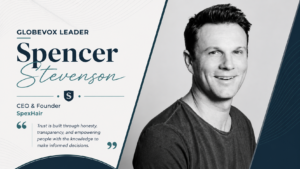
There is a particular type of leader that an industry needs not when things are working well, but when an entire sector has quietly normalized confusion, pressure, and unrealistic promises at the expense of the people it is supposed to serve. Spencer Stevenson has spent more than two decades being that person for hair restoration, a global industry worth billions, built almost entirely on the credibility of independent voices willing to tell patients the truth before a clinic tells them what they want to hear.
Known worldwide as SpexHair, Stevenson is the founder and CEO of SpexHair and co-founder of The Hair Loss Lab podcast, and he is widely regarded as one of the most recognized independent patient advocates in hair restoration anywhere in the world. He did not arrive at that reputation through a medical degree or a business plan. He arrived at it through thirteen hair transplant surgeries, some successful and some disastrous, and a decision to make sure no one else had to learn the hard way he did.
A Foundation Built on Hard-Won Experience
Two decades ago, Spencer Stevenson was a man in his twenties staring at a rapidly receding hairline with nowhere reliable to turn. There was no independent advocate to consult, no trusted resource cutting through the noise; there was only an industry of wigs, supplements, questionable therapies, and hair transplant clinics, many operating with more marketing polish than medical rigor. He tried nearly all of it. His first surgery was a disaster, launching him into a long and painful journey as a repair patient, complete with every disappointment, expense, and physical toll that entails.
That period, and the twelve procedures that followed it, could easily have ended as a private tragedy. Instead, it became the foundation of Stevenson’s life’s work. He has been candid that the credibility he carries today was not built through study alone; it was built by living through both sides of the scalpel, as a patient who suffered the industry’s worst outcomes long before he became the person warning others away from them.
Speaking Out Before It Was Safe to Do So
What sets Stevenson apart from the wider field of hair loss commentary is timing as much as substance. He was speaking publicly and bravely about his own hair loss and hair transplant history long before celebrities like Wayne Rooney brought the subject into mainstream conversation, at a moment when open discussion of male pattern baldness still carried real social stigma. That early willingness to be visible, at personal cost, is what allowed his story to be picked up repeatedly by major media and gave his later advocacy work its credibility.
Over the years that followed, Stevenson became a fixture across major outlets including the BBC, The Telegraph, The Times, The Guardian, HuffPost, GQ, Esquire, Men’s Health, and Bloomberg, and co-hosted the UK version of The Bald Truth radio show, offering live, honest guidance to thousands of listeners navigating the same confusion he once faced alone. That media presence was never the goal in itself; it was the mechanism through which he could reach people before predatory marketing did.
SpexHair: Building an Industry’s Independent Conscience
Through SpexHair.com, Stevenson built one of the world’s most trusted educational platforms for people struggling with hair loss, offering evidence-based guidance, long-term planning insight, and honest perspective, all of it free, all of it independent of any clinic’s commercial interest. That independence is the platform’s entire value proposition. In an industry frequently driven by confusion, pressure, and unrealistic promises, Stevenson positioned himself explicitly as someone with no surgery to sell.
The impact of that positioning shows up in individual stories as clearly as it does in the size of his following. One young man, close to committing to a low-cost transplant abroad, consulted Stevenson first and learned his hair loss was still unstable, meaning surgery would likely have caused long-term damage. Guided instead toward medication and non-surgical care, the patient stabilized his hair and regained his confidence without ever needing an operation, a quieter kind of outcome than a successful surgery, but arguably a more important one.
Stevenson has extended that same mission through The Hair Loss Lab, a growing educational platform and podcast built around expert interviews, real patient stories, and evidence-led guidance, designed to bring calmer, more transparent conversations to a space that has rarely rewarded either quality.
A Philosophy Built on Earned Trust
Stevenson has been direct about what separates genuine authority in his field from its imitation. Influence, in his framing, is not about visibility or follower count; it is about responsibility, exercised with the knowledge that both patients and professionals are paying close attention, often more than they let on. He has watched the industry’s more commercially driven voices adopt approaches he pioneered only once exposure became personally beneficial to them, a pattern he regards with more wry amusement than resentment.
That distinction between perception and credibility is one Stevenson returns to often. He has observed that perception can be created far more quickly than credibility can be earned, and that some in his field mistake visibility for expertise and exposure for genuine respect. His own standing, by contrast, has been built the slower way: through independence, consistency, and a willingness to challenge narratives that do not serve the patient, sustained over more than twenty years rather than manufactured in a single news cycle.
What Makes an Advocate Like This
It is worth pausing on what makes Spencer Stevenson’s career, taken as a whole, more unusual than it might first appear. The conventional path to authority in a medical or quasi-medical field runs through credentials: a degree, a license, a title that confers legitimacy before a single patient is helped. Stevenson inverted that model entirely. He built his authority from the opposite direction, starting as the least credentialed person in the room and turning thirteen surgeries’ worth of lived failure and eventual success into a form of expertise no medical degree alone could replicate.
That inversion is the source of his singular value to the people he serves. A patient in crisis, staring down the same decision Stevenson once faced with no one to guide him, does not need another sales pitch dressed up as consultation; they need someone who has been burned by the same false promises and lived to map the safer path. The skills this requires are specific: the discipline to stay independent of clinic sponsorship in an industry built on referral fees, the patience to sit with someone else’s fear and confusion long enough to guide rather than simply advise, and the honesty to admit when the right answer is no surgery at all.
Stevenson has built all of these, and the throughline connecting the desperate twenty-something staring in the mirror, the repair patient enduring a botched first surgery, and the globally recognized patient advocate is the same: a conviction that the people this industry serves deserve the truth before they deserve a sale.
The Road Ahead
The work continues to expand. The Hair Loss Lab is growing its reach in partnership with established platforms, extending credible, patient-first education to a wider audience of both men and women navigating hair loss. Stevenson continues to work in association with surgeons, clinics, and hair care brands who share his commitment to ethics, transparency, and long-term patient welfare, proof that independence and industry relationships are not, in his case, mutually exclusive.
He remains candid that the field still has plenty of catching up to do on standards of honesty, and equally candid that he sees that as an opportunity rather than a grievance: if his own standard for transparency pushes others in the industry to raise theirs, that ultimately benefits the patients both are meant to serve.
More than two decades into a mission he never set out to build, Spencer Stevenson remains exactly what he has always been at heart: proof that the most credible voice in a room is often the one who has already survived what everyone else in it is afraid of.