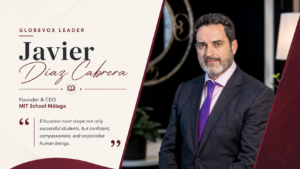
There is a particular type of leader that a community calls on not to run an institution as it has always been run, but to build the institution that doesn’t exist yet because no one else has been willing to take the risk. Javier Díaz Cabrera has spent more than three decades being that leader in Málaga, Spain, first steering an existing school for two decades and then, in 2010, founding the one he had always imagined from the ground up.
As founder and director of MIT School Málaga, Díaz Cabrera has built the only school in Málaga authorized by the Junta de Andalucía as a bilingual English-language center across every stage of education, from Infantil through the three tracks of Bachillerato. It is not a title he arrived at by inheritance or convenience. It is the product of a career spent refusing to accept that a school had to choose between academic rigor, emotional development, and technological ambition, when in his view a genuinely excellent education required all three at once.
A Foundation Built on an Unusual Breadth of Study
Javier Díaz Cabrera holds a doctorate in English Philology, along with additional university-level training in Chemistry, Psychology, and Law, an academic breadth that is unusual even among school directors and that would prove directly relevant to the institution he eventually built. Rather than specializing narrowly and deepening within a single discipline, he assembled a foundation that spans the humanities, the sciences, human behavior, and formal structure, a combination that mirrors, in miniature, the integrated philosophy he would later apply to an entire school.
He began his career as a school administrator at Colegio Los Rosales in Torremolinos, where he built the operational and pedagogical experience that would carry him through more than thirty uninterrupted years in Málaga school leadership, making him, by a wide margin, the longest-serving school director in the province.
The Founding of MIT School: Building the “Ideal” School From Scratch
In 2010, after two decades leading an existing institution, Díaz Cabrera made the decisive move of his career: founding MIT School Málaga inside the Parque Tecnológico de Andalucía with the explicit goal of creating the school he considered ideal, built on his own terms rather than adapted from someone else’s model. That ambition was not modest. He set out to combine the best of established pedagogical traditions, Montessori, behaviorist, Sudbury, and constructivist approaches among them, with the technological demands of a century none of those traditions had originally been designed for.
The results have been difficult to argue with. MIT School became the first school in Spain to introduce Virtual Reality Programming in the Unity environment as a fourth-year secondary subject, positioning it as a leader in advanced digital education years ahead of most of its peers. It became an official Cambridge Platinum examination center in 2018 and remains the only school in Europe certified to administer official Chinese language examinations, the YCT and HSK tests, a subject the school teaches from age three onward alongside German, introduced from the first years of primary school.
A Philosophy Built on the Whole Person
Díaz Cabrera has described his guiding educational philosophy directly: helping students reach the greatest possible degree of fulfillment across every dimension present in a human being, mind, body, energy, feelings, and relationships with the outside world. That is not a marketing phrase for him; it is the organizing structure behind everything the school builds, from its curriculum to its extracurricular programs to its approach to student evaluation.
One of the clearest expressions of that philosophy is MIT School’s adoption of the TEI program, Tutoría Entre Iguales, a peer-tutoring initiative in which older students mentor younger ones to prevent bullying and cyberbullying, making MIT the first Centro TEI in Málaga starting in 2019. The program reflects a belief that ran through Díaz Cabrera’s founding vision from the outset: that a school’s responsibility to its students extends well beyond test scores, into how those students treat one another.
That whole-student approach carries into how MIT evaluates outcomes as well. Student assessment weighs not only exam performance but effort, dedication, and attitude, and the results have followed. Students presenting for Spain’s university entrance examinations achieved an average score of 10.99, with more than two-thirds of students scoring above 11, results that place the school well above what would be predicted by its students’ socioeconomic and cultural profile according to the region’s own diagnostic evaluations.
Steering the School Through Disruption
Díaz Cabrera’s emphasis on technological infrastructure was tested directly during the pandemic, when MIT School’s existing digital capability allowed classes to continue without interruption. He has credited the high level of technological preparedness among both students and teachers with ensuring the school’s academic standard was not compromised by the lockdown, a claim borne out by the fact that the disruption other schools describe as a crisis became, for MIT, closer to a continuity exercise.
That same forward orientation has produced a string of formal recognitions: Spain’s award for best school in Integral Education in 2019, best school in Andalusia in 2020, one of the two best schools in Spain for bilingual quality, a Gold Medal for Excellence in Work, a Certificate of Excellence in Business Management, and, in 2022, Andalucía’s Excelente award in the Educational Project category, alongside a European award for business innovation and digitalization.
What Makes a Leader Like This
It is worth pausing on what makes Javier Díaz Cabrera’s career, taken as a whole, more unusual than it might first appear. The conventional narrative for a long-tenured school director emphasizes stability: running an established institution well, maintaining its reputation, and preserving what already works. Díaz Cabrera inverted that model at the exact midpoint of his career, walking away from two decades of accumulated institutional standing to found something unproven, on the theory that the ideal school he had in mind could not be built by incrementally adjusting someone else’s.
That willingness to rebuild from first principles rather than optimize an inherited system is the clearest throughline in his work. The skills it requires are specific: the intellectual range to design a curriculum spanning four languages and multiple pedagogical traditions without any of them feeling bolted on, the operational discipline to keep a growing school with waiting lists across numerous grade levels running at Cambridge and European examination-body standards, and the patience to build a teaching staff stable enough that many instructors have become minority partners in the school itself, an unusually direct form of buy-in for an educational institution.
Díaz Cabrera has built all of these, and the throughline connecting the young scholar with degrees in English Philology, Chemistry, Psychology, and Law, the administrator at Los Rosales, and the founder of MIT School is the same: a conviction that education, done properly, is not a service delivered to students but an environment built for the whole of who they are becoming.
The Road Ahead
The work continues to expand. MIT School’s Diploma Dual program now allows students to graduate with both a Spanish and an American qualification, extending the school’s international orientation beyond language instruction into the credentials students carry with them. The waiting lists across numerous grade levels stand as their own quiet verdict on demand for the model Díaz Cabrera built.
He has said the goal was never simply for MIT students to study several languages, but to learn and relate to one another in several languages, a distinction that captures how he thinks about education generally: not as content to be delivered, but as a way of being in the world that a school either builds into its students or fails to.
More than three decades into a career defined by an unwillingness to accept the ordinary version of a school, Javier Díaz Cabrera remains exactly what he has always been at heart: the educator who built the institution he once wished existed, and then spent the rest of his career proving it could work.