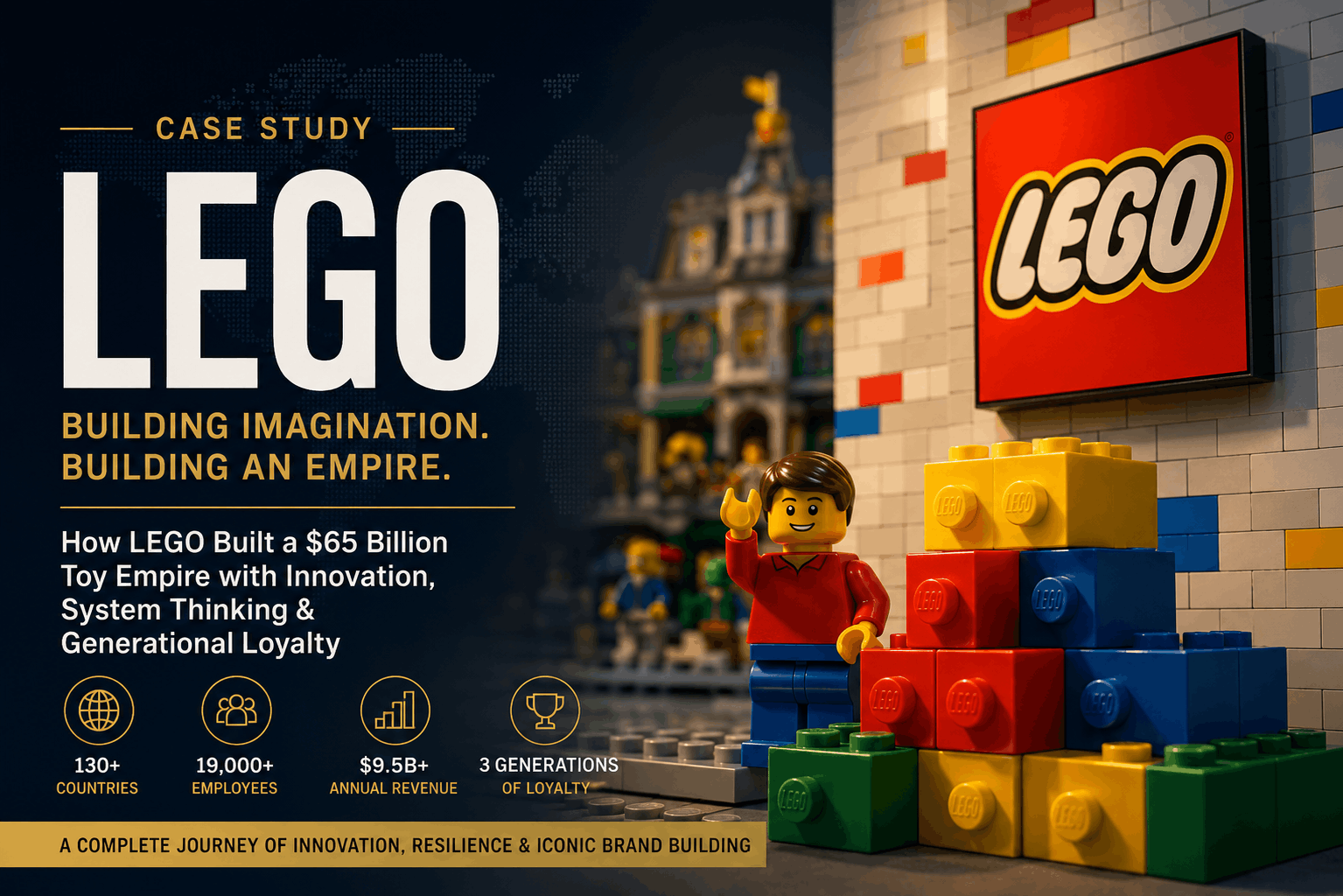
In 1932, when Ole Kirk Christiansen started LEGO in his carpentry workshop in Billund, Denmark, he had no idea he was creating what would become the world’s most profitable toy company and a brand that would outlive most Fortune 500 companies.
Today, LEGO operates in 130+ countries, employs 19,000+ people, generates $9.5+ billion in annual revenue, and has achieved something no other toy company has accomplished: three consecutive generations of customer loyalty. More remarkably, LEGO survived the digital revolution that killed Toys “R” Us, navigated the shift from physical to digital play, and created a franchise ecosystem that generates billions in ancillary revenue (movies, video games, theme parks).
This comprehensive case study reveals how LEGO didn’t just build toys they built a lifestyle brand, created unmatched brand loyalty across three generations, pioneered the licensing and entertainment empire model, and established a business model so resilient it survived threats that destroyed every competitor.
—
Part 1: The Foundation and Birth of an Icon (1932-1970)
1.1 The Humble Beginning in Denmark
In 1932, Ole Kirk Christiansen opened a woodcraft workshop in Billund, Denmark. The Great Depression hit hard. To survive, he pivoted to making wooden toys.
First products: Simple wooden toys, cars, animals, furniture. Handmade quality, affordable prices.
The name “LEGO”: Derived from the Danish words “leg godt” (play well). This wasn’t an accident; the name encoded the company’s philosophy: toys should facilitate good play, creativity, and imagination.
1.2 The Plastic Revolution (1958)
In 1958, LEGO introduced the modern brick with interlocking tubes the foundation of all LEGO bricks today.
Why this was revolutionary:
- Before: LEGO bricks didn’t interlock well (would fall apart)
- After: Bricks could be stacked and combined endlessly
- Result: LEGO became system, not just toys
Patent granted in 1958. This patent protection lasted decades and gave LEGO years of competitive advantage.
1.3 The System Concept (1960s-1970s)
LEGO’s Genius Insight: Instead of selling individual toys, sell a “system” where every brick fits with every other brick.
The System Benefits:
- Kids could build anything (limited only by imagination)
- Parents could buy more bricks anytime (recurring revenue)
- Bricks lasted forever (inheritance from older siblings)
- Sets could be combined (multiplied play value)
Economic Genius: The system locked in customers. Once you owned LEGO bricks, you’d buy more LEGO (incompatible with competitors). This created incredible switching costs.
| Year | Key Development | Impact |
|---|---|---|
| 1958 | Interlocking brick patent | Foundation of modern LEGO |
| 1968 | LEGO Minifigure introduced | Expansion into figurative play |
| 1969 | LEGO Space theme launched | Opened themed building categories |
| 1970s | TV commercials expand globally | International brand recognition |
—
Part 2: System Expansion and Theme Multiplication (1970-2000)
2.1 The Theme Strategy
LEGO’s Brilliant Strategy: Instead of one LEGO product, create dozens of themes that appeal to different ages and interests.
Theme Timeline:
- 1969: LEGO Space – Futuristic play, astronauts, aliens
- 1974: LEGO Classic Town – Everyday scenarios, realistic buildings
- 1978: LEGO Minifigures Expanded – Different characters, professions
- 1980s: LEGO Castle, LEGO Pirates – Fantasy and adventure themes
- 1990s: Expansion accelerates – Star Wars, Creator, Expert themes
Why Multiple Themes?
- Appeal to different ages (simple vs. complex)
- Appeal to different interests (space, castles, towns, sports)
- Create re-purchasing incentives (kids want sets in different themes)
- Multiple customer touchpoints (every demographic covered)
2.2 Global Expansion (1970s-1990s)
Revenue Growth:
- 1970: ~$50 million
- 1980: ~$200 million
- 1990: ~$1.0 billion
- 2000: ~$2.1 billion
Key Markets Entered: USA (1958, breakthru in 1970s-80s), Europe (steady growth), Asia (1990s acceleration).
2.3 The Patent Expiry Challenge (1969 Onward)
Critical Event: The original LEGO brick patent expired, allowing competitors to make compatible bricks.
Competitors That Emerged: Tyco, Mega Bloks, and others made cheaper, compatible alternatives.
LEGO’s Response:
- Brand loyalty overcome price competition
- Quality perception (LEGO = premium) protected pricing
- Continuous innovation (new themes, new products)
- Community building (fan base, user-generated content)
Result: Despite patent expiry, LEGO maintained 70%+ market share in brick toys. The moat was brand, not patents.
—
Part 3: The Entertainment Era and Franchise Expansion (2000-2015)
3.1 The Licensed Franchises Revolution
Turning Point (1999): LEGO signed deal to create LEGO Star Wars sets. This was the first major licensed franchise.
Licensed Franchises Timeline:
| Year | Franchise | Impact |
|---|---|---|
| 1999 | Star Wars | Game-changer, massive sales |
| 2005 | Batman | DC Comics partnership |
| 2012 | Avengers/Marvel | MCU tie-ins, massive audience |
| 2013 | The LEGO Movie | $468M box office, cultural phenomenon |
3.2 Revenue Diversification Beyond Toys
LEGO Revenue Streams (2015):
- Core Toys: 50% of revenue (traditional building sets)
- Licensed Products: 20% of revenue (Star Wars, Marvel, etc.)
- Entertainment (Movies, Games): 15% of revenue
- Theme Parks: 12% of revenue
- Other (licensing, digital): 3% of revenue
The Entertainment Genius: Movies and theme parks aren’t just entertainment; they’re advertising for LEGO toys. Every movie drives toy sales. Every theme park visit creates future toy purchases.
3.3 The LEGO Movie Effect (2014)
Critical Success (February 2014):
- Box office: $468 million worldwide
- Cultural phenomenon (all ages appeal)
- Marketing masterpiece (toy sales accompanying film release)
- Franchise expanded: LEGO Movie 2 (2019), LEGO Batman Movie (2017), LEGO Ninjago Movie
Financial Impact: LEGO Movie merchandise and tie-ins generated an estimated $500M+ in additional revenue (direct and indirect).
—
Part 4: Theme Parks, Digital, and Modern Challenges (2015-2026)
4.1 LEGOLAND Theme Parks Expansion
LEGOLAND Timeline:
- 1968: First LEGO House in Billund (museum/exhibition)
- 1978: LEGOLAND Billund opens (Denmark)
- 2012-2020: LEGOLAND expansion accelerates (California, Florida, Tokyo, Dubai)
- 2026: 16+ LEGOLAND locations globally
LEGOLAND Revenue Impact:
- Theme parks generate 15-20% of LEGO Group revenue
- Each park generates $50-200M annually (location dependent)
- Strategic benefit: Kids visit parks, want toys after the visit (flywheel effect)
4.2 Digital Transformation (2010s-2020s)
LEGO Digital Products:
- LEGO Video Games: $200M+ revenue annually (hundreds of millions of players)
- LEGO Digital Designer: Free online building tool (CAD-like for kids)
- LEGO Fortnite: Brand new game in mega-popular platform (2023 launch)
- Mobile Games: Multiple titles, millions of downloads
Strategy: Digital complements physical (kids play games, want physical sets). Doesn’t cannibalize physical toy sales; instead, it drives them.
4.3 Sustainability and Modern Challenges
Major Challenge (2020s): Plastic bricks + sustainability concerns.
LEGO Response:
- Committed to sustainable materials (phasing in bio-based plastics)
- Recyclability initiatives (encouraging returns of old bricks)
- Sustainable packaging (moved to cardboard, reduced plastic)
- Carbon neutral goal (by 2032)
Strategic Insight: Sustainability isn’t just PR it’s future-proofing. As regulations tighten, LEGO’s early moves provide competitive advantage.
—
Part 5: Financial Performance and Revenue Streams
5.1 Revenue Growth Trajectory
LEGO Group Revenue Evolution:
- 1950: ~$5 million
- 1970: ~$50 million
- 1990: ~$1.0 billion
- 2000: ~$2.1 billion
- 2010: ~$3.6 billion
- 2015: ~$5.2 billion
- 2020: ~$7.9 billion
- 2023: ~$9.5 billion
- 2026 Estimate: ~$10.5+ billion
CAGR (1950-2026): 12%+ annually (sustained growth over 76 years)
5.2 Profitability and Margins
| Metric | Value | Significance |
|---|---|---|
| Gross Margin | 65-70% | Premium pricing power |
| Operating Margin | 25-30% | Exceptional profitability |
| EBITDA Margin | 30-35% | Highly efficient operation |
| Return on Invested Capital (ROIC) | 20-25% | Excellent capital efficiency |
Key Insight: 25-30% operating margins are exceptional. Most toy companies operate at 5-15% margins. LEGO’s premium positioning enables these margins.
5.3 Profitability Without Public Markets
Unique Aspect: LEGO is privately held (owned by Kirkbi Foundation, descendants of Ole Kirk).
Advantages of Private Ownership:
- Long-term thinking (not quarterly earnings pressure)
- Can invest heavily without ROI pressure (R&D, sustainability)
- Stable leadership, consistent culture
- Patient capital for multi-year initiatives
Financial Power: ~$10B revenue + 25-30% margins = ~$2.5B+ annual free cash flow. Enables massive reinvestment.
—
Part 6: Competitive Advantages and Strategic Moat
6.1 Brand Loyalty Moat (Primary)
Intergenerational Loyalty: Grandparents played with LEGO. Parents played with LEGO. Kids now play with LEGO.
Why This Matters:
- Parents specifically buy LEGO for kids (not competitors)
- Emotional attachment (childhood memories)
- Quality perception (LEGO = premium, lasts forever)
- Collectibility (old LEGO valuable, resold, passed down)
Loyalty Metrics:
- Brand awareness: 98%+ in developed countries
- Preferred brand: 70%+ of parents buy LEGO first
- Customer lifetime value: $1,000+ per household (lifetime)
- Switching costs: High (bricks incompatible with competitors)
6.2 The Brick Ecosystem Moat
Genius of the System: Every LEGO brick made since 1958 is compatible with every other brick.
Why This Locks in Customers:
- Buy one set → want more sets (but they must be LEGO)
- Inherit old sets → want new sets (that fit with inherited bricks)
- Incompatible with competitors (Mega Bloks, Tyco)
- Switching cost = throwing away old bricks OR accepting incompatibility
Competitive Advantage: Competitors can’t match 50+ years of compatible bricks. Network effects favor incumbent (more bricks existing = more valuable to buyer).
6.3 Innovation and Theme Pipeline
Continuous Innovation:
- New themes every year (keeps product line fresh)
- Licensed franchises (Star Wars, Marvel, etc.)
- Advanced building capabilities (larger sets, robotics, AR features)
- Digital integration (games, apps, digital design)
R&D Investment: LEGO invests 8-12% of revenue in R&D (industry standard 3-5%). This enables continuous innovation competitors can’t match.
6.4 Distribution and Retail Moat
Retail Presence:
- Official LEGO stores: 500+ locations worldwide
- Flagship stores: Premium locations in major cities
- Online: Lego.com generates $1B+ revenue
- Retail partnerships: Every major toy retailer stocks LEGO
Why This Matters: Customers can find LEGO everywhere. Distribution convenience = more sales. LEGO stores provide brand experience (creates emotional connection).
—
Part 7: Challenges and How LEGO Overcame Them
7.1 The Crisis Years (1998-2004)
The Problem: Video games and digital entertainment emerged. Experts predicted end of physical toys.
- Toys “R” Us went bankrupt (2018)
- Competitors failed (Mega Bloks acquired, Tyco dissolved)
- LEGO nearly failed (2003-2004 worst years)
Why LEGO Nearly Failed:
- Overexpanded product lines (confused parents)
- Theme confusion (Star Wars cannibalizing core LEGO sales)
- Digital underestimated (wrong positioning vs. video games)
- Retail challenges (mass-market retail declining)
LEGO’s Response (2004 Onward):
- Simplified product line (focused on core themes)
- Strategic licensing (Star Wars, Marvel became core, not cannibals)
- Entertainment strategy (movies to drive toy sales, not replace)
- Direct-to-consumer (LEGO.com, flagship stores became growth engine)
7.2 The Digital Threat (2010-2020)
The Challenge: Kids spending more time on screens (phones, tablets, games) vs. physical play.
LEGO’s Strategy: Embrace digital as complement, not competitor.
- Create LEGO-branded games (Fortnite, Minecraft, original games)
- Augmented Reality (AR app for real sets)
- Digital building tools (free CAD-like software)
- Result: Digital drives physical purchases (kids play games, want sets)
Outcome: Digital became 10-15% of revenue by 2020, driving net growth (not cannibalizing physical).
7.3 Supply Chain and Sustainability
Modern Challenges:
- Plastic bricks + ESG pressure (environmental concerns)
- Manufacturing costs rising (labor, energy)
- Supply chain disruptions (COVID, geopolitics)
- Regulatory risk (plastic restrictions)
LEGO Response:
- Investing in sustainable materials (bio-based plastics)
- Renewable energy (manufacturing facilities)
- Circular economy (brick take-back programs)
- Partnerships (environmental NGOs for credibility)
Strategic Benefit: Early movers in sustainability get regulatory advantage + brand loyalty from younger generations valuing ESG.
—
Part 8: Strategic Lessons for Business Leaders
8.1 Build Systems, Not Just Products
Lesson: LEGO’s genius was system (compatible bricks), not individual toys.
Why This Matters: Systems create switching costs and network effects. Individual products can be copied. Systems take decades to replicate.
Application: Think about what system your product could be part of. How can compatibility lock in customers? How can you create ecosystem others can’t replicate?
8.2 Intergenerational Loyalty is Unbeatable Moat
Lesson: LEGO succeeded because grandparents → parents → kids all buy LEGO.
Why This Matters: Intergenerational loyalty creates automatic demand. Can’t easily compete when customers are born into your brand.
Application: Build products parents want to buy for kids. Focus on quality (lasts generations). Create emotional attachment (nostalgic value). Make it heirloom-worthy (valuable over time).
8.3 Embrace Entertainment as Marketing Tool
Lesson: LEGO Movie isn’t entertainment business it’s toy business disguised as entertainment.
Why This Matters: Movies, theme parks, games all drive toy sales. Entertainment creates emotional connection and cultural relevance.
Application: Don’t think entertainment is competing with core business. Use it as marketing amplifier. Every movie = advertising for products. Every theme park visit = future customer.
8.4 Premium Positioning Enables Superior Economics
Lesson: LEGO charges 3-5x more than competitors. Customers pay because of brand, quality, longevity.
Why This Matters: Premium positioning justifies higher prices and enables 25-30% operating margins. Competitors competing on price have 5-10% margins (unsustainable).
Application: Build premium brand through quality, heritage, emotional connection. Premium positioning enables better profitability and reinvestment. Race to bottom (price competition) is race to bankruptcy.
8.5 Diversification Within Core Competency
Lesson: LEGO expanded to theme parks, movies, games, digital all within “building” theme.
Why This Matters: Diversification reduces risk (toy sales declining? entertainment grows). But staying within competency (building/creativity) maintains brand cohesion.
Application: Expand into adjacent revenue streams, but stay true to core competency. LEGO didn’t become animation company—they made LEGO-themed content. Same brand, new format.
8.6 Long-term Ownership Enables Long-term Strategy
Lesson: LEGO is privately held. Can invest in sustainability, R&D, long-term initiatives without quarterly earnings pressure.
Why This Matters: Public companies optimize for short-term (quarterly earnings). LEGO optimizes for long-term (decades). This creates different strategic choices.
Application: If public, work to align with long-term shareholders. If private, leverage this advantage invest heavily in future-proofing while competitors focus on quarterly profits.
8.7 Innovation Requires Continuous R&D Investment
Lesson: LEGO invests 8-12% of revenue in R&D (double industry average).
Why This Matters: Continuous innovation keeps product line fresh, prevents commoditization, enables premium pricing.
Application: Budget generously for R&D (8%+ of revenue). Innovation isn’t cost center it’s competitive advantage. Underfunding R&D is false economy.
—
Conclusion: The LEGO Blueprint for Building Multi-Generational Empires
LEGO’s journey from carpentry workshop to $10B global brand spanning 94 years wasn’t luck. It resulted from:
- System Innovation: Compatible bricks creating ecosystem
- Quality Obsession: Never compromised on product quality
- Brand Building: Premium positioning + emotional connection
- Theme Innovation: Multiple themes for multiple customer segments
- Entertainment Expansion: Movies, games, theme parks as marketing multipliers
- Distribution Control: Official stores + online + retail partnerships
- Private Ownership: Long-term thinking vs. quarterly optimization
- Continuous R&D: Invest 2x industry average in innovation
- Resilience: Survived digital revolution, retail consolidation, competitors
- Intergenerational Loyalty: Built brand that spans generations
For entrepreneurs and business leaders, LEGO teaches:
- How to build systems that lock in customers for life
- Why premium positioning creates sustainable competitive advantage
- How intergenerational loyalty is ultimate moat
- Why entertainment is marketing tool, not competitor
- How continuous innovation maintains premium positioning
- Why quality and longevity create emotional attachment
- How private ownership enables long-term strategy
- The power of staying true to core competency while diversifying revenue
The LEGO story isn’t just about toys it’s about how vision, execution, and patience can build a brand so strong it survives 94 years of market disruption and remains relevant to every new generation of children.
—
Financial Snapshot (2026)
| Annual Revenue | ~$10.5 billion |
| Operating Margin | 25-30% |
| Gross Margin | 65-70% |
| Employees Globally | 19,000+ |
| Countries | 130+ |
| Official LEGO Stores | 500+ |
| LEGOLAND Theme Parks | 16+ |
| Years in Business | 94+ years |
—
About The LEGO Group
- Founded: 1932
- Headquarters: Billund, Denmark
- Founder: Ole Kirk Christiansen
- Current CEO: Niels B. Christiansen
- Ownership: Privately held (Kirkbi Foundation)
- Markets: 130+ countries
- Product Range: Building sets, minifigures, digital games, theme parks, movies
- Brand Value: $7+ billion (world’s most valuable toy brand)