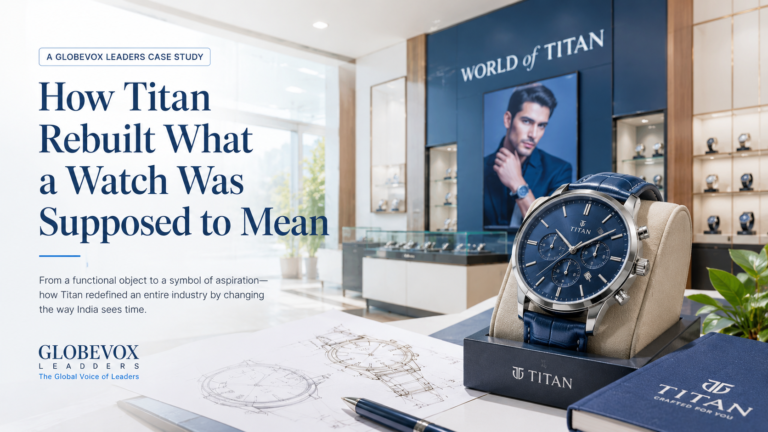
In the grand tapestry of Indian entrepreneurship, few brands have orchestrated a transformation as remarkable as Titan Company Limited. What began as a modest watch manufacturer has evolved into one of the world’s largest watch companies, controlling over 35% of India’s organized watch market while maintaining operations in 45+ countries.
This comprehensive case study reveals how Titan challenged established global players, redefined consumer expectations, and created entirely new market categories offering invaluable lessons for any business leader seeking to build a market-dominating brand.
Part 1: The Genesis – Understanding Titan’s Foundation
The Founding Vision (1984)
Titan Industries was established in 1984 as a joint venture between the Tata Group (40%), Tamil Nadu Industrial Development Corporation (TIDC), and the Murugappa Group. The timing was strategic and the vision was clear: create world-class watches for India’s aspiring middle class.
In the 1980s, India’s watch market was characterized by:
- HMT Watches – Government-owned, struggling with quality and reliability
- Imported luxury brands – Rolex, Omega, Seiko commanding premium prices
- Cheap mechanical watches – Low quality, unreliable, rapidly becoming obsolete
There was a critical gap: no Indian company was offering quality, affordable, stylish watches that met international standards.
Early Market Position & Strategic Entry
The founders understood three critical insights about Indian consumers that would prove revolutionary:
- Quality Aspiration: Indians wanted quality products but couldn’t afford imported luxury brands
- Status Signal: The watch was evolving from a functional timepiece to a status symbol and personal statement
- Market Opportunity: India’s rapidly growing middle class was creating unprecedented demand for aspirational products
By 1990, Titan had captured just 3% of the market. Most industry analysts dismissed them as a minor player. Few recognized they were laying the foundation for market leadership that would span decades.
“Titan wasn’t trying to copy the global watch industry they were trying to understand what Indian consumers actually wanted.” – Industry Observer
Part 2: The Turning Point – Strategic Pivots That Changed Everything
2.1 The Technology Leap: From Mechanical to Quartz
The Challenge: By the 1990s, mechanical watches were becoming technologically obsolete worldwide. Quartz technology offered superior accuracy at dramatically lower costs.
Titan’s Audacious Response: Rather than incrementally improve existing capabilities, Titan made a bold decision to completely retool its production infrastructure. They invested massively in:
- Japanese quartz technology partnerships and licensing
- State-of-the-art manufacturing facilities aligned with international standards
- Quality control infrastructure rivaling global competitors
- Workforce training programs for precision manufacturing
The Result: By the late 1990s, Titan wasn’t just making “Indian watches” they were manufacturing world-class watches that happened to be designed and produced in India. This shift from production-based to technology-based manufacturing transformed their competitive position fundamentally.
2.2 The Brand Elevation Strategy: Multi-Brand Portfolio Genius
Titan understood something that many brands still don’t: watches in 2024 aren’t about telling time they’re about telling stories.
Rather than compete with a single brand across all segments, Titan launched a multi-brand portfolio strategy, each brand with distinct identity, positioning, and target market:
| Brand | Target Market | Price Point | Core Strategy |
|---|---|---|---|
| Titan | Premium Professionals | ₹3,000-₹15,000 | Quality + Affordability |
| Fastrack | Youth & Fashion-Forward | ₹1,500-₹4,000 | Trendy, Bold, Experimental |
| Sonata | Value-Conscious Buyers | ₹800-₹2,000 | Value Leadership & Quality |
| Raga | Women (All Income Levels) | ₹2,000-₹8,000 | Elegance + Functionality |
This wasn’t casual line extension it was sophisticated market segmentation mastery. Each brand was managed independently with:
- Distinct visual identity and brand guidelines
- Separate retail presence and store design
- Independent marketing narratives and campaigns
- Rigorous target demographic research and customer personas
Strategic Brilliance: This portfolio approach allowed Titan to own the watch category across all price points while maintaining distinct brand equity for each segment. When a customer upgraded from Sonata to Raga to Titan, they perceived each as a genuine aspiration move not recognizing they were buying from the same parent company.

2.3 The Retail Revolution: Exclusive Stores as Brand Temples
While competitors relied on traditional jewelry stores and multi-brand retailers, Titan pioneered an entirely new retail paradigm.
The Titan Exclusive Store (TES) Model:
- Designed as Lifestyle Destinations: Not merely retail shops, but curated spaces celebrating watch culture, design, and craftsmanship
- Customer Education Central: Staff trained to educate customers about watch mechanics, materials, and style
- Interactive Experience: Interactive displays, private viewing areas, personalized consultation spaces
- Brand Immersion: Every element from lighting to music reinforced brand values and positioning
By 2010, Titan operated 500+ exclusive stores. This vertical integration delivered strategic advantages that competitors couldn’t replicate:
- Direct feedback on customer preferences and emerging trends
- Complete control over brand presentation and customer experience
- Higher profit margins than wholesale channels (60-65% vs. 35-40%)
- Real-time market data and consumer insights
- Ability to launch new collections simultaneously across markets
The retail strategy proved transformational these stores became more than sales channels; they became brand ambassadors and community spaces.
Part 3: Market Dominance – The Numbers That Define Success
3.1 Market Share Growth: From Challenger to Leader
Titan’s market share growth trajectory tells the story of systematic, relentless execution:
| Period | Market Share | Market Position | Key Initiative |
|---|---|---|---|
| 1990 | 3% | Emerging Challenger | Market entry & production setup |
| 1995 | 8% | Growing Competitor | Brand building & distribution expansion |
| 2000 | 12% | Significant Player | Multi-brand strategy launch |
| 2005 | 18% | Market Leader | Exclusive store expansion |
| 2010 | 28% | Dominant Position | Technology & design innovation |
| 2015 | 32% | Market Stronghold | Digital transformation begins |
| 2020 | 35% | Peak Position | Omnichannel strategy deployment |
| 2026 | 35-37% | Sustained Leadership | International expansion |
3.2 Revenue Performance & Financial Metrics
Current Watch Division Performance (FY 2025-26):
- Annual Revenue: $563 Million+
- Lifetime Watches Sold: 16.5+ Million units
- Employees (Watches Division): 3,500+
- Operating Margin: 18-22% (Exceptional for consumer goods)
- Return on Equity (ROE): 28-32% (Industry-leading)
- Global Footprint: Operations in 45+ countries
3.3 Growth Rate Analysis
Titan’s growth has shown consistent, impressive CAGR across decades:
- 1990-2000: 40% CAGR (Rapid market penetration phase)
- 2000-2010: 25% CAGR (Market leadership consolidation)
- 2010-2020: 12% CAGR (Market saturation & profitability focus)
- 2020-2026: 8-10% CAGR (Maturity & international expansion)
This declining CAGR is natural and healthy as markets mature, growth rates moderate. The key insight: Titan maintained profitability and margins even as growth moderated, indicating a shift from growth-focused to profit-focused operations.
Part 4: The Marketing Mastery Behind Growth
4.1 Positioning Strategy: “Crafted for a Lifetime”
Titan’s genius in marketing lies not in clever taglines, but in fundamental repositioning of what a watch means to consumers.
The Traditional Positioning (What Competitors Said):
“We make affordable watches” or “Quality watches at low prices”
Titan’s Positioning (What They Actually Said):
“We craft watches that become part of your life story. A Titan watch marks your achievements, celebrates your milestones, and stays with you through life’s most important moments.”
Every campaign, every advertisement, every retail experience reinforced this narrative:
- “Life’s Big Moments” – Positioning watches as milestone markers (first job, wedding, promotion)
- “Wear Your Story” – Emphasizing personal narrative and identity expression
- “Timeless Elegance” – Balancing fashion-forwardness with durability
- “Crafted with Care” – Highlighting precision manufacturing and quality
This emotional positioning allowed Titan to command premium prices despite being an “Indian” brand (historically associated with lower quality).
4.2 Celebrity Endorsement Strategy
Titan’s approach to celebrity partnerships was sophisticated and long-term:
- Amitabh Bachchan (20+ years) – Positioned Titan as prestigious and trustworthy
- Aishwarya Rai (Raga brand) – Global recognition and aspirational femininity
- Shah Rukh Khan (Fastrack) – Youthful energy and accessibility
- Regional stars – Market-specific penetration and cultural relevance
Key Differentiator: Unlike typical endorsements (athlete in ad, forget product), Titan ensured:
- Authentic Usage: Celebrities actually wore the watches in personal and professional life
- Long-term Relationships: 5-10+ year partnerships building credibility
- Storytelling Integration: Ads told stories about life moments, not just watch features
- Multiple Touch Points: Print, TV, digital, retail, and events
4.3 Digital Marketing Innovation (2015-2026)
Titan successfully navigated the digital transformation without losing brand equity:
Social Media Strategy:
- Instagram-first visual storytelling showcasing lifestyle imagery
- User-generated content campaigns (#TitanStory, #WearYourMoment)
- Micro-influencer partnerships over celebrity reliance
- Interactive stories and behind-the-scenes manufacturing content
SEO & Content Marketing:
- Blog content on watch maintenance, styling tips, and watch culture
- How-to guides on watch selection and care
- Brand heritage storytelling (40+ years of history)
- Keyword-optimized content for “best watches in India,” “luxury affordable watches,” etc.
E-commerce Integration:
- Seamless online-to-offline (O2O) shopping experience
- Virtual try-on technologies for watch selection
- Personalized product recommendations using AI
- Same-day delivery in major metropolitan areas
Email Marketing & CRM:
- Segmented email campaigns based on purchase history and preferences
- Exclusive previews of new collections for VIP customers
- Personalized anniversary and milestone reminders
- Loyalty program communication and rewards
Part 5: Operational Excellence – The Hidden Engine
5.1 Manufacturing Mastery
While competitors competed on marketing, Titan built competitive advantage through operational excellence:

Manufacturing Facilities:
- State-of-the-art Production: Aligned with ISO 8601 international standards for timekeeping precision
- Vertical Integration: In-house manufacturing of critical components (movements, dials, cases)
- Quality Excellence: Defect rate <0.5% (industry average: 2-3%)
- Sustainability Focus: Energy-efficient manufacturing, waste reduction, recycling initiatives
Supply Chain Optimization:
- Just-in-time inventory management reducing carrying costs
- Strategic partnerships with component suppliers globally
- Supplier diversification to reduce geopolitical risks
- Quality assurance at every supply chain step
- Real-time supply chain visibility using IoT technologies
Why This Matters: Manufacturing excellence meant Titan could maintain quality while reducing costs a rare combination that created unsustainable competitive advantage.
5.2 Innovation in Product Development
Titan didn’t just follow watch industry trends; they created them:
Recent Innovations Launched:
- Raga Premium Series: Women’s watches featuring sapphire crystals (typically only in luxury brands)
- Titan Automatics: Entry-level mechanical watches for enthusiasts
- Smart Watch Integration: Hybrid watches combining traditional aesthetics with digital capability
- Eco-Friendly Materials: Sustainable watch manufacturing using recycled materials
- Limited Editions: Collectible watches creating urgency and exclusivity
Product Lifecycle Management:
- 4-6 new designs per brand annually ensuring freshness
- Seasonal collections aligned with Indian festivals and seasons
- Limited editions (500-5,000 units) creating collectibility
- Planned obsolescence balanced with durability expectations
5.3 Customer Relationship Management
Titan built loyalty through systematic customer care:
Warranty & After-Sales:
- Industry-leading 3-year warranty on all models
- Free servicing and maintenance included in warranty
- Transparent, straightforward repair policies
- Lifetime parts availability (watches 20+ years old still serviceable)
Loyalty Programs:
- Titan Watches Club: Membership with exclusive benefits
- VIP Previews: Early access to new collections
- Personalized Offers: Birthday and anniversary special discounts
- Trade-in Programs: Upgrade incentives encouraging repeat purchase
- Referral Rewards: Incentives for customer referrals
Part 6: Challenges Overcome – How Titan Navigated Disruption
6.1 The Smartphone Threat (2010-2015)
The Existential Challenge: The rise of smartphones appeared to render traditional watches functionally obsolete. Market experts predicted inevitable decline of the watch industry.
Industry Response: Most watch companies doubled down on functionality and attempted smartwatch development.
Titan’s Strategic Response:
- Repositioned watches as fashion statements not timekeepers – shifted narrative from utility to style
- Invested heavily in design and aesthetics – created watches that made style statements
- Emphasized the personal touch – articulated why a watch was more meaningful than a phone notification
- Launched “Smartphone Era” marketing campaigns – celebrated the watch as a counterpoint to digital overload
The Result: While global watch market declined 3-5% during 2010-2015, Titan grew 8-10%. They had successfully repositioned the category.
6.2 Chinese Competition & Price Wars
The Challenge: Chinese manufacturers flooded the budget segment with extremely cheap watches, pressuring margins.
Titan’s Response (Not Competing on Price):
- Owned the “quality-at-affordable-price” positioning – competed on value, not price
- Emphasized “Made in India” as quality signal – leveraged Tata Group credibility
- Invested in brand building – made Titan brand too strong to commoditize
- Market segmentation strategy – Sonata for value seekers (competing with Chinese), Titan for quality seekers
Strategic Brilliance: Rather than compete head-to-head with cheaper competitors, Titan redefined what “value” meant in consumers’ minds. They sold quality that lasted, not just low prices.
6.3 Economic Downturns (2008 Financial Crisis, 2020 COVID-19)
Challenge: Watches are discretionary purchases, highly vulnerable to economic cycles.
Strategic Resilience:
- Diversified pricing: Customers across all income levels remained engaged during downturns
- Exclusive retail stores as communities: Emotional connections transcended price sensitivity
- Direct-to-consumer model: Reduced dependency on wholesale channels affected by retailer shutdowns
- Digital transformation acceleration: Post-COVID, rapidly expanded e-commerce and online sales
- Loyalty programs: Existing customers remained brand loyal even during financial stress
Result: Titan emerged from 2008 crisis stronger (gained market share), and navigated COVID with relatively minor disruption.
Part 7: The Competitive Moat – Why Competitors Can’t Catch Up
7.1 Brand Equity: Intangible Competitive Advantage
Titan has built unprecedented brand equity in India, creating a psychological barrier to competition:
- Top-of-mind Awareness: 67% among watch buyers (unprompted recall)
- Consideration Rate: 81% among target demographic
- Net Promoter Score (NPS): 72 (exceptional for consumer goods category)
- Brand Loyalty Rate: 58% of customers own multiple Titan watches
This brand equity means Titan can:
- Command premium pricing compared to competitors
- Launch new products with minimal marketing investment
- Sustain customer relationships across decades
- Weather economic downturns better than competitors
7.2 Scale Advantages
With 35%+ market share, Titan enjoys structural cost and competitive advantages:
- Economies of Scale: Massive production volume reduces per-unit manufacturing costs
- Bargaining Power: With 35% market share, Titan negotiates favorable supplier terms
- Distribution Network: 250+ exclusive stores + 1,500+ multi-brand partners impossible for competitors to replicate quickly
- Investment Capacity: Superior profitability funds R&D and marketing investments competitors can’t match
7.3 Relationship Capital
Over 40 years, Titan has built deep relationship capital:
- 250+ Retail Partnerships: Strategic alliances that prioritize Titan placement and support
- Supply Chain Relationships: Decades-old partnerships ensuring priority allocation of quality components
- Customer Relationships: Spanning generations – grandparents’ Titan watch passes to grandchild
- Influencer & Celebrity Relationships: Long-term partnerships (Amitabh Bachchan 20+ years)
7.4 Operational Capabilities
Competencies built over 40 years that competitors can’t quickly replicate:
- In-house manufacturing expertise and vertical integration
- Quality control systems and defect prevention
- Product design and innovation capabilities
- Retail store operations and customer experience management
- Supply chain management and logistics
Part 8: Future Vision – What’s Next for Titan
8.1 International Expansion Strategy
Current Reality: India accounts for 85% of Titan’s watch revenues
Strategic Objective: Grow international markets to 40% of revenue by 2030
Focus Markets & Strategies:
- Middle East: Catering to growing expat Indian population + local luxury market demand
- Southeast Asia: Rising middle class, cultural affinity with India, growing demand
- Africa: Untapped emerging markets with expanding aspiring middle class
- Europe: Premium positioning through luxury acquisitions (Favre Leuba model)
8.2 Technology Integration & Smart Watches
Strategic Challenge: Embrace smartwatch evolution without cannibalizing traditional watch positioning
Hybrid Approach:
- Health tracking features integrated with traditional aesthetics
- Mechanical precision combined with digital capability
- Customization through wearable technology
- Integration with Indian digital payment systems (UPI, RuPay)
8.3 Sustainability & ESG Leadership
2030 Commitments:
- 100% recyclable watch components
- Carbon-neutral manufacturing facilities
- Ethical sourcing of materials
- Community impact programs in manufacturing regions
8.4 Digital-First Strategy for Younger Demographics
Emerging Channels:
- TikTok and Instagram Reels for trend-setting content
- Gaming partnerships (product placement in popular games)
- Metaverse presence (virtual watch collections, digital ownership)
- Direct-to-consumer digital platforms reducing retail dependency

Part 9: Key Lessons for Business Leaders
9.1 Market Entry Strategy
Lesson: Identify underserved segments, not just market gaps.
Titan didn’t invent watches they identified that no company was serving the “quality-loving, budget-conscious” Indian consumer. This consumer insight was worth billions in market value.
Application: Look for segments where customer desires remain unmet by existing offerings.
9.2 Brand Segmentation & Portfolio Strategy
Lesson: Multiple brands in one portfolio can dominate the market without cannibalizing each other.
Titan, Fastrack, Sonata, and Raga allowed Titan to own 35% market share by competing at every price point without diluting premium positioning.
Application: Consider portfolio strategy rather than single-brand approach for market dominance.
9.3 Retail Innovation & Channel Control
Lesson: Control the customer experience end-to-end through owned retail.
Exclusive retail stores weren’t a cost they were an investment in brand building and customer loyalty that generated exponential returns.
Application: Consider vertical integration into retail to control brand narrative and customer experience.
9.4 Adaptation Over Disruption
Lesson: When disrupted (smartphones), don’t resist or die evolve and reposition.
Titan repositioned the watch from functional timepiece to lifestyle statement and personal identity marker. This wasn’t defensive—it was strategic repositioning.
Application: Embrace disruption as opportunity to redefine your category and value proposition.
9.5 Long-term Thinking Over Short-term Optimization
Lesson: Build for 40 years, not 4 quarters.
Titan’s willingness to invest in exclusive stores, R&D, and brand building when cheaper, faster paths existed created their unbreakable competitive moat.
Application: Prioritize sustainable competitive advantage over quarterly earnings optimization.
9.6 Operational Excellence as Competitive Weapon
Lesson: Marketing gets attention, but operations win markets.
Titan’s 0.5% defect rate and vertical integration created quality that competitors couldn’t match, enabling premium positioning.
Application: Invest in operations and quality as seriously as marketing and brand building.
Part 10: Financial Analysis – The Profitability Model
10.1 Profitability Metrics (Exceptional for Consumer Goods)
- Operating Margin: 18-22% (Industry average for watches: 10-12%)
- Return on Equity (ROE): 28-32% (Double the FMCG industry average)
- Net Profit Margin: 12-15% (Well above consumer goods average of 6-8%)
10.2 Investment Allocation – Where Does Revenue Go?
- Manufacturing & Production: 45-50%
- Marketing & Brand Building: 8-10%
- R&D & Innovation: 3-4%
- Retail & Store Operations: 2-3%
- Supply Chain & Logistics: 5-6%
- Operating Profit: 18-22%
Key Insight: Titan invests heavily in brand building and innovation while maintaining operational excellence. This balanced investment mix explains their competitive position they’re not just chasing revenue; they’re building sustainable competitive advantage.
10.3 Valuation Impact
While watches represent 30% of Titan Company’s total revenue, the division generates:
- 35% of operating profit (higher margins)
- 40% of brand equity (Titan is synonymous with watches)
- 45% of retail footprint
This disproportionate value creation generating 35% of profit from 30% of revenue demonstrates the pricing power and market dominance Titan has achieved.
Part 11: Competitive Landscape Analysis
| Competitor | Key Strengths | Key Weaknesses | Market Share |
|---|---|---|---|
| Titan | Brand equity, retail presence, innovation | Limited international presence, high costs | 35% |
| HMT | Heritage, government backing | Outdated operations, quality issues, brand decline | 8% |
| Fossil Group | International operations, fashion brands | Limited India focus, weak local market presence | 6% |
| Seiko | Technology, luxury heritage | High entry price, limited mass market appeal | 5% |
| Others | Varied/Unorganized | Fragmented, no clear positioning | 46% |
Competitive Conclusion: No single competitor has Titan’s combination of brand strength, market share, operational excellence, and retail presence. The competitive moat is deep and durable.
Conclusion: The Titan Blueprint for Building Billion-Dollar Brands
Titan’s 40-year transformation from a modest startup to a global watch powerhouse wasn’t accidental. It resulted from a potent combination of strategic vision, relentless execution, and unwavering commitment to excellence:
- Strategic Vision: Identifying underserved market segments before they became obvious
- Consistent Execution: Maintaining quality standards and brand promises for 40+ years
- Technological Innovation: Embracing new technologies while maintaining brand heritage
- Brand Building: Creating emotional connections transcending mere product transactions
- Operational Excellence: Manufacturing and distribution mastery creating unbeatable quality
- Strategic Adaptability: Evolving with market changes without losing brand identity
- Long-term Thinking: Prioritizing sustainable growth over short-term financial optimization
For entrepreneurs and business leaders, Titan offers a masterclass in:
- Challenging established global players successfully
- Building market-dominating positions through sophisticated segmentation
- Maintaining premium brand positioning while expanding volume
- Creating competitive moats through brand equity and operational excellence
- Navigating disruption through strategic repositioning, not defensive retreating
The Titan story isn’t ultimately about watches it’s about how vision, strategy, and execution can transform not just a company, but an entire industry.