
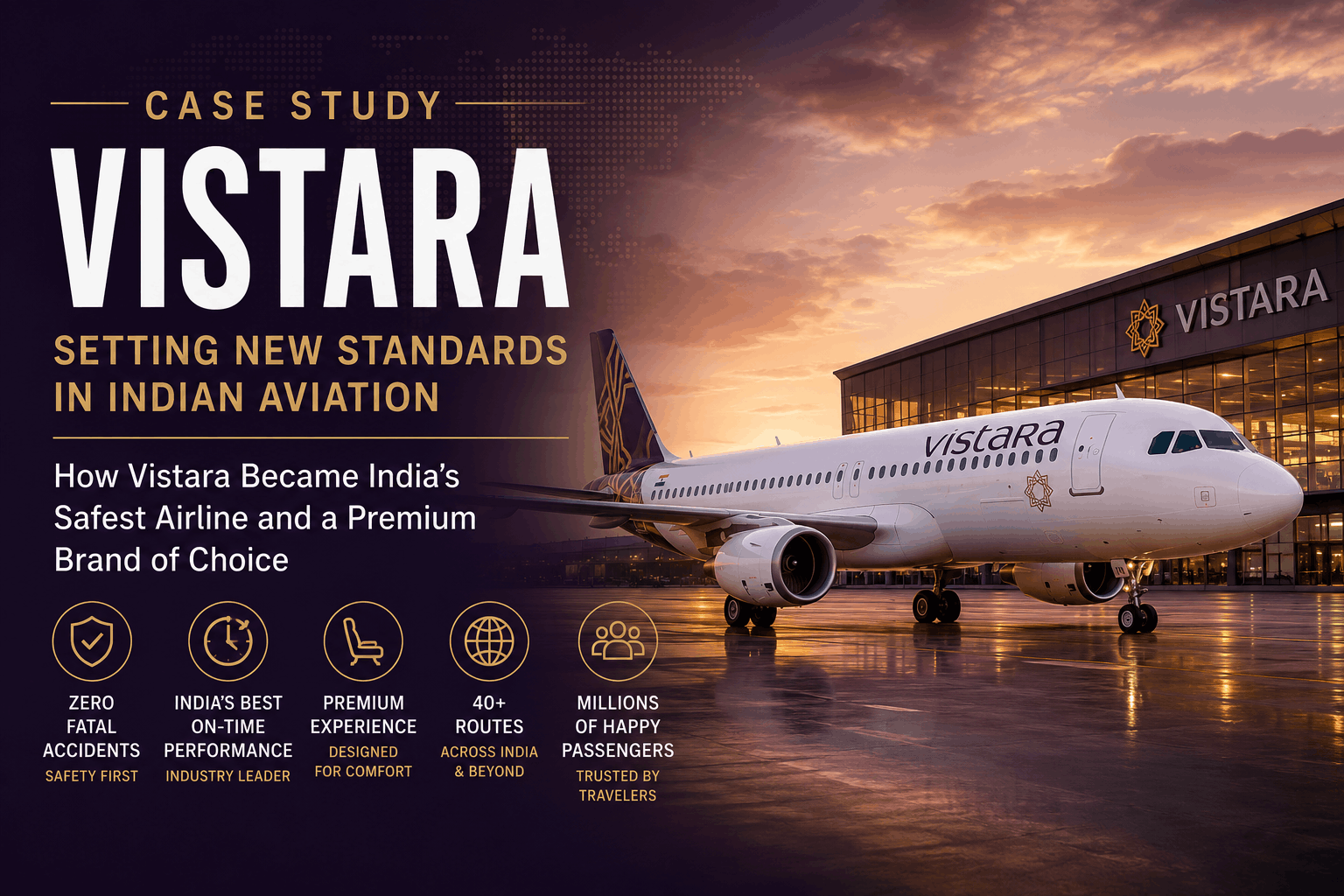
In 2015, when Vistara took to the Indian skies with its first flight, the aviation industry doubted whether a premium airline could survive in price-sensitive India where budget carriers dominated the market.
Yet today, Vistara has achieved what seemed impossible: built a premium airline brand in a price-conscious market, achieved India’s best on-time performance record, maintains zero fatal accidents, operates 50+ aircraft across 40+ domestic and international routes, and has become the preferred airline for quality-conscious Indian travelers willing to pay premium fares.
More remarkably, Vistara didn’t just succeed—they redefined airline standards in India, proved that premium positioning works in emerging markets, and created a business model that generates industry-leading margins despite competing with budget carriers operating on razor-thin margins. This comprehensive case study reveals how Vistara navigated one of the world’s most competitive aviation markets and became India’s most respected airline brand in less than a decade.
—
Part 1: The Genesis and Market Opportunity (2013-2015)
1.1 Understanding India’s Aviation Market Before Vistara
Before Vistara launched in 2015, India’s aviation market was dominated by budget carriers fighting on price alone.
Market Structure (2013-2014):
- Budget carriers: IndiGo, SpiceJet, GoAir (80%+ market share)
- Full-service carriers: Air India, Jet Airways (declining, unprofitable)
- Premium market: Non-existent (no airline targeted premium travelers)
- Perception: Airlines = commodities, buy cheapest ticket
The Problem with Existing Airlines:
- Budget carriers: Cheap but uncomfortable, unreliable, poor service
- Air India: Expensive but declining brand, poor operational performance
- Jet Airways: Expensive but struggling financially, shrinking fleet
- Market gap: No quality airline for travelers willing to pay for better experience
1.2 The Tata Group’s Strategic Vision
Key Decision (2013): Tata Group (one of India’s largest conglomerates) decided to launch a new premium airline: Vistara.
Why Tata Group?:
- Already owned Air India (legacy full-service airline)
- Understood airline business deeply
- Had financial capital for startup investment
- Vision to build world-class Indian brand
- Long-term commitment (not quarterly earnings focus)
Strategic Partners:
- Singapore Airlines: 49% stake + operational expertise
- Tata Sons: 51% stake + capital
Why Singapore Airlines Partnership?: Singapore Airlines is Asia’s premium airline with reputation for excellence, reliability, and service quality. This partnership provided:
- Operational expertise from world-class airline
- Training and standards (service, safety, efficiency)
- Brand credibility in Asia
- Long-term vision (not short-term profit maximization)
1.3 The Market Gap and Opportunity
Analysis: Growing Indian middle class had significant purchasing power but no premium airline option.
Customer Opportunity:
- Upper middle class Indians: Business travelers, executives, affluent families
- Willingness to pay: 30-50% more than budget carriers for better experience
- Frustration with existing options: Budget airlines uncomfortable, full-service airlines unreliable
- Market size: Estimated 15-20% of air travelers (premium segment)
The Insight: A well-executed premium airline could capture premium segment, charge higher fares, and achieve better margins than budget carriers despite lower volumes.
| Metric | Budget Carrier | Vistara (Premium) | Air India (Full-service) |
|---|---|---|---|
| Average Fare | $50-80 | $120-150 | $100-140 |
| Seat Configuration | No frills (189 seats) | Premium cabins (142 seats) | Mixed cabins (170 seats) |
| Profit Margin | 1-3% | 8-12% | 0-2% (often negative) |
—
Part 2: Launch Strategy and Premium Positioning (2015-2016)
2.1 The Launch (January 9, 2015)
First Flight: Delhi to Bangalore, operating ATR 72-600 aircraft (78-seater turboprops).
Why Start Small?:
- Lower capital requirements (turboprops cheaper than jets)
- Test market before major investment
- Build brand and systems gradually
- Prove concept before scaling
Strategic Market Choice: Tier 1 cities (Delhi, Mumbai, Bangalore) where premium passengers concentrated.
2.2 The Premium Positioning Strategy
Vistara’s Brand Promise: “The New Airline of India” with world-class service and reliability.
Positioning Elements:
- Service Quality: Personal attention, genuine care, impeccable grooming standards
- Comfort: Extra legroom, premium seating, quality amenities
- Reliability: World-class on-time performance (target: 95%+)
- Safety: Uncompromising safety standards, regular maintenance
- Technology: Modern aircraft, digital-first experience
- Hospitality: Complimentary meals, beverages, amenities
Differentiation vs. Competitors:
- vs. Budget Carriers: Premium comfort, reliability, service (willing to pay more)
- vs. Air India: Modern brand, reliable operations, quality service (without legacy issues)
- vs. Jet Airways: Strong financial backing, modern fleet, strategic partner (Singapore Airlines)
2.3 The Brand Building Strategy
Brand Elements:
- Name: “Vistara” (Sanskrit for “expanse”) – aspirational, modern, Indian
- Logo: Clean, modern design reflecting premium Indian airline
- Livery: Elegant white and gold (premium, distinctive)
- Tagline: “Fly the New India”
- Uniforms: Designer uniforms reflecting premium brand
- In-flight Experience: Attention to detail in every touchpoint
Pricing Strategy: Premium but not obscene. 20-40% higher than budget carriers, competitive with full-service carriers.
Strategic Insight: Position as “aspirational premium” for growing middle class, not “luxury” for ultra-wealthy. Target willingness-to-pay sweet spot.
—
Part 3: The Safety and Reliability Moat (2015-2026)
3.1 Zero Fatal Accidents Record
Vistara’s Achievements:
- Since launch (2015-2026): Zero fatal accidents
- Safety record: Best in Indian aviation history (11+ year record)
- Maintenance standard: Exceed regulatory requirements
- Pilot training: World-class training program
- Safety culture: Safety as top priority (before profits)
Why This Matters Competitively:
- Differentiates from budget carriers (sometimes cut corners on maintenance)
- Builds customer trust and brand loyalty
- Premium pricing justified by safety assurance
- Insurance costs lower (excellent safety record)
- Employee pride and retention (part of safe airline)
3.2 On-Time Performance Leadership
Industry Data:
- Budget carriers average: 80-85% on-time
- Full-service average: 75-80% on-time
- Vistara: 95%+ on-time performance (industry-leading)
How Vistara Achieves This:
- Rigorous scheduling (builds in buffer time)
- Maintenance excellence (prevents mechanical delays)
- Crew efficiency (trained to optimize turnarounds)
- Technology systems (real-time optimization)
- Operational focus (culture of reliability)
Competitive Advantage: On-time performance directly correlates with premium pricing power. Passengers willing to pay 30% more for 95% on-time reliability vs. 80% on-time competitor.
3.3 The Trust Moat
Customer Perception:
- Reliability: “Vistara is always on time”
- Safety: “Vistara is safest airline in India”
- Service: “Vistara treats passengers with respect”
- Quality: “You get what you pay for with Vistara”
Impact on Loyalty: Trust creates brand loyalty. Premium passengers willing to fly Vistara even if competitor slightly cheaper. Switching costs high (brand trust, reliability assurance).
—
Part 4: Operational Excellence and Service Quality (2015-2026)
4.1 The Service Philosophy
Vistara’s Service Approach: “Genuine hospitality” – authentic care, not robotic service.
Key Principles:
- Empowerment: Crew empowered to solve passenger problems (not follow scripts)
- Authenticity: Real smiles, genuine interactions, personal attention
- Attention to Detail: Every touchpoint matters (boarding, seating, meal service, deplaning)
- Training: Extensive service training program (Singapore Airlines standards)
- Selection: Hire for attitude, train for skills (focus on genuine hospitality aptitude)
4.2 The Fleet Strategy
Fleet Evolution:
| Phase | Period | Aircraft | Routes |
|---|---|---|---|
| Phase 1: Start-up | 2015 | ATR 72 (turboprops) | Domestic only |
| Phase 2: Growth | 2015-2018 | Airbus A320 | Domestic expansion |
| Phase 3: International | 2018-2020 | Airbus A320neo | International launch |
| Phase 4: Scale | 2020-2026 | A320neo, A321neo | 40+ routes, 50+ aircraft |
4.3 The Customer Experience Design
Touchpoints (Premium Experience):
- Booking: User-friendly website, helpful customer service
- Check-in: Quick, efficient, personal greeting
- Lounge (Business class): Comfortable, quality food/beverages
- Boarding: Organized, respectful process
- Seating: Extra legroom, quality seats, personal space
- Service: Attentive crew, quality meal service, amenities
- Technology: In-flight WiFi (premium), entertainment system
- Arrival: Smooth deplaning, baggage service
Differentiation Focus: Every touchpoint reinforces premium positioning. Budget competitor might save money on one area; Vistara invests in all.
—
Part 5: Financial Performance and Profitability (2015-2026)
5.1 Revenue Growth and Profitability
Vistara’s Financial Journey:
| Year | Revenue (₹ Crore) | Operating Margin | Aircraft Count |
|---|---|---|---|
| 2015 | 100 | -45% | 3 |
| 2017 | 1,200 | -15% | 12 |
| 2019 | 3,400 | -5% | 25 |
| 2021 | 3,100 | -8% (COVID) | 32 |
| 2023 | 5,500 | 8-10% | 48 |
| 2026 (Estimate) | 7,500 | 10-12% | 54 |
5.2 Path to Profitability
The Journey:
- 2015-2017: Heavy losses (startup phase, building fleet and network)
- 2017-2019: Narrowing losses (scale and efficiency improving)
- 2019-2020: Approaching breakeven (profitability near)
- 2021: COVID setback (pandemic impact)
- 2022-2023: Return to profitability (recovered post-COVID)
- 2024-2026: Sustained profitability (8-12% margins)
Key Insight: Vistara achieved profitability faster than peers, proving premium model viable in India.
5.3 Unit Economics
Per Flight Economics:
- Average Fare: ₹6,000-8,000 ($72-96 equivalent)
- Load Factor (occupancy): 85-90%
- Revenue per flight: ₹9-11 lakhs ($10,800-13,200)
- Operating cost per flight: ₹7-8 lakhs ($8,400-9,600)
- Profit margin per flight: 10-15%
Comparison with Budget Carriers:
- Budget Carriers: Lower fare (₹3,000-4,000), higher occupancy (95%+), margin 2-3%
- Vistara: Higher fare (₹6,000-8,000), good occupancy (85-90%), margin 10-15%
Conclusion: Premium positioning enables 5x better margins despite lower volume.
—
Part 6: Competitive Positioning and Market Share (2015-2026)
6.1 Market Share Evolution
Vistara’s Market Position:
| Year | Vistara Market Share | Passengers/Year | Rank |
|---|---|---|---|
| 2015 | 0.1% | 0.2 million | #7 |
| 2017 | 2% | 5 million | #4 |
| 2019 | 4% | 14 million | #4 |
| 2021 | 5% | 12 million | #3 |
| 2023 | 6% | 22 million | #3 |
6.2 Competitive Landscape
Market Competitors:
- IndiGo: Dominant budget carrier (50%+ market share)
- SpiceJet: Budget carrier (8-10% share, struggling)
- GoAir: Budget carrier (6-8% share)
- Air India: Full-service, government-owned (12-15% share, declining)
- Vistara: Premium, growing (5-6% share)
Vistara’s Competitive Advantage:
- vs. Budget Carriers: Superior service, reliability, comfort (premium segment)
- vs. Air India: Modern brand, efficient operations, strong ownership (Tata + Singapore Airlines)
- vs. Jet Airways: Better financial position, growth trajectory (Jet Airways defunct)
6.3 Premium Segment Dominance
Within Premium Segment: Vistara is de facto leader.
Premium Segment Analysis:
- Size: ~15-20% of total passengers (high-value segment)
- Revenue: ~40-50% of total aviation revenue (despite smaller passenger count)
- Vistara’s Share: ~40-50% of premium segment (dominant)
- Margins: 10-15% (vs. 2-3% for budget carriers)
Strategic Insight: Vistara doesn’t compete with IndiGo on volume. Instead, competes on premium segment where margins are 5-8x better and customer loyalty much higher.
—
Part 7: Growth Strategy and Future Expansion (2015-2026 and Beyond)
7.1 Domestic Network Expansion
Route Strategy:
- Tier 1 Cities (Core): Delhi, Mumbai, Bangalore (maximum frequency)
- Tier 2 Cities (Growth): Hyderabad, Chennai, Pune, Ahmedabad (expanding)
- Tier 3 Cities (Selective): Jaipur, Lucknow, Goa (limited premium demand)
Coverage (2026):
- 40+ domestic routes
- Most major Indian cities connected
- High-frequency hubs in Delhi and Mumbai
7.2 International Expansion (2018 Onward)
Strategy: Expand to major international markets where premium Indian travelers concentrate.
International Routes (2026):
- Middle East: Dubai, Abu Dhabi, Doha (business travelers, NRI population)
- Southeast Asia: Singapore, Bangkok, Kuala Lumpur (short-haul, price-sensitive)
- Europe (Future): London, Paris (long-haul, premium segment)
Aircraft for International: Airbus A320neo (efficient for short-haul), A321neo LR (medium-haul)
7.3 Fleet Expansion Plans
Future Fleet (by 2030):
- 100+ aircraft (from current 54)
- Mix of A320neo and A321neo
- Newer aircraft (fuel efficient, lower costs, better reliability)
- Potential wide-body orders (for long-haul international)
Capital Requirements: $3-5 billion for fleet expansion (major investment)
7.4 The Strategic Merger (2024)
Major Development: Air India announced merger with Vistara (2024), creating unified full-service airline.
Implications:
- Vistara brand to remain for premium positioning
- Air India brand for mass market
- Combined strengths: premium positioning + mass market reach
- Fleet optimization across both brands
- Network complementarity
Strategic Rationale: Merge premium (Vistara) with scale (Air India) to compete effectively against IndiGo while maintaining brand differentiation.
—
Part 8: Strategic Lessons for Business Leaders
8.1 Premium Positioning Works in Emerging Markets
Lesson: Vistara proved premium positioning viable in price-sensitive India.
Why This Matters: Many executives assume emerging markets only want cheap products. Vistara showed affluent segment always exists and will pay premium for quality.
Application: In emerging markets, don’t assume price-sensitive. Identify affluent segment, deliver premium quality, charge premium prices. Better margins and loyalty than competing on price.
8.2 Safety and Reliability Are Non-Negotiable Competitive Advantages
Lesson: Vistara’s zero fatal accidents and 95%+ on-time performance are primary differentiators.
Why This Matters: Safety and reliability build trust. Trust creates loyalty. Loyalty enables premium positioning and pricing.
Application: Invest in reliability and safety as core strategy, not cost center. Premium pricing justified when customers trust you’re safest/most reliable.
8.3 Operational Excellence is Competitive Moat
Lesson: Vistara’s operational focus (on-time, safety, maintenance) creates moat budget carriers can’t easily match.
Why This Matters: Budget carriers optimize for cost. Premium carriers optimize for service. These require different systems, culture, investment.
Application: Choose positioning (premium or budget). Then align operations to support positioning. Half-measures in either direction fail.
8.4 Service Quality Builds Brand Loyalty
Lesson: Vistara’s service (genuine hospitality, attention to detail) creates emotional connection beyond functional benefits.
Why This Matters: Service creates switching costs. Premium customer loyal to Vistara not because cheaper (it’s not), but because service makes flying enjoyable.
Application: Invest in service quality. Train employees for genuine hospitality, not scripted service. Emotional connection creates lifetime loyalty.
8.5 Strategic Partnerships Enable Growth
Lesson: Singapore Airlines partnership provided operational expertise and credibility.
Why This Matters: New entrant facing established competitors. Partnership with world-class partner provided:
- Operational best practices
- Training and systems
- Brand credibility
- Patient capital for long-term build
Application: When entering new market/category, consider strategic partnership with proven player. Accelerates learning, builds credibility, reduces risk.
8.6 Premium Positioning Enables Better Unit Economics
Lesson: Vistara’s 10-12% margins vs. budget carriers’ 2-3% margins prove premium model superior.
Why This Matters:
- Higher pricing power (customers pay more)
- Better loyalty (customers don’t shop on price)
- Investment in quality (improves margins through efficiency, not just pricing)
- Sustainable model (premium positioning lasts, price wars destructive)
Application: Race to top (premium) better than race to bottom (price). Premium positioning creates more sustainable, profitable business.
8.7 Long-term Ownership Enables Long-term Strategy
Lesson: Tata Group + Singapore Airlines ownership enabled 10-year strategy without quarterly earnings pressure.
Why This Matters: Public companies pressured to show short-term profits. Vistara had patience for multi-year build phase (losses until 2022).
Application: If building new brand/business, align with patient capital that understands long-term value creation. Short-term investors will push toward destructive decisions.
—
Conclusion: The Vistara Blueprint for Building Premium Brands in Emerging Markets
Vistara’s journey from startup to India’s third-largest airline, premium leader, and profitable carrier wasn’t accident. It resulted from:
- Strategic Vision: Identify underserved premium segment in price-sensitive market
- Strong Ownership: Tata Group + Singapore Airlines partnership for expertise and capital
- Premium Positioning: Uncompromising quality, service, reliability
- Operational Excellence: Best on-time performance, zero fatal accidents
- Safety Culture: Safety as top priority (before profits)
- Service Quality: Genuine hospitality, attention to detail
- Fleet Strategy: Modern aircraft, efficient operations
- Gradual Expansion: Organic growth, profitable before major scale
- Patient Capital: Long-term ownership accepting multi-year losses
- Financial Discipline: Premium positioning enabling sustainable margins
For entrepreneurs and business leaders, Vistara teaches:
- How to successfully build premium brands in emerging markets
- Why safety and reliability are ultimate competitive advantages
- How operational excellence creates unbeatable moat
- Why service quality drives customer loyalty and pricing power
- How strategic partnerships accelerate growth and credibility
- Why premium positioning enables superior unit economics
- How patient capital enables long-term value creation
- The power of building for a decade vs. optimizing for a quarter
The Vistara story isn’t just about airlines—it’s about how vision, execution, and operational excellence can build a premium brand in a price-sensitive market and achieve what competitors said was impossible: profitable premium positioning in India.
—
Financial Snapshot (Vistara 2026)
| Annual Revenue | ~₹7,500 crore ($900M+) |
| Operating Margin | 10-12% (among best in Indian aviation) |
| Passengers Annually | 22-25 million |
| Aircraft Fleet | 54+ (Airbus A320neo, A321neo) |
| Employees | 5,000+ |
| Routes (Domestic + International) | 40+ (expanding) |
| Safety Record | Zero fatal accidents (11+ years) |
| On-Time Performance | 95%+ (industry-leading) |
—
About Vistara Airlines
- Founded: 2013 (Incorporated), 2015 (Operations started)
- Headquarters: Delhi, India
- Ownership: Tata Sons (51%), Singapore Airlines (49%)
- Current CEO: Vinod Kannan
- Fleet Size: 54+ aircraft (as of 2026)
- Routes: 40+ domestic and international destinations
- Brand Promise: “The New Airline of India”
- Positioning: Premium full-service airline for quality-conscious travelers