
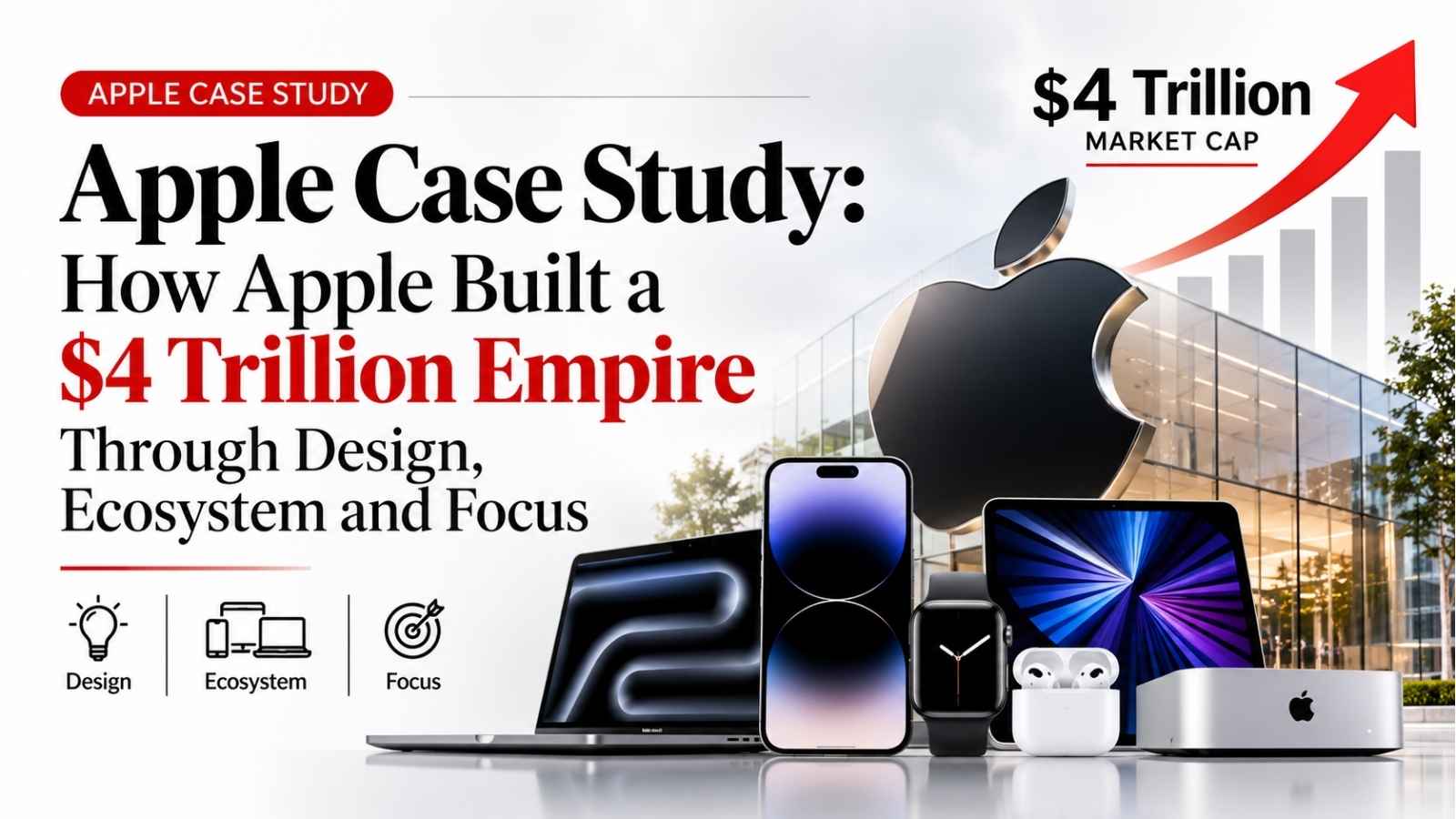
This Apple case study explains how Apple went from near-bankruptcy in 1997 to a $4 trillion company. Apple’s business strategy rests on one idea: control hardware, software and services as a single system, charge premium prices, and build an ecosystem that keeps customers for years. Below you will find Apple’s business model, marketing strategy, competitive advantage, SWOT analysis, financial performance and the leadership lessons every founder and executive can use. It joins our library of business case studies, alongside Netflix, Starbucks and LEGO.
Apple at a Glance
| Detail | Information |
|---|---|
| Founded | April 1, 1976, Cupertino, California |
| Founders | Steve Jobs, Steve Wozniak, Ronald Wayne |
| Industry | Consumer electronics, software, services |
| Core products | iPhone, Mac, iPad, Apple Watch, AirPods, Vision Pro |
| Core services | App Store, iCloud, Apple Music, Apple Pay, Apple TV+ |
| CEO | John Ternus (from September 1, 2026) |
Apple Case Study at a Glance
| Detail | Information |
|---|---|
| Company | Apple Inc. |
| Founded | April 1, 1976, Cupertino, California |
| Founders | Steve Jobs, Steve Wozniak, Ronald Wayne |
| Industry | Consumer electronics, software, services |
| Core products | iPhone, Mac, iPad, Apple Watch, AirPods, Vision Pro |
| Core services | App Store, iCloud, Apple Music, Apple Pay, Apple TV+ |
| CEO | John Ternus (from September 1, 2026) |
| Key strategy | Vertical integration, ecosystem lock-in, premium positioning |
Under Tim Cook’s leadership, Apple’s market capitalisation grew from roughly $350 billion to $4 trillion, and annual revenue nearly quadrupled to more than $416 billion, according to reports on the CEO announcement. Apple also reports an installed base of more than 2.5 billion active devices in its first-quarter fiscal 2026 results. That scale is why this Apple case study is one of the most studied in business schools.
Apple Company Background and History
Apple began in 1976, when Steve Jobs and Steve Wozniak started selling hand-built computer boards. The Apple II (1977) was one of the first mass-market personal computers and made the company a success. The Macintosh (1984) introduced the graphical interface to mainstream users, backed by its famous “1984” Super Bowl ad.
Then the company lost focus. After internal conflict, Jobs left in 1985. During the 1990s Apple sold too many confusing product lines, lost ground to Windows-based PCs, and by 1997 was close to insolvency. The lesson from this part of the Apple story is that a strong brand and good technology do not protect a company from a bloated portfolio and weak execution.
Apple Turnaround Under Steve Jobs (1997–2011)
Apple bought Jobs’s company NeXT in 1997, and Jobs returned and soon became CEO. Microsoft’s $150 million investment that year also helped stabilize the company. The Apple turnaround strategy rested on a few decisions:
- Cut the product line. Apple went from dozens of confusing models to a simple grid: consumer and professional, desktop and portable.
- Relaunch the brand. The “Think Different” campaign sold Apple’s identity rather than its specifications.
- Ship hits. The iMac (1998), iPod (2001), iTunes Store (2003), iPhone (2007), App Store (2008) and iPad (2010) each created or redefined a category.
The iPod and iTunes combination mattered most strategically. It proved Apple could win by pairing hardware with a software and content platform, which became the template for everything after. A similar focus-first recovery shaped the LEGO turnaround, another brand that nearly collapsed before simplifying its business.
Apple Business Model Explained
The Apple business model has two connected revenue engines: premium products and recurring services.
Products. Premium-priced devices with strong margins. In the June 2026 quarter, iPhone brought in $54.3 billion, Mac $10.4 billion, iPad $6.2 billion and Wearables, Home and Accessories $7.9 billion, per the segment breakdown.
Services. Recurring revenue sold to the installed base through the App Store, iCloud, Apple Music, Apple Pay, AppleCare and advertising. Apple Services revenue reached $30.7 billion in that same quarter.
The two sides feed each other. Hardware sales grow the installed base, the installed base generates services revenue, and a good services experience makes customers buy the next device. Services also carry higher margins than hardware, so growing their share lifts overall profitability. This platform thinking is a core part of any modern digital transformation strategy.
Apple Business Strategy: Five Pillars of Success
- Apple vertical integration. Apple designs its own hardware, operating systems and, since the M1 in 2020, its own chips. Controlling the whole stack lets it tune performance, battery life and security in ways competitors who rely on third-party components struggle to match.
- Apple ecosystem strategy. iMessage, AirDrop, iCloud, Apple Watch pairing and Handoff work best when you own several Apple products. Each additional device raises the cost of switching away.
- Premium positioning. Apple rarely competes on price. It chooses categories where design and experience justify higher prices, and it accepts lower market share in exchange for stronger margins. India’s Titan followed a similar premium-positioning playbook in watches.
- Product focus. Apple launches few products compared with its rivals, then puts large resources behind each one. This habit comes straight from the 1997 turnaround.
- Control of the customer experience. From Apple Stores to the App Store review process, Apple shapes how people buy, set up and use its products.
Apple Competitive Advantage
Many companies sell phones and laptops, so what is Apple’s competitive advantage? It comes from several advantages that reinforce one another rather than any single feature:
- Brand strength. Apple is one of the most recognised and trusted consumer brands in the world, which supports premium pricing.
- Integrated hardware and software. Because Apple builds both, features such as security, battery optimisation and camera processing work as one product.
- Custom silicon. Apple’s own chips give it control over performance and cost, and a hard-to-copy technical edge.
- Apple ecosystem and switching costs. Photos, messages, purchases and subscriptions tied to an Apple ID make leaving costly.
- Scale and loyalty. A 2.5 billion-device installed base gives Apple a huge audience for new services and a strong base for developers.
- Retail and service. Apple Stores and AppleCare create a branded experience that online-only competitors struggle to copy.
A competitive advantage lasts only if rivals cannot easily copy it. The same principle shows up in our Netflix case study, where data and content ownership created the moat.
Apple Marketing Strategy
Apple’s marketing strategy is built around emotion, simplicity and anticipation rather than technical detail.
- Brand over specs. Apple sells what a product lets you do, not its processor speed. Ads emphasize creativity, privacy and simplicity.
- Product launches as events. Keynotes generate enormous free media coverage and anticipation.
- Retail experience. Apple Stores, introduced in 2001, let people touch and try products, and staff are trained to help rather than hard sell. Compare the experience-led approach in our Starbucks case study.
- Privacy as a differentiator. Apple positions privacy as a core feature, which sets it apart from advertising-driven competitors.
- Scarcity and secrecy. Tight control over product information keeps rumors and attention circulating before each release.
Apple Marketing Mix (4Ps)
The Apple marketing mix shows how product, price, place and promotion work together:
| The 4Ps | How Apple applies it |
|---|---|
| Product | A small, focused range of well-designed devices plus connected software and services that work as one system |
| Price | Premium pricing strategy, justified by design, quality and ecosystem value, with a tiered lineup so buyers can choose among models |
| Place | Apple Stores, apple.com, carriers and select retail partners, with tight control over how products are presented |
| Promotion | Keynote launches, minimal and emotional advertising, word of mouth and a strong brand identity |
Apple Supply Chain Strategy
Operations is an underrated part of the Apple success story and of any Apple case study. Under Tim Cook, Apple built a global supply chain that relies on contract manufacturers, long-term supplier relationships and tight inventory control, so it can launch products at massive scale while keeping margins healthy. The risk of this model is concentration, because much of the manufacturing sits in Asia and exposes Apple to tariffs, trade tensions and disruption. Apple has been diversifying production, including into India, to reduce that exposure.
Apple Innovation Strategy
Apple’s innovation strategy is not about being first. Apple often enters a category after others, then focuses on making the experience simple and polished enough to win mainstream customers. Smartphones, tablets and smartwatches all existed before Apple’s versions. The company’s edge is in combining custom chips, software, design and services into one product people find easy to use. This approach also lets it launch fewer products with higher confidence.
Apple Leadership: Jobs, Cook and Ternus
Steve Jobs was the product visionary who saved the company and created its design-led identity.
Tim Cook (CEO from 2011) was an operations expert who scaled the business globally, built out the supply chain and grew Services into a major revenue stream.
John Ternus is the next chapter. Apple announced that Ternus, a 25-year company veteran and senior vice president of hardware engineering, would succeed Cook as CEO effective September 1, 2026, with Cook becoming executive chairman, as reported at the time of the announcement and in a second report. The choice of a long-serving internal leader signals continuity of Apple’s hardware-first culture, while the new CEO faces a major test in artificial intelligence.
Want more leadership insight? Read our exclusive interviews with business leaders and cover stories.
Apple Financial Performance and Revenue
Recent results show how strong the business remains.
- In the December 2025 quarter, Apple posted record revenue of $143.8 billion, up 16 percent from a year earlier (Apple Q1 FY2026 release). iPhone contributed roughly $85.3 billion of that, about 59 percent of the quarter.
- In the June 2026 quarter, revenue was $109.4 billion, also up 16 percent, with growth across iPhone, Mac and Services (Apple’s SEC filing).
What the numbers tell us: Apple revenue growth is still driven heavily by iPhone, but Services keeps adding a steadier, higher-margin layer on top. Figures change every quarter, so check Apple Investor Relations for the latest results before quoting numbers.
Apple Challenges and Risks
Dependence on iPhone. With iPhone near 60 percent of revenue in the December quarter, Apple is exposed to any weak product cycle.
Artificial intelligence. Competitors have moved faster on generative AI. Apple introduced an all-new Siri AI at its WWDC26 developer conference, but its ability to match rivals on AI capability is still being tested. For the wider debate, see our piece on AI safety as an infrastructure problem.
Regulation and antitrust. Governments in the US, EU and elsewhere are scrutinizing App Store fees, default-search arrangements and platform control. Rulings that open up the App Store could pressure Services margins.
Supply chain and geopolitics. Manufacturing remains concentrated in Asia, which exposes Apple to tariffs, trade tensions and supply disruptions.
Succession. A leadership change at this scale always carries execution risk, even when well planned.
Apple SWOT Analysis
This Apple SWOT analysis summarises the company’s internal strengths and weaknesses and the external opportunities and threats it faces.
| Strengths | Weaknesses |
|---|---|
| Powerful global brand | Heavy reliance on iPhone |
| Integrated hardware, software and services | High prices limit share in price-sensitive markets |
| Loyal, large installed base | Late in some AI developments |
| Strong margins and cash generation | Closed ecosystem draws regulatory attention |
| Opportunities | Threats |
|---|---|
| Expansion in India and emerging markets | Antitrust and App Store regulation |
| Growth of Services and subscriptions | Tariffs and trade tensions |
| AI features across the ecosystem | Competition from Samsung, Google and Chinese brands |
| Wearables, health and spatial computing | Slowing smartphone upgrade cycles |
Opportunity-hunting leaders can also explore the fastest growing industries over the next five years.
Lessons from the Apple Success Story for Business Leaders
These are the seven takeaways from this Apple case study that founders and executives can apply to their own companies.
- Focus beats breadth. Apple’s recovery began by cutting products, not adding them.
- Build an ecosystem, not just a product. Products that work together raise switching costs and customer lifetime value.
- Sell the experience. Customers pay premiums for products that feel simple and well designed.
- Control what matters most. Owning key technologies, such as chips, gave Apple a lasting advantage.
- Add recurring revenue. Services reduced Apple’s dependence on one-time hardware sales.
- Plan succession early. Apple’s transition from Jobs to Cook, and now Cook to Ternus, was gradual and internal.
- Don’t assume dominance is permanent. The AI race shows even the strongest companies must keep adapting. For tactics you can apply, see our guide to business growth strategies.
Conclusion: What This Apple Case Study Teaches
This Apple case study shows that lasting success comes from a clear business strategy executed with discipline. Apple’s competitive advantage is not one product but the combination of vertical integration, a loyal ecosystem, premium positioning and a powerful brand. Its business model, backed by growing Services revenue, makes the company less dependent on any single launch. Apple revenue and the Apple ecosystem keep growing, and the next test is AI and a new CEO, but the core lessons hold for any leader: stay focused, own what matters, and build a system customers do not want to leave.
Apple Case Study FAQ
Quick answers to the questions readers ask most about Apple’s business strategy and success.
1. What is Apple’s business model?
Apple sells premium hardware (iPhone, Mac, iPad, wearables) and earns recurring revenue from services like the App Store, iCloud and Apple Music, all tied together through one ecosystem.
2. What is Apple’s competitive advantage?
Its main advantages are the integration of hardware, software and services, a powerful brand, custom chips, and an ecosystem that makes customers reluctant to switch.
3. What is Apple’s business strategy?
Apple’s business strategy combines vertical integration, premium positioning, a tightly focused product range and an ecosystem that links devices and services.
4. What is Apple’s marketing strategy?
Apple markets the experience rather than the specifications, using keynote launches, minimal emotional advertising, retail stores and privacy as a brand message.
5. How does Apple make most of its money?
iPhone is the largest revenue source, but Services is the fastest-growing and highest-margin part of the business.
6. What is Apple’s ecosystem strategy?
Apple designs its devices, software and services to work best together, which raises switching costs and encourages customers to buy more Apple products over time.
7. Who is the CEO of Apple?
John Ternus succeeded Tim Cook as CEO effective September 1, 2026. Cook became executive chairman.
8. What was Apple’s biggest turnaround?
The 1997–2001 recovery under Steve Jobs, when Apple simplified its product line and launched the iMac and iPod.
9. What are Apple’s biggest challenges?
Dependence on iPhone, AI competition, regulatory pressure and supply chain exposure.
10. Why is Apple so successful?
Because it combines strong design, a controlled ecosystem, premium positioning, and disciplined focus on a small number of products.
Related Case Studies
- How Netflix Disrupted Entertainment and Built a $250 Billion Empire
- How Starbucks Built a $35 Billion Coffee Empire
- How LEGO Built a $65 Billion Toy Empire
- How Titan Transformed the Watch Industry
- How Vistara Became India’s Safest Airline
Explore more stories in the GlobeVox Leaders.